Time to read: 8 min
Bead Blasting vs Sandblasting: Which Surface Finish Should You Choose for CNC Parts?
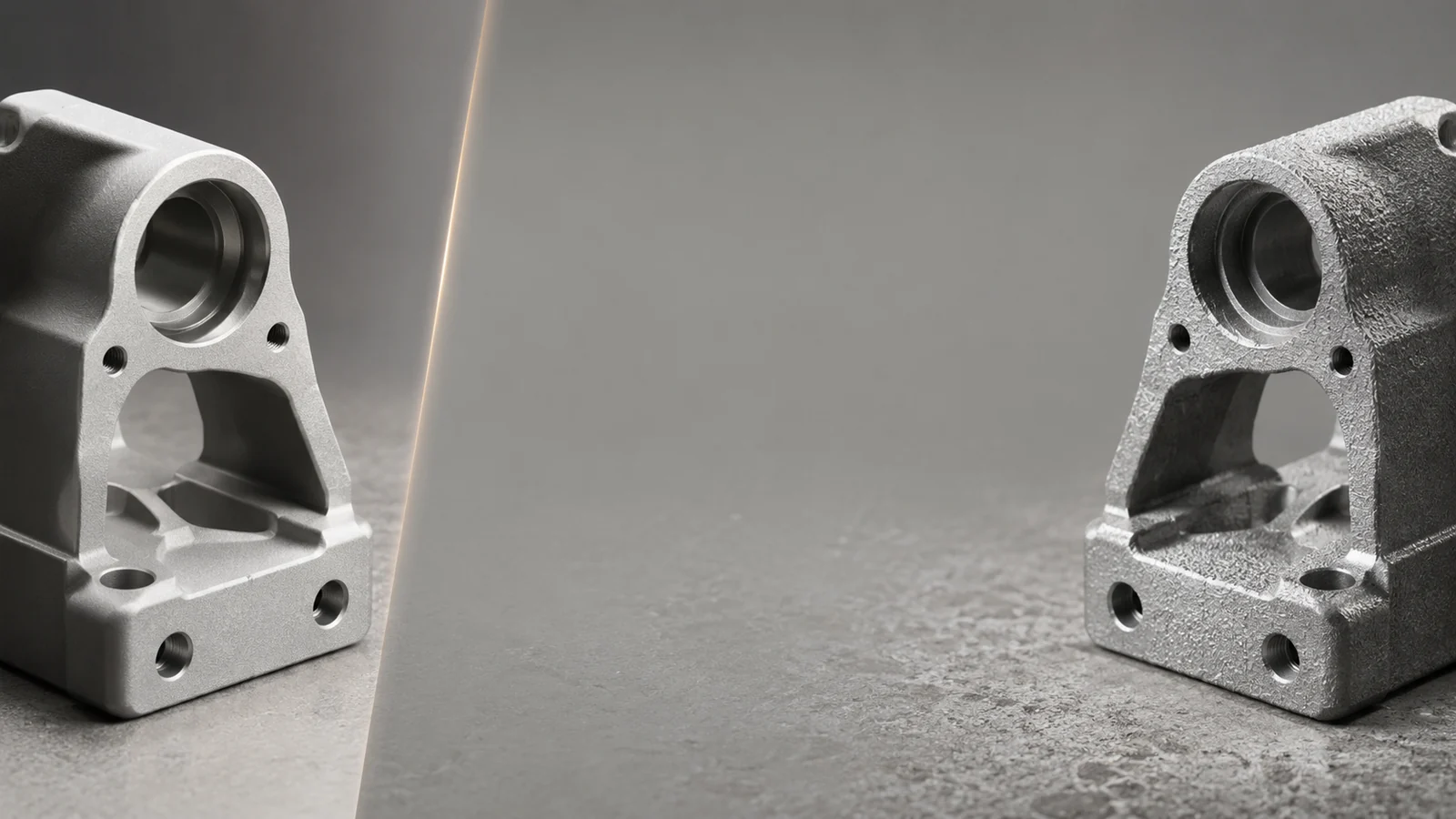
Bead blasting and sandblasting are both abrasive blasting processes, but they do not create the same surface or solve the same manufacturing problem.
For CNC machined parts, bead blasting is generally selected when the goal is a uniform matte or satin appearance with relatively little material removal. Sandblasting—or, more accurately in many industrial applications, grit or abrasive blasting—is usually preferred when stronger cleaning, rust removal, coating removal, or a rougher surface profile is required.
The difference, however, is not simply that one process uses lower pressure than the other. Media shape, hardness, particle size, air pressure, nozzle distance, impact angle, dwell time, base material, and the incoming machined surface all influence the result.
This guide compares bead blasting vs sandblasting from the perspective of CNC machined parts and explains how each process affects appearance, surface roughness, tolerances, coatings, materials, cost, and part design.
What Is the Difference Between Bead Blasting and Sandblasting?
The primary difference is the blasting media and the way those particles interact with the workpiece.
Glass beads are generally spherical. When they strike a metal surface, they primarily impact and peen the surface rather than aggressively cutting into it. This produces the soft, uniform matte appearance commonly seen on bead-blasted aluminum and stainless steel CNC parts.
More aggressive blasting media such as aluminum oxide, garnet, silicon carbide, or other angular abrasives have sharper particle geometry. Their edges cut and abrade the workpiece more strongly, making them more effective for removing scale, corrosion, paint, or other coatings and for producing a stronger surface profile.
| Factor | Bead Blasting | Sandblasting / Grit Blasting |
|---|---|---|
| Typical media | Glass beads, ceramic beads | Aluminum oxide, garnet, silicon carbide, other angular abrasives |
| Particle shape | Mostly spherical | Usually angular |
| Surface action | Impacts and peens | Cuts and abrades |
| Aggressiveness | Low to moderate | Moderate to high |
| Typical finish | Uniform matte or satin | Rougher, etched matte surface |
| Material removal | Relatively low when properly controlled | Generally higher |
| Heavy rust or scale removal | Limited | Very effective |
| Cosmetic CNC parts | Often preferred | Used when a stronger texture is acceptable |
| Coating preparation | Useful for cleaning and selected finishes | Better when a stronger mechanical surface profile is required |
| Thin or delicate parts | Usually easier to control | Requires greater caution |
Is Sandblasting Always Done With Sand?
No. This terminology causes considerable confusion.
“Sandblasting” is commonly used as a general name for abrasive blasting even when actual sand is not used. Modern industrial shops may instead use aluminum oxide, garnet, ceramic abrasive, steel grit, or another engineered blasting medium.
This distinction matters because silica-containing sand can generate respirable crystalline silica during blasting. For this reason, professional manufacturing specifications should preferably identify the actual blasting media instead of writing only “sandblast.”
In this article, sandblasting refers broadly to aggressive abrasive or grit blasting unless silica sand is specifically mentioned.
What Is Bead Blasting?
Bead blasting propels fine spherical media, most commonly glass beads, against a workpiece using compressed air or another controlled blasting system.
On machined metal parts, the process is commonly used to:
- Reduce the visual contrast of CNC tool marks
- Create a uniform matte or satin appearance
- Clean light surface contamination
- Blend minor cosmetic differences
- Prepare a visually consistent surface before anodizing or another finish
- Reduce glare on visible metal components
What Surface Does Bead Blasting Produce?
The typical result is a non-directional matte texture. Unlike brushing, which creates visible parallel lines, bead blasting impacts the surface from many directions and can therefore create a more uniform appearance.
However, there is no single universal “bead blasted finish.”
A fine glass bead used at controlled pressure may produce a relatively soft satin texture, while larger media or more aggressive parameters can create a noticeably heavier finish.
Does Bead Blasting Remove CNC Tool Marks?
It can visually blend light machining marks, but it should not be treated as a repair process for poor machining.
Deep cutter marks, chatter, scratches, dents, gouges, step mismatches, or severe deburring defects can remain visible after blasting. In some cases, blasting makes inconsistent machining more noticeable because the entire part is converted to a uniform matte surface except where underlying defects remain.
If a CNC part is cosmetic, the incoming machined condition should therefore be controlled before bead blasting.
What Is Sandblasting?
Sandblasting or grit blasting uses abrasive particles propelled at high velocity toward the workpiece. When angular media are used, their sharp edges remove material through abrasion.
This stronger cutting action makes abrasive blasting particularly useful for:
- Removing rust and corrosion
- Removing mill scale
- Stripping paint or old coatings
- Cleaning heavily oxidized metal
- Producing a rougher coating profile
- Preparing steel components for painting or powder coating
Why Is Sandblasting More Aggressive?
It is tempting to explain the difference only through blasting pressure, but that is incomplete.
The shape and hardness of the media have a major effect. Angular abrasive grains have edges that cut into the substrate. Spherical glass beads have a rolling impact geometry that produces more peening and less cutting under comparable conditions.
Pressure still matters, but it is only one variable.
Bead Blasting vs Sandblasting: Which Creates a Better Surface Finish?
Neither finish is universally better. The correct surface depends on what the finished part must do.
Choose Bead Blasting for a Uniform Cosmetic Finish
Bead blasting is generally the stronger choice when the customer wants a refined matte metal appearance.
Typical examples include:
- Aluminum electronics housings
- Camera components
- Robotic enclosures
- Instrumentation housings
- Machine control components
- Visible stainless hardware
- Consumer-product metal parts
- Medical equipment housings
Choose Sandblasting for Strong Surface Preparation
More aggressive abrasive blasting is preferable when visual refinement is secondary to cleaning or coating preparation.
Examples include:
- Rusted carbon-steel brackets
- Cast components with scale
- Industrial frames
- Welded structures
- Parts with old paint or coatings
- Steel parts before heavy-duty coating systems
How Does Blasting Media Affect the Result?
The phrase “bead blasting vs sandblasting” can hide an important engineering fact: media selection often matters more than the process name.
Glass Beads
Glass beads are spherical and commonly selected for cosmetic finishing, light cleaning, and producing a uniform matte or satin surface.
They are particularly common on aluminum and stainless steel CNC parts.
Aluminum Oxide
Aluminum oxide is considerably more angular and abrasive. It is useful when stronger cutting action, coating removal, cleaning, or surface profiling is required.
Different grit sizes allow the operator to control how aggressively the material attacks the surface.
Garnet
Garnet is another angular abrasive used for cleaning and surface preparation. It produces substantially different results from spherical glass bead media even though both processes may casually be called sandblasting.
Ceramic Beads
Ceramic blasting media can provide a durable and controlled blasted finish. Depending on composition and process parameters, ceramic media may be selected where longer media life or a particular surface texture is required.
How Do Pressure, Bead Size, and Nozzle Distance Affect the Finish?
The blasting media alone does not determine the final result.
Air Pressure
Increasing blasting pressure increases particle impact energy. This can increase cleaning efficiency and texture, but excessive pressure can also create uneven appearance, unnecessary surface deformation, or edge rounding.
Particle Size
Fine media generally produce a finer surface texture, while larger particles create more visible impact texture.
For cosmetic production parts, the media grade should remain controlled between batches.
Nozzle Distance
A short nozzle-to-part distance concentrates the blast stream. Increasing distance spreads the stream and reduces local intensity.
Inconsistent operator distance is one reason manually blasted parts can show cloudy or uneven areas.
Blasting Angle
Changing the impact angle changes how particles interact with the surface. Complex housings with pockets, ribs, bosses, and deep walls may therefore develop different textures on different surfaces.
Dwell Time
Holding the nozzle over one location too long can create a darker or heavier blasted area.
Cosmetic parts require controlled coverage rather than simply blasting until the original machining marks disappear.
Bead Blasting vs Sandblasting for Different Metals
| Material | Bead Blasting | Aggressive Sand/Grit Blasting | Main Concern |
|---|---|---|---|
| Aluminum | Excellent for uniform matte cosmetic surfaces | Useful for stronger cleaning or coating prep | Soft material can become heavily textured or distorted |
| Stainless steel | Common for satin cosmetic finish | Useful for scale or heavy contamination removal | Avoid ferrous cross-contamination |
| Carbon steel | Useful for light cleaning or appearance | Excellent for rust, scale, and coating preparation | Clean steel may rust quickly without subsequent protection |
| Titanium | Can create a controlled matte finish | Possible for specific preparation requirements | Media contamination and surface specification require control |
| Brass and copper | Can create decorative matte surfaces | Possible but easily becomes aggressive | Soft substrate can change texture rapidly |
Bead Blasting vs Sandblasting for Aluminum CNC Parts
Aluminum is one of the most common materials for bead-blasted CNC components.
The soft metallic surface responds readily to glass beads, allowing manufacturers to convert visible cutter patterns into a more consistent matte texture.
Why Is Bead Blasting Common Before Anodizing?
Machined aluminum often contains directional cutter marks. Anodizing alone does not hide them and can sometimes make surface differences more visible.
A controlled blast before anodizing can create a more consistent incoming texture, producing the familiar matte anodized appearance found on many electronic, optical, robotic, and consumer-product housings.
However, blasting does not guarantee color uniformity. Aluminum alloy, temper, machining condition, material batch, welds, heat-affected areas, media condition, and anodizing chemistry can all influence the final appearance.
Should Critical Fits Be Bead Blasted?
Not automatically.
Bearing bores, precision locating diameters, sealing faces, datum surfaces, sliding fits, threads, and other controlled interfaces may need masking.
Even though properly controlled bead blasting removes relatively little material, repeated particle impact can change surface texture and edges. For tight CNC tolerances, the drawing should identify which surfaces may be blasted.
Can Bead Blasting or Sandblasting Change Part Dimensions?
Yes, although the degree of change depends heavily on the process.
Bead blasting is frequently described as having “no dimensional effect.” That is too absolute for precision manufacturing.
Edge Rounding
Repeated abrasive impact can soften sharp edges, particularly on aluminum, brass, thin fins, and small features.
Small Holes and Threads
Blast media can enter threaded holes, precision bores, and small internal features. These areas may need masking or thorough cleaning afterward.
Thin Walls
Repeated impact creates local surface stress. Thin or unsupported walls can be more sensitive to aggressive blasting than rigid components.
For more information about controlling dimensions on precision parts, see How to Control CNC Machining Tolerances.
Precision Datum Surfaces
Inspection datums should not be blasted indiscriminately. Changing their texture can influence contact measurement and repeatability even when bulk dimensions change very little.
Should Threads, Holes, and Sealing Surfaces Be Masked?
Often, yes.
Masking becomes particularly important when the surface has a functional requirement rather than a cosmetic requirement.
Threads
External and internal threads may accumulate blasting media or experience unnecessary surface alteration. Precision threads can therefore be protected during blasting.
Bearing Fits
Bearing seats and close-tolerance locating diameters are typically better treated as controlled functional surfaces.
Sealing Faces
O-ring grooves, gasket seats, valve interfaces, and sealing faces may have specific roughness requirements that should take priority over a general cosmetic blast specification.
Electrical Contacts
Electrical grounding or conductive contact areas may also require masking depending on subsequent finishing.
Hole and thread requirements should be considered during the initial CNC design rather than after machining. See RapidMFGPro's guide to designing holes, threads, and tapped features for CNC machining.
Can the Same Blasting Cabinet Be Used for Different Media?
Technically, many blasting systems can operate with more than one compatible media type. For precision manufacturing, however, the more important question is whether cross-contamination is acceptable.
Residual coarse abrasive mixed with fine glass beads can change the intended cosmetic finish. Ferrous particles transferred onto stainless steel can create additional contamination concerns. Media left from a previous process can also alter surface texture unpredictably.
When a finish is tightly controlled, manufacturers may use dedicated cabinets, dedicated media loops, dedicated nozzles, or defined cabinet-cleaning procedures.
This is especially important for medical, semiconductor, food-processing, aerospace, stainless steel, and high-cosmetic components.
Which Process Is Better Before Painting or Powder Coating?
Aggressive grit blasting is generally the stronger option when the coating system requires a pronounced mechanical surface profile.
Angular particles remove contamination while creating microscopic peaks and valleys that can support coating adhesion.
Glass bead blasting creates a smoother surface and may still be used for cleaning or preparation, but it should not automatically replace a specified abrasive profile.
The required preparation should therefore come from the coating system, drawing, or qualified manufacturing process rather than appearance alone.
Which Process Is Better for Rust Removal?
Sandblasting or aggressive grit blasting is normally more effective for heavy rust.
Angular abrasive particles can cut through corrosion products, scale, and degraded coatings much faster than fine spherical glass beads.
Glass beads are better suited to lighter contamination or situations where the substrate must retain a more refined finish.
Which Is Better for CNC Machined Parts?
For many precision CNC parts, bead blasting is the more common cosmetic finish, but that does not mean it is universally superior.
Use Bead Blasting When:
- You need a uniform matte or satin appearance
- The part is aluminum or stainless steel
- You want to blend light machining marks
- Dimensional alteration must remain limited
- The component has visible cosmetic surfaces
- The part will later be anodized for a matte appearance
Use Sandblasting or Grit Blasting When:
- You need to remove rust or scale
- You need to strip an old coating
- The surface requires aggressive cleaning
- A stronger coating profile is required
- The substrate is sufficiently robust
- Cosmetic smoothness is not the primary goal
Bead Blasting vs Sandblasting Cost
There is no reliable universal price-per-part difference between the two processes.
Cost depends on:
- Part size
- Total surface area
- Geometry complexity
- Batch quantity
- Media type
- Required texture
- Masking
- Manual versus automated blasting
- Incoming surface condition
- Cleaning requirements
- Cosmetic inspection requirements
- Subsequent anodizing, coating, or plating
A small CNC enclosure requiring extensive masking and strict cosmetic inspection may cost more to bead blast than a much larger industrial steel component requiring ordinary abrasive cleaning.
For this reason, comparing blasting processes only by price per square foot is rarely useful for precision CNC parts.
How Should Bead Blasting Be Specified on a CNC Drawing?
Simply writing “bead blast finish” can leave too much room for interpretation.
Two suppliers can both technically bead blast a component and deliver visibly different parts.
Specify the Base Material
State the exact alloy and condition, such as 6061-T6 aluminum or 304 stainless steel.
Define the Cosmetic Surfaces
Use the drawing to identify which faces require the controlled appearance.
Identify Masked Areas
Threads, bores, bearing fits, sealing faces, datum surfaces, electrical contacts, and other functional areas should be clearly identified.
Define the Media When Necessary
For tightly controlled programs, specify glass bead or another approved media and, when required, an agreed media grade.
Define the Final Process Sequence
State whether the part is:
- Bead blasted only
- Bead blasted then anodized
- Blasted then passivated
- Blasted then painted
- Blasted then powder coated
The sequence affects both appearance and functional dimensions.
Use an Approved Appearance Sample
For highly cosmetic components, a physical sample or approved reference coupon is often more useful than describing the finish only as “fine matte.”
Surface appearance depends on more than Ra. Color, gloss, texture distribution, machining history, and lighting all influence visual acceptance.
Should You Specify a Surface Roughness Ra for Bead Blasting?
You can specify roughness where it is functionally necessary, but a generic Ra value should not be treated as a universal definition of bead blasting.
The resulting roughness depends on:
- Incoming machined Ra
- Media material
- Media size
- Media wear
- Air pressure
- Nozzle distance
- Impact angle
- Dwell time
- Base-metal hardness
- Surface geometry
A better manufacturing specification separates functional roughness requirements from cosmetic appearance requirements.
For example, a visible outer housing may be controlled against an approved cosmetic sample while a sealing face is separately specified with a measured Ra requirement and excluded from blasting.
Common Bead Blasting and Sandblasting Mistakes
Using “Sandblast” Without Naming the Required Result
The supplier may interpret the term differently and use a media that produces the wrong texture.
Trying to Hide Poor Machining With Blasting
Blasting can blend light machining patterns but cannot reliably eliminate deep scratches, chatter, dents, or geometric defects.
Blasting Every Surface
Precision fits, threads, seals, and datums may require protection.
Changing Media Between Production Lots
Changing media composition or particle size can cause visible batch-to-batch differences.
Ignoring Post-Blast Processing
Anodizing, passivation, plating, painting, and powder coating can all change the appearance and functional condition produced by blasting.
Ignoring Thin-Wall Geometry
Aggressive blasting can affect thin sections more severely than rigid walls. Thin-wall manufacturing must consider finishing as part of the complete process rather than as a cosmetic operation added afterward.
How Does RapidMFGPro Evaluate Bead Blasting and Sandblasting Projects?
RapidMFGPro evaluates surface-finishing requirements together with the CNC machining process instead of treating blasting as an isolated final step.
Material Review
The review begins with the alloy, hardness, part condition, corrosion requirements, and response of the substrate to blasting.
Geometry Review
Thin walls, deep pockets, small holes, internal threads, sealing faces, sharp edges, cosmetic faces, and hard-to-reach surfaces are reviewed for blasting risk and masking requirements.
Tolerance Review
Critical fits and post-finish dimensions are identified so that blasting, anodizing, plating, or other subsequent treatments do not interfere with assembly.
Finish Review
The intended result—cosmetic matte finish, rust removal, coating preparation, surface profiling, or light cleaning—is used to determine whether bead blasting or more aggressive abrasive blasting is appropriate.
Supplier Matching
RapidMFGPro can match projects with independent suppliers according to CNC capability, blasting equipment, media control, finishing processes, masking, part size, quantity, cosmetic quality, inspection capability, and delivery requirement.
A supplier suitable for blasting large fabricated steel frames is not automatically the right supplier for cosmetic aluminum CNC housings. The equipment, media-control system, operator experience, cleanliness, inspection method, and downstream finishing capability must match the part.
Conclusion
Bead blasting and sandblasting are both abrasive surface-treatment processes, but they are designed for different results.
Choose bead blasting when a CNC part needs a controlled matte or satin appearance with relatively low material removal. Choose aggressive sand or grit blasting when the main objective is rust removal, coating removal, heavy cleaning, or creating a stronger surface profile.
For precision parts, however, the process name alone is not enough. Media shape and size, pressure, geometry, masking, tolerance, contamination control, and subsequent finishing all need to be considered before production begins.
FAQs About Bead Blasting vs Sandblasting
Is Bead Blasting the Same as Sandblasting?
No. Both are abrasive blasting processes, but bead blasting normally uses spherical glass or ceramic media, while sandblasting or grit blasting generally refers to more aggressive abrasive media. Their surface interaction and resulting texture are different.
Is Bead Blasting Better Than Sandblasting?
Bead blasting is better for many cosmetic and precision metal parts. Sandblasting or grit blasting is better for heavy rust, scale, coating removal, and aggressive surface preparation. Neither is universally better.
Does Bead Blasting Remove Material?
Material removal is usually relatively low compared with aggressive angular abrasive blasting, but it should not be assumed to be zero. Process pressure, media size, dwell time, substrate hardness, edges, and thin features all influence the result.
Can You Bead Blast Aluminum?
Yes. Aluminum is one of the most common materials for bead blasting. The process can create an even matte surface and is frequently used before cosmetic anodizing.
Can You Bead Blast Stainless Steel?
Yes. Glass bead blasting can create an attractive satin finish on stainless steel. Media cleanliness and contamination control are particularly important when corrosion performance or cleanliness is critical.
Is Sandblasting Good Before Powder Coating?
Aggressive abrasive blasting is commonly used before coating because it can remove contamination and create a mechanical surface profile. The required blasting media and profile should match the coating specification.
Should Threads Be Masked Before Bead Blasting?
Precision threads, fits, sealing surfaces, and other controlled features may need masking. The decision depends on tolerance, media, pressure, final finish, and assembly requirements.
Can Bead Blasting Hide Machining Marks?
It can visually blend light cutter patterns and create a more uniform appearance, but it will not reliably eliminate deep tool marks, chatter, scratches, dents, or poor machining.
Need Help Reviewing a Custom Part?
Share your CAD file and requirements to request supplier matching. Supplier capability and commercial terms must be verified before order placement.
Request Supplier Match