Roughly midway between aluminum and steel; exact density varies by grade.
TITANIUM MATERIAL & MACHINING RESOURCE
Titanium Material Guide: Properties, Grades & Custom Parts
Explore titanium properties, common grades, CNC machining considerations, finishes, and applications. Use the linked material guides for deeper technical questions, then compare manufacturing requirements before sourcing custom titanium parts.
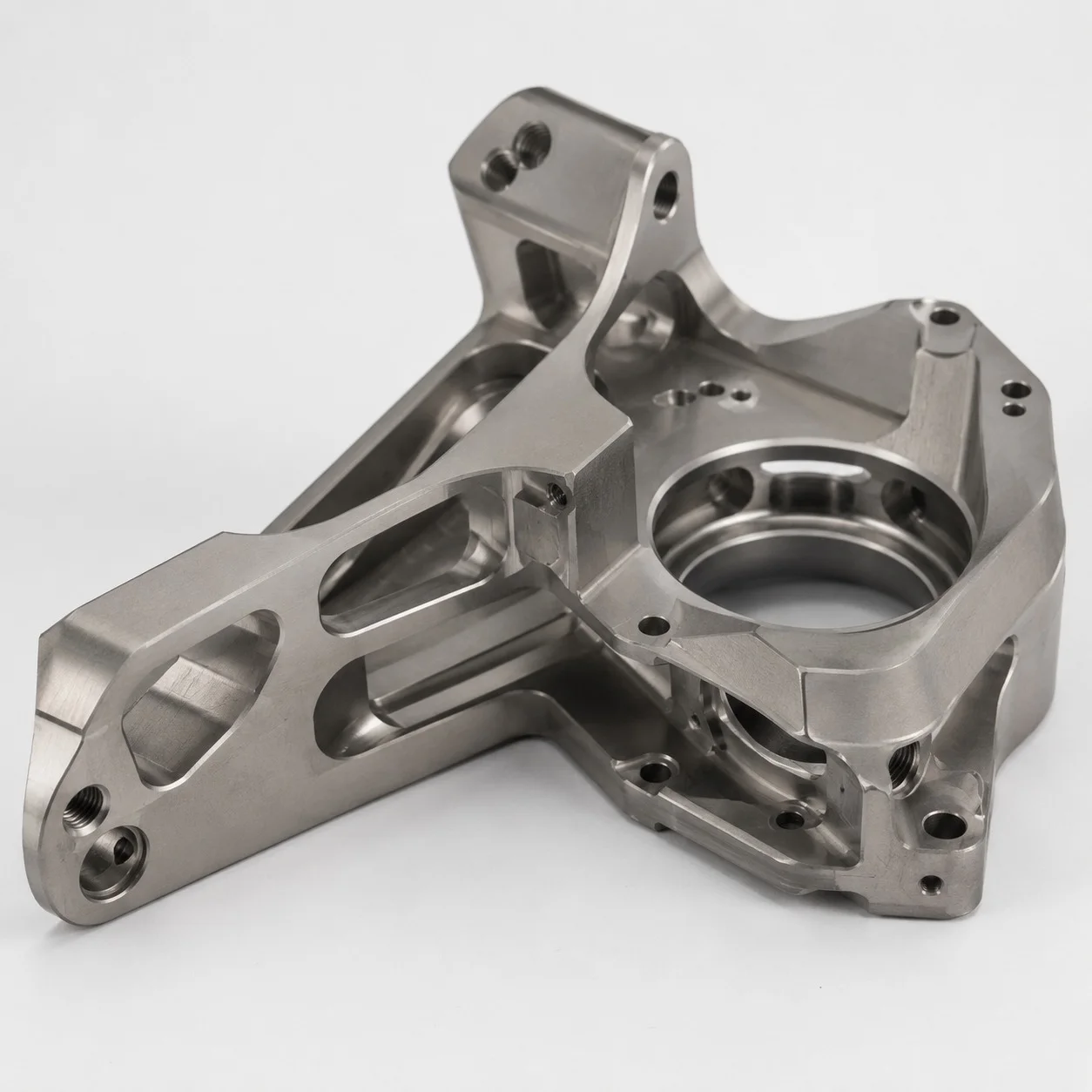
MATERIAL OVERVIEW
Titanium at a Glance
Relative project profile
Strength-to-weight
Corrosion resistance
Ease of machining
Request a Titanium Supplier Match
- Feature
- Titanium combines relatively low density with a high strength-to-weight ratio, useful corrosion resistance, low thermal conductivity, and essentially nonmagnetic behavior. Exact properties vary by grade, condition, and product form, so detailed values belong in the relevant titanium guide and certified material data.
- Key Data
-
Common Grades Stock Forms Machining Finish Options Production Fit Grade 2, Grade 5 (Ti-6Al-4V) Plate, bar, billet, tube Rigid setups, sharp tooling, controlled heat and chip evacuation As-machined, bead blasted, polished, anodized, cleaned or wear coated Custom prototypes and precision production parts - Properties
- Typical CNC Parts
- Aerospace brackets, mounts, fittings, and housings
- Precision shafts, pins, sleeves, and fasteners
- Valve bodies, fluid fittings, and instrument manifolds
- Medical instrument housings and tool components
- Robotic joints, end-effectors, and sensor housings
- Marine and scientific instrument hardware
- Consider Alternatives When
- Ultra-low-cost commodity parts
- Designs with unnecessary deep pockets or excessive tool reach
- Projects where aluminum can meet the same load and environment at lower cost
TITANIUM KNOWLEDGE HUB
Explore Titanium Properties & Material Guides
Use the guides below to understand material behavior first, then relate those properties to grade selection, CNC machining, part design, finishing, and supplier requirements.
A key reason titanium is considered for mass-sensitive structural components.
A stable oxide film protects titanium in many service environments.
Heat stays near the cutting zone, making machining control important.
Property values are general reference information. Use the specification and certified data for the exact titanium grade, condition, product form, and service environment before final design approval.
PROCESS PLANNING
Machining & Finish
RapidMfgPro reviews geometry, tolerance, material behavior, finish, quantity, and inspection requirements before matching the project with suitable manufacturing resources.
CNC Milling
Rigid workholding, sharp tools, controlled engagement, coolant delivery, and chip evacuation help manage concentrated cutting heat.
Explore CNC milling →CNC Turning
Used for titanium shafts, pins, sleeves, threaded components, and rotational housings where heat, deflection, and surface quality must be controlled.
Explore CNC turning →Surface Finishes
Finishing is commonly selected for appearance, cleanliness, identification, wear control, or friction management—not only for corrosion protection.
Review common finishes →DESIGN GUIDE
Designing Parts in Titanium
Use the following points as an early DFM checklist. Final recommendations depend on part geometry, stock form, quantity, finish, and functional requirements.
Request a DFM ReviewReduce tool reach
Keep deep cavities and small internal corners only where they are functionally necessary.
Plan heat control
Allow practical cutting access and avoid very thin unsupported walls.
Define critical surfaces
Identify sealing, bearing, threaded, and cosmetic surfaces on the drawing.
Specify inspection needs
Call out critical dimensions, material documentation, and traceability before production.
PART & FINISH OVERVIEW
Titanium Applications & Surface Finishes
Use this overview to identify relevant topics. Detailed selection criteria, limitations, and specifications should be covered in the linked titanium guides and project drawings.
Where Titanium Parts Are Used
Titanium is often considered when low mass, strength, corrosion behavior, cleanliness, or reduced magnetic response matters.
- Aerospace: brackets, mounts, fittings, housings, and fasteners
- Medical and laboratory: instrument housings, tool components, fixtures, and hardware
- Robotics: joints, end-effectors, shafts, and sensor housings
- Fluid and marine systems: valve parts, fittings, manifolds, and exposed hardware
Common Finish Directions
Titanium naturally forms a protective oxide film. Additional finishing is therefore usually chosen for a specific functional or visual purpose.
- As-machined: retain dimensions and avoid unnecessary finishing
- Bead blasting or polishing: adjust appearance and surface texture
- Anodizing: provide color identification or modify the oxide surface
- Validated cleaning or passivation: remove contamination for specified applications
- PVD or DLC coating: support wear or friction control on selected surfaces
Design note: Titanium threads and sliding interfaces can gall. Review mating materials, lubrication, surface treatment, and coating thickness before finalizing close-tolerance or moving features.
SUPPLIER MATCH REQUEST
Need custom titanium parts?
Upload your drawing and share the material, quantity, tolerance, finish, and delivery requirements.