Time to read: 8 min
Can Titanium Rust? Understanding Titanium Corrosion in CNC-Machined Parts
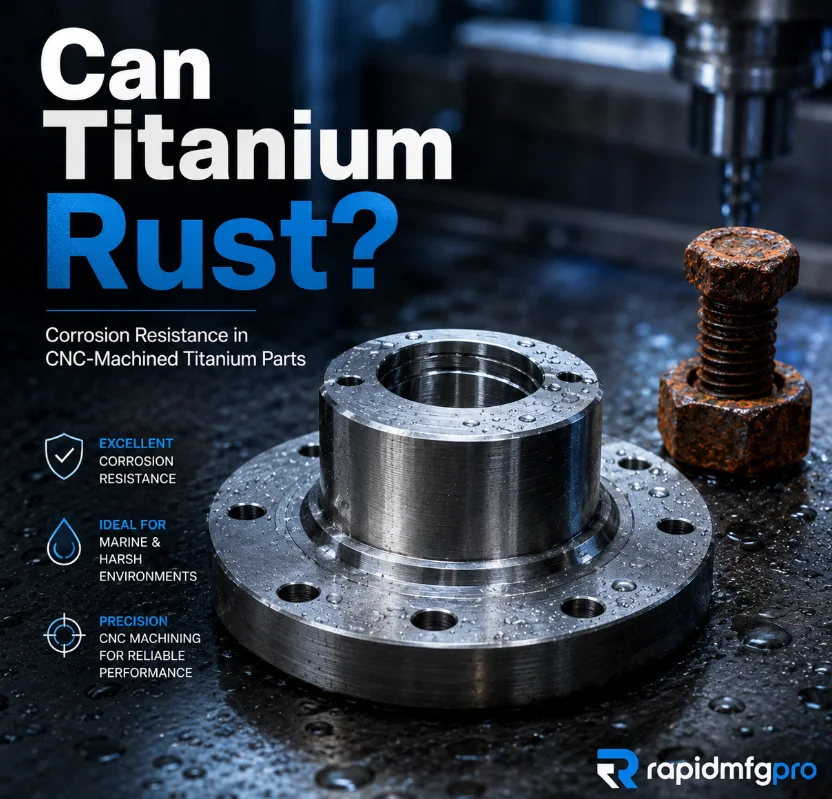
Can titanium rust? In the technical sense, no. Rust is the iron-oxide corrosion product associated with iron and iron-containing alloys, while titanium contains no iron as its base metal and therefore does not develop the familiar red-brown rust seen on carbon steel. Titanium does, however, oxidize. The important difference is that titanium oxidation normally creates a thin, adherent, protective oxide film rather than a porous corrosion product that continuously exposes new metal.
This is why titanium performs exceptionally well in water, seawater, humid air, and many chemical environments. But “titanium does not rust” should not be interpreted as “titanium can never corrode.” Grade, temperature, chemical composition, crevice geometry, contamination, galvanic coupling, and surface condition can all change the result. The distinction becomes particularly important for CNC-machined titanium components, where embedded iron, inappropriate cleaning, heat exposure, or incompatible mating metals may create problems that initially look like titanium rust.
| Question | Practical Answer |
|---|---|
| Does titanium rust like carbon steel? | No. Titanium does not form conventional red-brown iron rust. |
| Does titanium oxidize? | Yes. It rapidly develops a protective titanium oxide surface film. |
| Can titanium corrode? | Yes, under certain chemical, thermal, crevice, galvanic, or contaminated-surface conditions. |
| Does titanium rust in water? | Normally no. Water supports the passive oxide film. |
| Does titanium rust in salt water? | Normally no. Titanium has exceptionally high resistance to seawater corrosion. |
| Can brown spots appear on titanium? | Yes, but they may come from embedded iron or other surface contamination rather than corrosion of the titanium itself. |
| Does titanium need paint to stop rust? | Usually not. Its natural passive film already provides substantial corrosion protection. |
Why Does Titanium Not Rust Like Steel?
The difference begins with the corrosion product itself. When ordinary iron or carbon steel is exposed to moisture and oxygen, iron oxides and hydroxides develop. These corrosion products are relatively porous and can crack or flake away. Fresh metal is then exposed, allowing corrosion to continue deeper into the material.
Titanium behaves differently. When a clean titanium surface encounters air, water, or another suitable oxygen source, it rapidly forms a continuous oxide film dominated by titanium dioxide. The International Titanium Association describes this surface oxide as tenacious, continuous, non-porous, transparent, and self-healing. This stable surface chemistry is the principal reason titanium resists corrosive attack so effectively.
The Titanium Oxide Layer Protects the Metal Below
The oxide film is extremely thin, but thickness alone does not determine corrosion protection. What matters is that the film adheres strongly to the substrate and acts as a barrier between the surrounding environment and the reactive titanium underneath.
This is an important engineering distinction: titanium is not corrosion-resistant because it is exceptionally hard, and its strength-to-weight ratio does not create its rust resistance. Corrosion resistance is primarily a surface-chemistry property.
The same principle applies after CNC milling or turning. A cutting tool continuously exposes fresh titanium, but once the newly machined surface encounters air or moisture, the passive surface reforms. Therefore, removing the original mill surface during machining does not permanently remove titanium's inherent corrosion resistance.
Does Titanium's Protective Layer Repair Itself After a Scratch?
Generally, yes. If the passive film is mechanically damaged while sufficient water or oxygen is available, a new protective oxide begins forming on the exposed titanium. The International Titanium Association specifically notes that titanium's oxide can repair itself after damage in the presence of very low levels of oxygen or water.
This means a normal handling scratch does not have the same consequence as scratching paint from carbon steel. With painted steel, removing the coating can expose a corrosion-prone substrate. With titanium, the substrate itself participates in rebuilding the protective surface.
However, this does not mean every scratched titanium surface should automatically be ignored. A scratch that also embeds foreign metal, occurs inside an aggressive chemical environment, or sits within a problematic crevice can create a different corrosion condition.
Can Titanium Corrode Even Though It Does Not Rust?
Yes. This is the most important limitation behind the simple answer that “titanium does not rust.” Rust is only one type of corrosion product. A titanium part can experience corrosion or degradation without ever developing the familiar reddish rust seen on steel.
For material selection, asking only whether titanium rusts is therefore insufficient. The better question is whether the specific titanium grade remains passive in the exact service environment.
Strong Reducing Acids Can Attack Titanium
Titanium performs particularly well in many oxidizing and neutral environments, but its resistance is not universal across all acids. Compatibility changes with acid type, concentration, temperature, contamination, and titanium grade.
This matters especially in chemical-processing equipment. A material that performs extremely well in seawater should not automatically be assumed suitable for concentrated hydrochloric, sulfuric, hydrofluoric, or other aggressive chemical environments. Grade selection should be based on corrosion data for the actual process fluid rather than a general statement such as “titanium is corrosion-proof.”
Crevices Can Create a More Aggressive Local Environment
A broad titanium surface exposed to seawater may remain highly passive while the chemistry inside a narrow gasket joint, lap joint, deposit, or stagnant crevice becomes substantially different. Temperature and crevice geometry can therefore matter even when the surrounding bulk fluid appears harmless.
This distinction is especially relevant for CNC parts containing deep recesses, sealing interfaces, trapped-fluid zones, threaded assemblies, gasket faces, or overlapping components. The geometry of the finished assembly can influence corrosion performance even if the titanium material itself has excellent general corrosion resistance.
Commercially pure titanium has an established record in seawater service, but corrosion-resistant alloying additions are available for applications involving more severe temperature or crevice conditions. The International Titanium Association notes that palladium-bearing titanium grades and Grade 12 can extend performance in demanding seawater environments.
Galvanic Corrosion Is an Assembly Problem, Not Just a Titanium Problem
Another common misconception is that if corrosion appears next to a titanium fastener or titanium component, the titanium must be corroding.
In a wet electrically conductive environment, titanium can form a galvanic couple with another metal. Because passive titanium is relatively noble, the less noble mating metal may become the component that corrodes more aggressively. The practical risk depends on the two materials, electrolyte, temperature, exposed surface-area ratio, electrical connection, and whether each metal remains passive.
For example, replacing a stainless or steel fastener with titanium should not be evaluated only by asking whether the titanium fastener will rust. Engineers should also ask what happens to the surrounding aluminum, steel, magnesium, or other mating material once the metals are electrically coupled in the actual environment.
High Temperature Changes Titanium Oxidation Behavior
The thin protective oxide associated with room-temperature titanium should not be confused with unlimited oxidation resistance at elevated temperature. As temperature increases, oxide growth accelerates and oxygen can increasingly affect the material beneath the surface.
The International Titanium Association notes that titanium's surface oxide changes at sufficiently elevated temperatures, eventually becoming less stable and more porous as oxidation progresses. High-temperature exposure can also produce oxygen-enriched surface material and affect ductility.
Therefore, a titanium part operating in ambient seawater and a titanium component continuously exposed to several hundred degrees Celsius should not be evaluated with the same corrosion assumptions.
Does Titanium Rust in Water?
Under ordinary fresh-water conditions, titanium does not develop conventional rust. Water actually supports formation and maintenance of its protective oxide surface.
This is one reason titanium is used for pumps, piping, heat exchangers, marine equipment, and other components where long-term exposure to water is unavoidable. Its resistance is not based on keeping the metal completely dry, as would commonly be attempted with unprotected carbon steel.
For a CNC-machined housing, flange, shaft, fitting, or valve component exposed to water, titanium may therefore eliminate the need for a corrosion-protection coating that would otherwise be necessary on many ferrous materials.
That does not eliminate the need to evaluate the entire environment. Water chemistry, contaminants, temperature, electrical potentials, mating metals, and crevice conditions still matter.
Does Titanium Rust in Salt Water?
Titanium is particularly well known for seawater resistance. TIMET identifies corrosion resistance as a major reason titanium is used in desalination, power generation, offshore, piping, and marine applications, while the International Titanium Association reports extensive experience with commercially pure titanium in seawater and brackish-water service.
This is where the statement “titanium does not rust” is most useful—but it still needs qualification. Titanium can offer excellent resistance to general seawater corrosion, whereas many steels require coating systems, sacrificial protection, or corrosion-resistant alloying.
However, seawater performance should not be reduced to a simple yes/no comparison. Engineers should still consider:
- continuous versus intermittent immersion;
- water temperature;
- crevice geometry;
- flow velocity and suspended solids;
- galvanic contact with other metals;
- electrical potentials or cathodic-protection systems;
- the exact titanium grade;
- surface contamination introduced during fabrication.
In other words, titanium's seawater resistance is excellent, but a corrosion-resistant material does not compensate for an unsuitable system design.
Why Can a Titanium Part Have Brown or Rust-Colored Spots?
This is one of the most useful distinctions when evaluating a machined titanium component. Seeing an orange or brown spot on a titanium surface does not necessarily mean that the titanium itself has begun to rust.
Iron Contamination Can Rust on Top of Titanium
Foreign iron can be transferred onto a titanium surface during manufacturing, finishing, handling, grinding, cleaning, or contact with steel equipment. The titanium beneath may remain corrosion-resistant while the embedded or smeared iron particles oxidize and create visible red-brown staining.
This can make a genuine titanium part appear to be “rusting.” In reality, the rust may originate from foreign ferrous contamination sitting on or embedded in the titanium surface.
The International Titanium Association notes that corrosion-protection treatments may begin by removing surface contamination, particularly iron, before rebuilding or enhancing the titanium oxide surface.
For CNC sourcing, this means material certification alone is not enough. A correct titanium grade can still leave the factory with an unacceptable surface if post-machining handling and cleaning are poorly controlled.
Heat Tint Is Not the Same as Rust
Titanium can develop straw, gold, purple, blue, gray, or other surface colors when oxide-film thickness changes. These colors can occur during controlled anodizing, heating, or thermally affected processing.
A color change should therefore be diagnosed before it is labeled corrosion. Surface oxidation, welding heat tint, contamination, deposits, and actual corrosion can produce very different implications for the finished part.
For high-reliability components, visual inspection may need to be combined with knowledge of the manufacturing history, cleaning procedure, service environment, and material specification.
Can CNC Machining Make Titanium More Likely to Corrode?
CNC machining itself does not make titanium inherently rust-prone. Freshly cut titanium quickly develops a passive surface after exposure to air or moisture. The manufacturing concern is more often what happens around the cutting process.
If your design uses titanium, review the broader titanium material properties and machining considerations rather than choosing the grade only from its strength value.
Foreign-Metal Contamination Matters
Shared grinding equipment, contaminated abrasive media, unsuitable wire brushes, dirty work surfaces, steel particles, or careless post-processing can introduce ferrous material onto titanium.
This is particularly important for parts intended for marine, chemical, medical, or high-cleanliness service. A machine shop that routinely processes carbon steel is not automatically unsuitable for titanium, but it needs appropriate contamination-control practices where the application requires them.
Coolant and Cleaning Residues Should Be Controlled
Deep holes, tapped features, internal channels, blind pockets, and narrow recesses can trap machining debris or cleaning residue. For corrosion-critical components, final cleaning should therefore be considered part of the manufacturing plan rather than an optional cosmetic operation.
The exact requirement depends on application. A structural aerospace bracket, marine fluid fitting, medical component, and chemical-process valve body may require very different cleaning documentation and acceptance criteria.
Machining Heat Is Different From Service Corrosion
Titanium's relatively low thermal conductivity concentrates machining heat near the cutting zone. That primarily creates tool-life and process-control challenges rather than automatically causing service corrosion.
It is important not to combine two separate issues:
- Cutting heat affects tool wear, cutting-edge temperature, surface integrity, and dimensional control during machining.
- Corrosion resistance depends primarily on the resulting surface condition, titanium grade, and service environment.
A capable CNC machining supplier should therefore control heat for manufacturing reasons while also preventing contamination and meeting any specified final-surface requirements.
Does Grade 2 Titanium Rust Differently From Grade 5 Titanium?
Neither Grade 2 nor Grade 5 should be described as a material that normally “rusts.” Both form passive titanium oxide surfaces. However, they should not be treated as interchangeable simply because both are titanium.
Grade 2 is commercially pure titanium and is widely selected where corrosion resistance, formability, and moderate strength are important. Grade 5, Ti-6Al-4V, is an alloy developed primarily to provide substantially greater mechanical strength while retaining useful corrosion resistance.
| Titanium Grade | Primary Selection Reason | Corrosion Consideration | Typical CNC Decision |
|---|---|---|---|
| Grade 2 | Excellent general corrosion resistance with moderate strength | Well established for water, seawater, chemical, and industrial service | Useful when corrosion resistance is more important than maximum structural strength |
| Grade 5 (Ti-6Al-4V) | High strength-to-weight ratio | Excellent in many environments, but compatibility should still be checked for the actual medium | Common when the part must carry substantially higher mechanical load |
| Grades 7 / 16 / 17 | Enhanced corrosion performance through noble-metal alloying | Used for more demanding reducing or crevice-corrosion environments | Consider when standard commercially pure titanium does not provide sufficient corrosion margin |
| Grade 12 | Industrial corrosion resistance with useful strength | Designed for demanding chemical and elevated-temperature environments | Often evaluated for process equipment and severe service conditions |
The International Titanium Association documents the use of commercially pure grades and corrosion-resistant alloyed grades for different seawater temperature and crevice conditions, illustrating why “titanium” alone is not a complete material specification.
Does Titanium Need Anodizing or a Coating to Prevent Rust?
Usually not. One advantage of titanium is that corrosion resistance generally does not depend on paint, zinc plating, or another sacrificial external coating.
This creates an important difference from carbon steel. A steel CNC component may require plating, painting, black oxide plus sealant, or another protective finish because the exposed substrate itself is susceptible to rust. Titanium already produces a protective oxide surface naturally.
Anodizing can still be useful on titanium, particularly for controlling surface appearance, oxide-film thickness, identification, friction behavior, or other functional requirements. But it should not automatically be specified simply because the designer is afraid that bare titanium will rust.
Similarly, PVD and other engineered coatings may be selected to improve wear, friction, galling behavior, appearance, or specialized surface properties. Corrosion resistance and wear resistance are not the same property. Titanium can have excellent corrosion resistance while still requiring surface engineering for a sliding or high-friction interface.
Does Corrosion Resistance Mean Titanium Is Always Better Than Stainless Steel?
No. Titanium's outstanding corrosion resistance does not automatically make it the best material for every CNC component.
In seawater, chloride-rich environments, or applications where low mass and corrosion resistance are both critical, titanium can provide advantages that justify its material and machining cost. In ordinary indoor, mildly corrosive, or cost-sensitive service, a suitable stainless steel may satisfy the requirement at substantially lower finished-part cost.
| Requirement | Material Direction | Reason |
|---|---|---|
| Outdoor component with only moderate moisture exposure | Evaluate stainless steel before defaulting to titanium | Titanium's corrosion capability may exceed what the application requires. |
| Continuous seawater exposure | Titanium becomes much more attractive | Its passive oxide provides exceptionally strong seawater resistance. |
| High load with aggressive corrosion exposure | Evaluate the specific titanium alloy | Corrosion requirement and mechanical strength must be satisfied together. |
| Strong reducing chemical environment | Do not select titanium generically | Exact chemical concentration, temperature, and grade become critical. |
| Sliding or high-wear interface | Do not choose titanium based on corrosion resistance alone | Galling and wear may require another material or surface treatment. |
| Assembly with aluminum, magnesium, or steel in seawater | Evaluate galvanic behavior of the complete assembly | The mating material may be more vulnerable even if titanium remains passive. |
Material selection should therefore compare total requirements rather than treating “does not rust” as the final decision criterion.
What Should You Specify for a Corrosion-Resistant CNC Titanium Part?
If corrosion resistance is an important reason for choosing titanium, communicate that requirement to the manufacturer instead of specifying only “Titanium, CNC machined.”
A more complete RFQ should identify:
- exact titanium grade and specification;
- service fluid or environmental exposure;
- operating temperature range;
- mating metals;
- continuous or intermittent immersion;
- critical crevices, sealing faces, grooves, and fluid passages;
- required surface finish;
- cleanliness or contamination restrictions;
- post-machining cleaning or passivation-compatible cleaning requirements;
- inspection and material-traceability requirements;
- whether dimensions apply before or after final finishing.
Corrosion performance should also be separated from dimensional performance. A titanium grade with excellent chemical resistance does not automatically enable tighter tolerances. Tooling, heat, part stiffness, workholding, geometry, cutting strategy, finishing, and inspection still determine achievable dimensional control. For precision parts, see the guide to controlling CNC machining tolerances.
How RapidMFGPro Helps With Titanium CNC Machining
Corrosion-critical titanium machining requires more than finding a supplier that lists titanium on a capability page. A manufacturer experienced mainly with aluminum or mild steel may not have the same process knowledge needed for Grade 2, Ti-6Al-4V, thin-wall titanium structures, corrosion-sensitive fluid components, or parts requiring controlled surface cleanliness.
RapidMFGPro can help identify manufacturers with experience relevant to the actual titanium component and review supplier fit according to material grade, CNC milling or turning requirements, geometry, tolerance level, surface condition, inspection, industry requirements, and production volume.
Supplier review can also consider whether the manufacturer has suitable procedures for titanium tooling, heat control, workholding, traceability, surface finishing, cleaning, contamination control, and final inspection. This is particularly important for marine, aerospace, chemical-processing, medical, and other applications where a seemingly small surface or process problem may affect service performance.
RapidMFGPro can match different manufacturing requirements, including medium-high precision and more demanding precision projects, rather than treating every titanium part as the same sourcing problem. Supplier matching is typically completed within 1–2 days. After matching, buyers can communicate directly with the manufacturer about quotations, drawings, technical questions, and production requirements.
The platform does not depend on hidden or deliberately confusing charges to influence supplier selection. If the matched supplier does not meet expectations, buyers can provide feedback so the supplier can be reviewed again and, where appropriate, another manufacturing option can be considered.
Which Titanium Grade Should You Choose When Corrosion Resistance Matters?
There is no universal “most rust-proof titanium” that should be specified for every project. Start with the service environment and then determine how much mechanical strength the part also requires.
- For ordinary atmospheric, water, marine, and many industrial environments: commercially pure titanium such as Grade 2 is often a logical starting point when moderate mechanical strength is sufficient.
- When substantially higher structural strength is required: Grade 5 Ti-6Al-4V is commonly considered, but its compatibility should still be checked against the actual chemical environment.
- For more aggressive reducing or crevice-corrosion conditions: specialized corrosion-resistant grades such as palladium-containing titanium or Grade 12 may provide better performance.
- For high-temperature service: evaluate oxidation, mechanical-property retention, exposure time, and the specific titanium alloy rather than relying on room-temperature corrosion behavior.
- For multi-metal assemblies: evaluate galvanic compatibility and area ratios rather than checking only whether the titanium component can corrode.
The correct decision is therefore not simply “use titanium because titanium cannot rust.” It is to select the titanium grade whose corrosion behavior, mechanical properties, manufacturability, and cost match the complete operating condition.
Conclusion
Titanium does not rust like iron or carbon steel because it does not form conventional iron rust. Instead, exposed titanium rapidly develops a thin, adherent, self-healing oxide film that gives the metal exceptional corrosion resistance in air, fresh water, seawater, and many industrial environments.
However, corrosion resistance is not immunity. Strong reducing chemicals, certain crevice conditions, elevated temperature, galvanic assemblies, hydrogen-related mechanisms, and surface contamination can still create problems. For CNC-machined titanium parts, apparent “rust” may even originate from foreign iron deposited during manufacturing rather than the titanium itself. Choose the exact grade, control the surface condition, and evaluate the complete service environment instead of relying only on the statement that titanium is rust-proof.
Frequently Asked Questions
How Long Does It Take Titanium to Rust?
Titanium does not develop conventional iron rust, so there is no meaningful universal “time to rust.” In normal atmospheric or water exposure, its passive oxide film protects the underlying titanium. Corrosion rate under aggressive conditions depends on grade, temperature, chemical composition, crevice geometry, surface condition, and electrochemical environment.
Does Grade 5 Titanium Rust?
Grade 5 Ti-6Al-4V does not normally develop red-brown iron rust. Like other titanium materials, it forms a protective oxide surface. However, Grade 5 is not universally immune to every corrosive chemical or high-temperature condition, so compatibility should be evaluated for the intended environment.
Does Titanium Steel Rust?
“Titanium steel” is not a precise titanium grade designation and is sometimes used commercially for products that are actually stainless steel or another iron-containing alloy. If the material contains significant iron, it may be capable of rusting depending on its composition and environment. Confirm the actual material specification rather than relying on the product name.
Can Titanium Rust After Being Scratched?
A normal scratch does not usually make titanium begin rusting. In air or water, the exposed titanium surface rapidly reforms a protective oxide film. More attention is required if the scratch embeds foreign iron, occurs in a severe chemical environment, or is located within a problematic crevice.
Does Titanium Rust in the Ocean?
Titanium is exceptionally resistant to general seawater corrosion and has extensive use in desalination, offshore, naval, piping, and heat-exchanger applications. However, engineers should still evaluate temperature, crevices, galvanic coupling, electrical potentials, and the selected titanium grade for the complete marine system.
Need Help Reviewing a Custom Part?
Share your CAD file and requirements to request supplier matching. Supplier capability and commercial terms must be verified before order placement.
Request Supplier Match