Time to read: 8 min
How to Find a CNC Machining Supplier in Houston
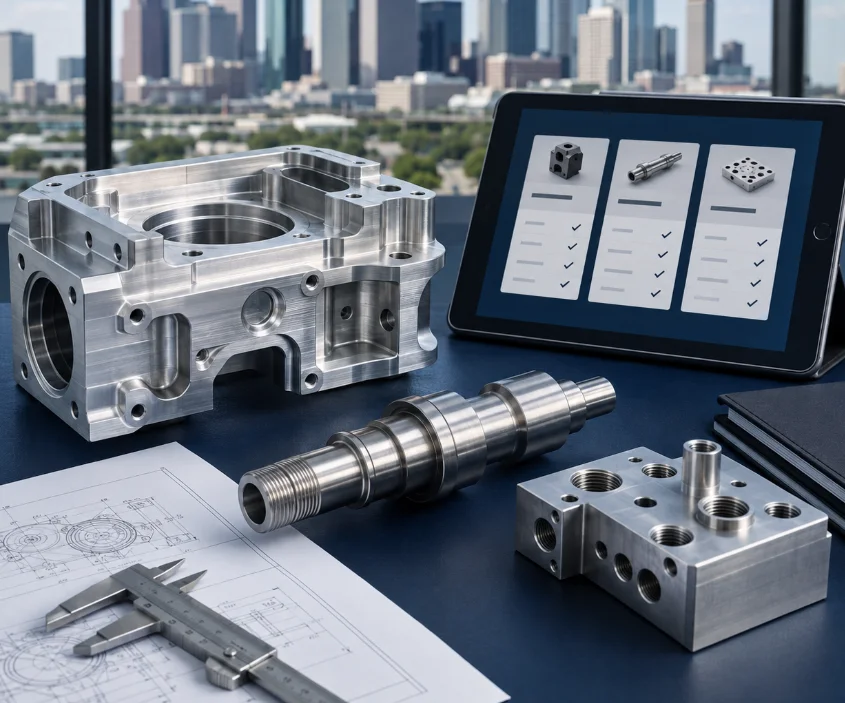
Finding a CNC machining supplier in Houston is not simply a matter of choosing the nearest machine shop. A suitable manufacturer must understand your material, part geometry, tolerances, inspection requirements, order quantity, surface treatment, and delivery expectations. It must also have the right equipment, engineering experience, quality controls, and available capacity.
However, many buyers do not have enough time to contact and screen dozens of machine shops. RapidMFGPro helps simplify this process. Its team has extensive experience coordinating CNC machining projects and reviewing manufacturing requirements. After a customer submits drawings and project information, RapidMFGPro considers the actual engineering requirements and provides references to potentially suitable manufacturers.
This supplier-matching assistance is provided to buyers at no charge. RapidMFGPro does not operate a Houston factory or require the customer to choose a particular manufacturer. Once a suitable supplier has been identified, the customer works directly with that manufacturer regarding technical details, quotation, payment, production, quality documentation, and delivery.
This guide explains how Houston buyers can define their requirements, compare local and cross-regional suppliers, evaluate manufacturing capabilities, prepare an accurate RFQ, and reduce sourcing risk.
Why Is Houston an Important Market for CNC Machining?
Houston supports a broad range of industries, including energy, oil and gas, aerospace, medical technology, industrial equipment, automation, transportation, and advanced manufacturing. These sectors require very different types of machined parts, from basic replacement bushings to complex five-axis housings and pressure-containing components.
Consequently, there is no single Houston CNC machine shop that is ideal for every project. Supplier selection must start with the application and the part’s manufacturing requirements.
Energy and Oilfield Equipment
Houston-based energy and industrial companies frequently source CNC-machined parts for:
- Valves and valve assemblies
- Pumps and compressors
- Hydraulic manifolds
- Pressure-control equipment
- Pipeline inspection systems
- Downhole and drilling tools
- Instrumentation systems
- Sealing assemblies
- Power-generation equipment
- Industrial replacement components
These parts may be exposed to pressure, corrosive fluids, abrasive media, vibration, fatigue loading, or elevated temperatures. The manufacturer may therefore need experience with sealing surfaces, pressure passages, threaded ports, corrosion-resistant alloys, material traceability, and dimensional inspection.
When reviewing an energy equipment project, RapidMFGPro does not rely only on the general description “CNC machining.” Its team considers the specific material, pressure-related features, thread specifications, sealing geometry, tolerances, inspection documents, and secondary treatments before providing supplier references.
Aerospace and Advanced Engineering
Houston’s aerospace and advanced engineering activities can generate demand for components such as:
- Structural brackets
- Avionics housings
- Sensor mounts
- Optical equipment components
- Robotic mechanisms
- Test fixtures
- Research equipment
- Thin-wall aluminum parts
- Titanium components
- Multi-axis machined housings
These projects may require five-axis machining, controlled deburring, first article inspection, material certificates, lot traceability, and detailed dimensional reports.
A manufacturer experienced in conventional industrial components may not automatically be suitable for aerospace-related parts. RapidMFGPro reviews whether a potential supplier’s equipment, material experience, inspection resources, and documentation capabilities are appropriate for the submitted project.
Medical, Laboratory, and Technology Equipment
Medical, laboratory, optical, and technology applications may require:
- Instrument housings
- Fluid-handling components
- Precision mounting plates
- Robotic parts
- Equipment frames
- Plastic insulating components
- Sensor housings
- Optical mounts
- Prototype assemblies
- Test equipment
These parts may emphasize cleanliness, appearance, small features, dimensional stability, surface finish, and reliable documentation. A supplier must understand not only how to cut the material but also how to prevent burrs, distortion, contamination, or cosmetic damage.
RapidMFGPro considers these application-specific requirements when narrowing the supplier search. This helps customers avoid contacting manufacturers whose general machining capability does not match the project’s actual demands.
What Should You Define Before Searching for a Supplier?
An effective supplier search begins with a clear project definition. If several machine shops receive incomplete or inconsistent information, their quotations may be based on different assumptions and become difficult to compare.
RapidMFGPro encourages customers to submit the available engineering information first. Its team can then use practical machining experience to understand what type of manufacturing capability is likely to be required.
Prepare the Manufacturing Files
A complete project package should normally include:
- A 3D CAD model
- A controlled 2D drawing
- Material grade and condition
- Required quantity
- General and feature-specific tolerances
- Surface roughness requirements
- Thread specifications
- Surface treatment requirements
- Inspection requirements
- Required certificates
- Delivery destination
- Target delivery date
The 3D model helps the manufacturer evaluate geometry, tool access, setups, and machining strategy. The drawing communicates tolerances, datums, threads, finishes, critical dimensions, and other requirements that may not be fully defined in the model.
If the drawing and model conflict, identify which document controls. Otherwise, different manufacturers may interpret the part differently.
RapidMFGPro’s team can review the submitted information before recommending potential suppliers. For example, a part with deep cavities, thin walls, tight bores, sealing grooves, or multiple compound angles may require a more specialized manufacturer than a straightforward plate or turned sleeve.
Define the Production Stage
Tell the potential supplier whether the project involves:
- A one-off concept part
- A functional prototype
- An engineering validation batch
- A first article
- Small-batch CNC machining
- Recurring production
- A replacement or repair part
- A production transfer from another supplier
A manufacturer optimized for fast CNC prototyping may be appropriate for one to ten parts but less competitive for recurring production. A high-volume supplier may provide lower production pricing but require more time and expense for fixtures, programming, and process validation.
RapidMFGPro considers both the immediate quantity and the expected future demand. This makes it possible to recommend a supplier that fits the current stage without ignoring the project’s possible transition into production.
Identify Critical-to-Quality Features
Not every dimension should receive an unnecessarily tight tolerance. Instead, identify the features that directly affect function, assembly, sealing, motion, alignment, or safety.
Typical critical features include:
- Bearing bores
- Shaft diameters
- O-ring grooves
- Valve seats
- Mating faces
- Threaded ports
- Hole patterns
- Datum surfaces
- Press-fit diameters
- Wall thickness around internal passages
- Runout between concentric features
- Flatness of sealing surfaces
When RapidMFGPro evaluates a project, these features help determine what type of machines, workholding, inspection equipment, and manufacturing experience the supplier should have.
Where Can You Search for CNC Machining Suppliers in Houston?
Typing “CNC machinist near me” into a search engine may produce a long list, but proximity alone does not establish suitability.
Search by Process and Application
More specific searches are usually more effective:
- CNC machining supplier in Houston
- CNC milling Houston
- CNC turning Houston TX
- Prototype machining services Houston
- Small-batch CNC machining Houston
- Five-axis CNC machining Houston
- Houston centerless grinding services
- Precision plastic machining Houston
- Energy equipment machining supplier Houston
- Contract CNC machining Texas
Adding the process, material, part type, or industry helps separate relevant manufacturers from companies focused on machine sales, repairs, programming, or unrelated fabrication services.
RapidMFGPro provides another route. Rather than requiring the buyer to search through many unrelated listings, its team reviews the project and uses engineering coordination experience to provide more focused supplier references.
Examine Supplier Websites Carefully
A polished website does not prove that a company can manufacture your part. Look for specific evidence, including:
- Machine types and working envelopes
- Three-, four-, or five-axis capability
- Maximum turning diameter and length
- Live tooling or mill-turn equipment
- Materials regularly machined
- Inspection equipment
- Current quality certifications
- Representative components
- Supported production quantities
- Secondary processes
- Engineering and DFM support
Be cautious when a supplier lists almost every process and material but provides no technical information. It may outsource many operations or have limited experience with some advertised capabilities.
RapidMFGPro’s role is not merely to give the customer a generic directory. Its team considers whether a potential manufacturer’s equipment and experience appear relevant to the submitted drawings and requirements.
Ask for Evidence Relevant to Your Part
A supplier does not need to disclose another customer’s confidential drawings. However, it should be able to explain:
- Whether it has machined similar materials
- How it would hold the part
- Which machine configuration it expects to use
- How it would inspect critical features
- Which processes would be subcontracted
- Whether the quantity fits its production model
- What technical risks it sees in the drawing
RapidMFGPro can use these same considerations when providing supplier references. The objective is to introduce the customer to manufacturers whose practical capabilities more closely match the project.
How Should You Evaluate a Houston CNC Machine Shop?
Once a shortlist has been created, evaluate each supplier systematically. Price matters, but a low quotation has little value if the manufacturer cannot control the critical features or meet the required schedule.
Confirm the Required Machining Processes
“CNC machining” covers many different manufacturing operations.
| Part Requirement | Capability to Confirm |
|---|---|
| Plates, brackets, and housings | Three-, four-, or five-axis CNC milling |
| Shafts, sleeves, and bushings | CNC turning |
| Turned parts with flats or cross-holes | Live-tool turning or mill-turn machining |
| Long, slender shafts | Suitable support, workholding, and straightness control |
| Tight cylindrical finishes | Cylindrical or centerless grinding |
| Deep internal passages | Deep-hole drilling or a qualified process partner |
| Large energy components | Sufficient travel, lifting capacity, and workholding |
| Precision plastic parts | Plastic machining and deformation-control experience |
| Machined assemblies | Machining, finishing, hardware installation, and assembly |
A machine may be physically large enough for a part but still be unsuitable for the required tolerance. Rigidity, workholding, tool access, thermal stability, setup strategy, and inspection access must also be considered.
RapidMFGPro reviews these details before recommending a manufacturer. A supplier reference is based on practical project requirements rather than on a broad claim that the company offers CNC services.
Verify Material Experience
The supplier should understand the exact material grade, not only the general material family.
- 6061-T6 and 7075-T6 aluminum have different strength and machining considerations.
- 304 and 316 stainless steel can work-harden.
- Titanium requires careful heat and tool-wear control.
- Copper may produce burrs and workholding difficulties.
- PEEK and other plastics may move after material removal.
- Nickel alloys can significantly increase tool wear and cycle time.
- Castings may contain inconsistent stock and irregular datum surfaces.
For Houston energy projects, materials such as stainless steel, duplex stainless steel, bronze, nickel alloys, and engineering plastics may be required. However, the correct supplier depends on the specified grade and application.
RapidMFGPro considers material experience as part of the matching process. A manufacturer that performs well with aluminum prototypes may not be the most suitable reference for a duplex stainless steel manifold or a thin-wall PEEK component.
Check Actual Production Capacity
A technically capable manufacturer can still miss delivery if its machines are fully booked. Ask:
- When can the material be obtained?
- When can programming begin?
- Is the required machine available?
- Does the lead time include finishing?
- Does it include final inspection?
- Are any operations subcontracted?
- Can the supplier support repeat orders?
- What happens if the first article needs revision?
RapidMFGPro considers the target delivery schedule when providing supplier references. Nevertheless, the customer should confirm the final production schedule directly with the selected manufacturer because the commercial and manufacturing relationship remains between those two parties.
Which Quality Capabilities Should You Verify?
Quality requirements should reflect the component’s function and risk. A decorative cover and a pressure-containing manifold do not require the same inspection plan.
Review the Quality Management System
ISO 9001:2015 certification can indicate that the supplier maintains documented quality-management processes. However, certification alone does not prove that a particular machine, operator, fixture, or measurement method is suitable for your component.
Verify:
- Company name and manufacturing address
- Certification scope
- Issue and expiration dates
- Certification body
- Whether the production location is included
- Whether additional industry-specific certifications are required
RapidMFGPro can include quality-system requirements in its supplier screening. If the customer requires ISO 9001, aerospace documentation, medical manufacturing controls, or another specific qualification, this should be stated when the project is submitted.
Match Inspection Equipment to the Drawing
Possible inspection equipment includes:
- Calipers and micrometers
- Bore gauges
- Height gauges
- Thread plug and ring gauges
- Surface roughness testers
- Optical comparators
- Coordinate measuring machines
- Vision measurement systems
- Roundness or contour measuring equipment
- Hardness testers
Do not stop at asking whether a supplier owns a CMM. Ask how the part will be aligned to the drawing datums, which characteristics will be measured, what sampling plan will be used, and what report will be provided.
RapidMFGPro’s engineering coordination experience helps identify when basic shop-floor inspection may be sufficient and when more advanced dimensional reporting should be included in the supplier requirements.
Specify the Required Documents
Depending on the project, the customer may require:
- Material certificates
- Certificate of conformance
- First article inspection report
- Dimensional inspection report
- Surface-treatment certificate
- Heat-treatment certificate
- Plating thickness report
- Nondestructive testing report
- Calibration records
- Lot traceability records
These requirements should be communicated before quotation. If they are added after production, the manufacturer may need to revise the price or may be unable to recover the necessary records.
RapidMFGPro considers documentation requirements when offering supplier references, helping reduce the risk of introducing a manufacturer that can machine the geometry but cannot provide the required quality evidence.
How Can You Compare CNC Machining Quotations?
Two quotations may appear to cover the same part while actually including different materials, inspection levels, finishes, or delivery terms.
Compare the Same Manufacturing Scope
| Quotation Item | What the Buyer Should Verify |
|---|---|
| Material | Exact alloy, grade, condition, form, and certification |
| Quantity | Prototype and production quantities quoted separately |
| Machining | All features, threads, and tolerances included |
| Surface treatment | Correct type, color, masking, and thickness |
| Inspection | Sampling level and required reports |
| Hardware | Inserts, pins, fasteners, and assembly included |
| Packaging | Protection of cosmetic and precision surfaces |
| Shipping | Method, destination, and whether freight is included |
| Tooling | One-time or recurring charge |
| Lead time | Starting point and inclusion of secondary operations |
| Quote validity | Validity period and material-price assumptions |
RapidMFGPro can help customers begin with a clearer project definition so potential suppliers review a more consistent scope. The final quotation, commercial terms, and order are then discussed directly between the customer and the manufacturer.
Investigate Unusually Low Quotations
A low price may be legitimate because the supplier has:
- Suitable material in stock
- Efficient fixtures
- Automated production
- Relevant previous experience
- Favorable machine configuration
- Available capacity
However, it may also indicate:
- A misunderstood tolerance
- Missing surface treatment
- Incorrect material
- Excluded inspection
- Unapproved process substitution
- Underestimated cycle time
- Incomplete drawing review
Because RapidMFGPro reviews actual engineering requirements before making a reference, it can help narrow the search to more relevant suppliers. The customer should still confirm critical assumptions directly with each manufacturer before placing an order.
Consider Total Acquisition Cost
The true project cost may include:
- Unit price
- Fixtures and tooling
- Quality documentation
- Shipping
- Supplier-management time
- Rework
- Expedited freight
- Production delays
- Assembly disruption
- Supplier requalification
A slightly higher quotation may be better if the manufacturer communicates clearly, understands the drawing, controls the critical dimensions, and delivers complete documentation.
Should You Choose a Local or Cross-Regional Supplier?
A Houston location can offer important benefits, but technical suitability should normally come first.
When a Houston Supplier May Be Preferable
A local Houston CNC machine shop may be advantageous when:
- The part is large or heavy.
- Local pickup reduces transportation time.
- Engineers need to inspect the first article in person.
- The design is changing frequently.
- The supplier must measure an existing mating component.
- A repair part must be reproduced from a physical sample.
- Shipping damage is a significant concern.
- On-site coordination is necessary.
- Equipment downtime makes delivery urgent.
For large valve bodies, fixtures, frames, shafts, or repair components, local transportation can materially affect total cost and schedule. When customers submit such requirements, RapidMFGPro can treat location and logistics as important supplier-selection factors.
When a Cross-Regional Supplier May Be Better
A manufacturer outside Houston may be more appropriate when:
- Specialized five-axis equipment is required.
- The material is difficult to machine.
- A particular certification is mandatory.
- Local manufacturers lack available capacity.
- Specialized grinding or finishing is required.
- The parts are small and economical to ship.
- Automated production can reduce recurring cost.
- The required tolerance exceeds nearby capabilities.
The closest manufacturer is not necessarily the fastest. A local shop with a four-week backlog may deliver later than a qualified cross-regional supplier with suitable material and immediate machine capacity.
RapidMFGPro does not limit its supplier references to Houston. Its team considers location alongside equipment, material experience, quality requirements, capacity, lead time, and project risk.
Use a Hybrid Sourcing Strategy When Necessary
Some companies maintain several types of suppliers:
- A local supplier for emergency replacement parts
- A specialized supplier for highly complex components
- A production supplier for recurring orders
- A backup supplier for supply continuity
RapidMFGPro can provide references according to the needs of a particular project. The customer remains free to evaluate the recommendations, contact the manufacturers directly, and decide whether a local, cross-regional, or dual-source strategy is appropriate.
What Should You Include in a CNC Machining RFQ?
A structured RFQ helps potential suppliers understand the work and prepare more comparable quotations.
Essential RFQ Information
- Part number and revision
- CAD model and PDF drawing
- Exact material specification
- Prototype and production quantities
- Required surface treatment
- Critical tolerances and surface finishes
- Inspection and documentation requirements
- Applicable standards
- Target delivery date
- Shipping destination
- Packaging requirements
- Approved substitutions, if any
RapidMFGPro uses this information to understand the project before offering supplier references. More complete information generally allows the team to identify manufacturers whose capabilities are more closely aligned with the part.
Separate Required Conditions from Preferences
- Required: 316L stainless steel with material certification
- Required: ±0.013 mm on the sealing bore
- Required: Delivery within six weeks
- Preferred: Manufacturer located in Texas
- Preferred: Black laser marking
- Optional: Complete CMM report
This distinction helps RapidMFGPro and potential suppliers understand where alternatives are possible without compromising the component’s function.
Ask Practical Technical Questions
- Which operations will be completed in-house?
- Which processes will be subcontracted?
- What machine configuration will be used?
- How will critical features be inspected?
- Is special tooling required?
- What is the material lead time?
- Can the supplier support repeat production?
- Which drawing features may increase cost or risk?
After RapidMFGPro introduces a potential supplier, the customer can ask these questions directly. This direct relationship allows the buyer and manufacturer to clarify engineering details without an unnecessary communication layer.
What Warning Signs Should You Watch For?
The Supplier Asks No Technical Questions
If a complex drawing receives an immediate quotation without any questions, important details may have been missed. Experienced manufacturers often ask about datums, tolerance interactions, coating allowance, thread class, surface finish, or inspection scope.
Capability Claims Are Vague
Statements such as “we machine everything” are less useful than clear information about machine size, controlled axes, materials, tolerances, inspection equipment, and representative work.
Subcontracting Is Unclear
Subcontracting is common for heat treatment, anodizing, plating, grinding, and special inspection. The concern is not outsourcing itself but whether the manufacturer clearly identifies and controls outside processes.
Tolerance Promises Are Unrealistic
Tolerance capability depends on feature size, geometry, material, workholding, temperature, process stability, and measurement method. A supplier should review these factors before accepting exceptionally tight requirements.
Revision Control Is Weak
Confirm that the quotation, purchase order, model, drawing, manufacturing instructions, and inspection report all reference the correct revision.
RapidMFGPro can provide matched CNC machining services to help reduce the number of irrelevant suppliers a customer must investigate, but the final qualification decision remains with the buyer. Customers should always verify the selected manufacturer’s technical, quality, and commercial suitability directly.
How Should You Qualify a New Supplier?
Begin with a Capability Review
- Relevant machines
- Material experience
- Similar manufacturing experience
- Quality systems
- Inspection resources
- Production capacity
- Subsupplier controls
- Communication process
- Data and revision control
RapidMFGPro performs an initial requirement-based matching process, but it does not replace the customer’s formal supplier approval procedure.
Order a Prototype or First Article
A controlled initial order can verify:
- Drawing interpretation
- Dimensional capability
- Surface quality
- Deburring
- Finishing
- Documentation
- Packaging
- Communication
- Actual lead time
The customer places this order directly with the selected manufacturer and receives the quotation, production updates, parts, and reports from that manufacturer.
Confirm Production Readiness
A successful prototype does not automatically prove recurring production capability. Before increasing volume, evaluate:
- Fixture repeatability
- Tool-life management
- In-process inspection
- Material availability
- Lot identification
- Capacity planning
- Nonconformance handling
- Change control
- Packaging consistency
RapidMFGPro can help customers begin with a more relevant supplier reference, while the manufacturer and customer directly establish the production and commercial relationship.
How Does RapidMFGPro Help You Find a Suitable CNC Supplier?
RapidMFGPro helps Houston buyers reduce the uncertainty and time involved in searching for a CNC machining supplier. Its team has extensive experience coordinating engineering requirements with manufacturers and understands that supplier suitability depends on much more than a general claim of offering CNC machining.
After receiving the customer’s drawings and project information, the team reviews factors such as:
- Required CNC milling or turning processes
- Part size and geometry
- Material and condition
- Critical tolerances
- Surface-finish requirements
- Prototype or production quantity
- Surface treatment
- Inspection and documentation
- Manufacturing capacity
- Delivery destination
- Target lead time
Based on these practical engineering considerations, RapidMFGPro provides references to manufacturers whose capabilities appear more closely aligned with the project.
This supplier-search assistance is free for the customer. RapidMFGPro does not charge buyers for helping them identify potential suppliers, does not require them to select a particular manufacturer, and does not replace the direct relationship between the customer and the manufacturing company.
Once a suitable manufacturer has been identified, the customer communicates directly with it to:
- Discuss technical questions
- Confirm drawing requirements
- Receive and compare quotations
- Negotiate commercial terms
- Place the order
- Monitor production
- Review quality documents
- Arrange shipping and delivery
RapidMFGPro therefore does more than provide a general machine-shop list. Its purpose is to use practical engineering coordination experience to help customers begin discussions with manufacturers that are more relevant to their actual components.
Frequently Asked Questions
Is RapidMFGPro a CNC Machine Shop in Houston?
No. RapidMFGPro does not represent itself as operating a Houston factory. It reviews customer requirements and provides references to potentially suitable manufacturers based on processes, materials, tolerances, quality requirements, capacity, location, and delivery expectations.
Does RapidMFGPro Charge Customers for Finding a Supplier?
No. RapidMFGPro’s supplier-matching assistance is provided to buyers at no charge. The service helps customers narrow their search using practical engineering considerations.
Who Provides the Quotation and Manufactures the Parts?
The selected manufacturer provides the quotation and manufactures the parts. After RapidMFGPro makes an introduction, the customer communicates directly with the manufacturer regarding technical details, pricing, payment, production, quality documents, and delivery.
Does the Customer Have to Choose the Supplier Recommended by RapidMFGPro?
No. RapidMFGPro provides supplier references rather than forcing a purchasing decision. The customer independently evaluates the manufacturer and decides whether to proceed.
How Do I Find the Best CNC Machine Shop for a Houston Project?
Start with the part’s requirements rather than distance alone. Evaluate the required processes, machine capacity, material experience, tolerances, inspection resources, documentation, production capacity, and lead time. RapidMFGPro can help identify potentially relevant manufacturers based on these conditions.
Is a CNC Machine Shop Near Me Always Faster?
No. A nearby manufacturer may still have a long backlog or wait for material and finishing. A qualified cross-regional supplier with available capacity may deliver sooner.
Can I Order One Prototype Before Production?
Many prototype machining services accept orders starting from one part. Confirm whether the manufacturer can also support future small-batch or production quantities if the design is approved.
What Should I Submit to RapidMFGPro?
Provide the 3D model, 2D drawing, material, quantity, tolerances, finishing, inspection requirements, delivery location, and target schedule. The more complete the project information is, the more accurately the team can assess the required supplier capabilities.
Conclusion
Finding a CNC machining supplier for a Houston project requires more than selecting the nearest shop or lowest quotation. The manufacturer must have suitable equipment, material experience, quality controls, inspection resources, capacity, and engineering understanding.
RapidMFGPro uses practical engineering coordination experience to review customer requirements and provide suitable supplier references at no charge. After the introduction, the customer works directly with the selected manufacturer for quotation, ordering, production, and delivery. This approach reduces the time spent searching while preserving the customer’s freedom to evaluate and select the final supplier.
Need Help Reviewing a Custom Part?
Share your CAD file and requirements to request supplier matching. Supplier capability and commercial terms must be verified before order placement.
Request Supplier Match