Time to read: 8 min
Is Titanium Magnetic? A Practical Guide for Titanium CNC Parts
Key Takeaways
The following points summarize the material, MRI, inspection, and sourcing decisions covered in this guide.
- Titanium is technically paramagnetic, but commercially pure titanium and common alloys such as Ti-6Al-4V are generally treated as non-magnetic in engineering because an ordinary magnet does not noticeably attract them.
- A magnet test cannot confirm that a part is titanium or identify its grade; aluminum, copper, brass, and some stainless steels may also show little or no attraction.
- Unexpected magnetic attraction may come from steel inserts, fasteners, ferromagnetic surface contamination, a material mix-up, or another component in the assembly.
- A titanium implant or device is not automatically MR Safe. MRI evaluation must also consider displacement, torque, RF-induced heating, image artifacts, device construction, and the manufacturer’s MR labeling.
- Conventional magnetic particle inspection is unsuitable for titanium. Penetrant, ultrasonic, radiographic, dimensional, and surface inspections should be selected according to the expected defect and part function.
- For custom titanium CNC parts, buyers should match the alloy grade, geometry, tolerances, traceability, inspection requirements, and DFM needs with a manufacturer that has relevant titanium machining experience.
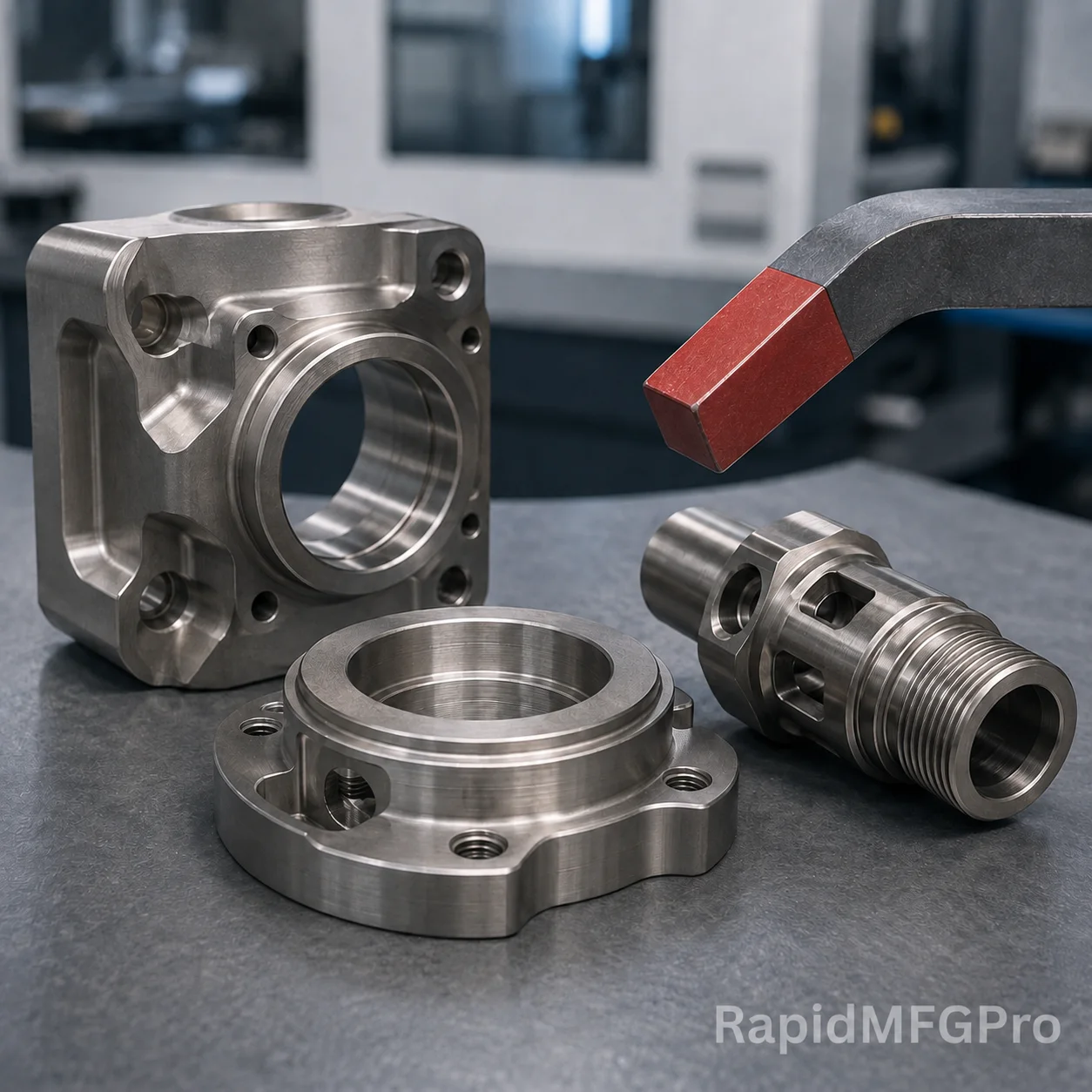
Titanium is technically paramagnetic, which means it responds weakly to an applied magnetic field. In normal engineering use, however, commercially pure titanium and common titanium alloys are usually described as non-magnetic because an ordinary magnet does not noticeably stick to them. That simple answer needs several qualifications. A part that does not attract a magnet is not necessarily titanium, a titanium device is not automatically MR Safe, and a titanium component that shows localized attraction may contain a steel insert or ferromagnetic contamination. For CNC parts, the material’s low magnetic response also changes the inspection methods that can be used. This guide explains those distinctions and connects them to titanium material selection, verification, machining, inspection, and supplier selection.
Is Titanium Magnetic?
Titanium has a measurable magnetic response, but it is not ferromagnetic. The distinction between paramagnetism and practical non-magnetism explains why laboratory instruments can detect a response while an ordinary workshop magnet does not stick.
Is Pure Titanium Magnetic?
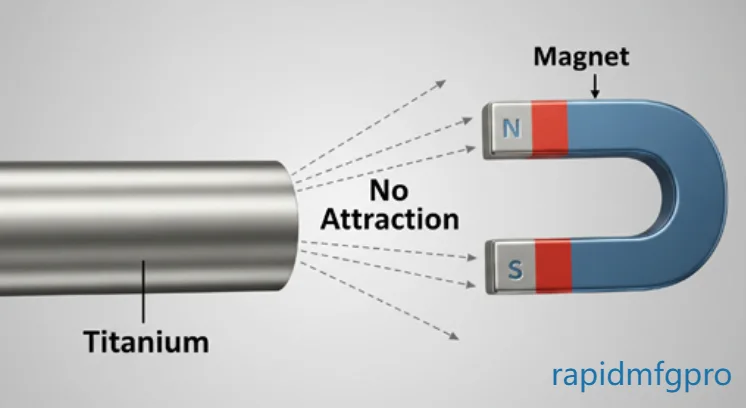
Pure titanium is not ferromagnetic. It does not behave like carbon steel, iron, cobalt, or strongly magnetic nickel-containing materials, and it does not become a conventional permanent magnet after exposure to a magnetic field. Its magnetic susceptibility is positive but small, so physicists classify it as paramagnetic. In practical terms, this means that a strong and sensitive laboratory setup can measure a response, while a normal workshop magnet usually produces no obvious attraction. In a National Institute of Standards and Technology (NIST) study of MRI artifacts, the titanium samples evaluated had a relative permeability of approximately 1.0002, illustrating titanium’s low but measurable magnetic response. [1]
This difference between scientific classification and shop-floor language is important. When a drawing, RFQ, or application note calls titanium “non-magnetic,” it normally means that the material has no meaningful ferromagnetic behavior for the intended use. It does not mean that titanium has exactly zero magnetic susceptibility under every field strength and test condition.
Why Is Titanium Paramagnetic but Usually Called Non-Magnetic?
A paramagnetic material becomes weakly magnetized in the direction of an external field. The response exists while the field is present and largely disappears when it is removed. Ferromagnetic materials behave very differently: their magnetic domains can align strongly, producing obvious attraction and, in some cases, retained magnetization. Titanium’s response is many orders of practical significance below what a machinist expects from ordinary steel.
For procurement and design, the useful question is not merely which label appears in a textbook. The useful question is whether the permitted magnetic response has been defined for the application. A sensor fixture near a precision magnetometer may require a measured susceptibility limit. A structural bracket far from a magnetic field may only need to avoid strongly ferromagnetic material. The same titanium grade can be acceptable in one case and require additional verification in another.
Why Does Titanium Conduct Electricity If It Is Not Magnetic?
Electrical conductivity and ferromagnetism are different material properties. Titanium conducts electricity because mobile electrons can carry charge through its metallic lattice. Strong magnetic attraction requires a different condition: magnetic moments must interact and align cooperatively into ferromagnetic domains. Titanium does not develop that iron-like domain structure under ordinary conditions, so it can conduct current while remaining only weakly paramagnetic. The same distinction applies to aluminum and copper, which conduct electricity but do not attract an ordinary magnet.
Will a Magnet Stick to Titanium?
An ordinary hand magnet should not stick firmly to commercially pure titanium or common alpha-beta titanium alloys such as Ti-6Al-4V. A weak movement detected with a powerful magnet does not, by itself, prove that the material is wrong. Test geometry, magnet strength, surface condition, nearby steel, and contamination can all affect what the user feels.
Conversely, no attraction does not prove that a part is titanium. Aluminum, copper, brass, many polymers, and some stainless steels can also pass a casual magnet test. Use the magnet as a quick screening tool, not as final material identification.
Are Titanium Alloys Magnetic?
Common titanium grades remain weakly paramagnetic, but alloy chemistry, microstructure, contamination, and test sensitivity can change the measured value. The table below separates normal alloy behavior from conditions that require investigation.
| Material | Practical magnet response | Relevant distinction | Verification need |
|---|---|---|---|
| Grade 1 commercially pure titanium | No noticeable attraction to an ordinary magnet | High purity, formability, and corrosion resistance | Certificate and heat traceability when grade matters |
| Grade 2 commercially pure titanium | No noticeable attraction to an ordinary magnet | Higher strength than Grade 1; widely used commercially | Magnet response cannot distinguish it from Grade 1 |
| Grade 5 Ti-6Al-4V | Normally treated as non-magnetic | Higher strength and different machining behavior | Confirm Al and V content through documentation or analysis |
| Grade 23 Ti-6Al-4V ELI | Similar practical response to Grade 5 | Lower interstitial limits; often used for demanding medical or aerospace requirements | A magnet cannot separate Grade 23 from Grade 5 |
| Titanium part with steel contamination or inserts | Localized or strong attraction may occur | Response may come from another material rather than the titanium matrix | Map the attraction, inspect the assembly, and verify composition |
Is Commercially Pure Titanium Magnetic?
Grade 1 and Grade 2 commercially pure titanium are weakly paramagnetic and normally show no obvious attraction to a workshop magnet. Small permitted amounts of interstitial or residual elements can alter a measured susceptibility, but they do not normally make the bulk alloy behave like carbon steel. A magnet cannot distinguish Grade 1 from Grade 2; use the material specification and traceability record.
Is Ti-6Al-4V Magnetic?
Grade 5 Ti-6Al-4V and Grade 23 Ti-6Al-4V ELI are also treated as non-magnetic for ordinary engineering use. Aluminum and vanadium change the alloy’s phase balance and mechanical behavior but do not create steel-like ferromagnetism. Because their practical magnet response is similar, grade identification must rely on traceable documentation and, where required, suitable chemical analysis. For a broader comparison of grades, properties, applications, and manufacturability, see what titanium is and whether it is suitable for a part.
How Do Alloying Elements Affect the Magnetic Response of Titanium?
Alloy chemistry and microstructure can change magnetic susceptibility, but the measured response of a finished part may also include effects unrelated to the titanium matrix. Trace iron, a ferromagnetic inclusion, embedded steel debris, heat treatment, phase distribution, and the sensitivity of the instrument can influence the result. A tiny amount of iron permitted by a titanium specification is not equivalent to a separate carbon-steel particle or insert, and it does not automatically cause strong attraction.
When magnetic performance is a functional requirement, define the acceptance criterion and test method on the drawing or purchasing specification. Terms such as “non-magnetic” are too vague for highly sensitive equipment unless the maximum permeability, susceptibility, test field, sampling plan, and applicable standard are understood by both buyer and manufacturer.
Can You Identify Titanium with a Magnet?
A magnet is useful only as a preliminary sorting tool. Reliable identification requires evidence that links the finished part to a material grade and, when risk justifies it, a suitable analytical test.
What Can a Magnet Test Tell You?
A magnet can quickly identify strong ferromagnetic behavior and may help separate an unknown piece from ordinary carbon steel. It is inexpensive, fast, and useful during preliminary sorting. It cannot establish chemical composition, titanium grade, heat treatment, mechanical condition, or compliance with a purchase specification.
The result should also be localized. If attraction occurs only around a threaded hole, bearing seat, edge, or welded area, the cause may differ from uniform attraction across the entire component. Record where the magnet reacts before cleaning or disassembling the part, because the pattern can guide the next check.
Why Is a Non-Magnetic Part Not Necessarily Titanium?
Many nonferrous metals are not noticeably attracted to an ordinary magnet. Aluminum can resemble titanium after machining or blasting, while some austenitic stainless steels are weakly magnetic or effectively non-magnetic depending on composition and cold work. Copper and brass are also non-ferromagnetic. Coatings, paint, and surface finishes can hide visual clues, and density estimates become unreliable when parts contain cavities or inserts.
This is why informal tricks—magnet response, color, spark appearance, sound, or perceived weight—should not replace traceability. They may support a screening decision, but they are not a defensible basis for accepting a critical aerospace, medical, or scientific part.
How Can You Verify Whether a Part Is Titanium?
Start with the purchase order, material certificate, heat or lot number, and the link between raw stock and the finished part. Traceability is often more valuable than testing a random surface because it establishes which certified batch was actually used. For incoming verification, positive material identification or laboratory chemistry can confirm major alloying elements. X-ray fluorescence is useful for many metals, but its ability to measure light elements is limited and the instrument’s alloy library and calibration matter. Optical emission spectroscopy or laboratory methods may be required when light elements or close grade distinctions are critical.
Density, hardness, conductivity, and microscopy can provide supporting evidence, but each has limitations. The verification plan should be proportional to risk: a decorative prototype may need basic receiving checks, while a load-bearing implant or flight component may require certified material, controlled traceability, and specified independent testing.
| Method | What it establishes | Main limitation | Best use |
|---|---|---|---|
| Magnet test | Presence of obvious ferromagnetic behavior | Cannot confirm titanium or determine grade | Preliminary sorting and localized troubleshooting |
| Material certificate plus heat number | Specified chemistry and properties for a traceable batch | Useful only if identity is maintained through production | Primary acceptance evidence for controlled supply chains |
| Handheld XRF/PMI | Many major alloying elements and alloy-family screening | Limited sensitivity to light elements; instrument library matters | Incoming verification and mix-up prevention |
| OES or laboratory chemistry | More complete elemental analysis, depending on method | Higher cost; may require surface preparation or sampling | Critical grade confirmation and dispute resolution |
| Density, hardness, or conductivity | Supporting physical-property evidence | Overlapping ranges and geometry-dependent error | Corroboration, not standalone certification |
Why Would a Titanium Part Attract a Magnet?
Unexpected attraction should be treated as a traceable nonconformance, not dismissed as “titanium is slightly magnetic.” First determine whether the response is uniform or localized, then isolate the material, assembly, and process causes.
- Map the response: test the body, threaded holes, inserts, edges, and assembled hardware separately.
- Review construction: compare the drawing and bill of materials with installed bushings, pins, bearings, springs, and fasteners.
- Inspect for contamination: check shared brushes, abrasives, blasting media, benches, fixtures, and chip handling.
- Reconcile traceability: match the part marking and traveler to the stock heat number and certificate.
- Escalate testing: use PMI, laboratory chemistry, or a specified magnetic-property test when the result affects function or compliance.
Check Whether the Entire Part Is Actually Titanium
A finished assembly may be sold or described as a titanium part even though it includes steel threaded inserts, bushings, pins, bearings, springs, fasteners, or tooling balls. A magnet may be reacting correctly to one of those items rather than to the titanium body. Review the bill of materials and drawing, then test the body and each installed feature separately where possible.
This is common in designs that need wear-resistant threads or standard bearing interfaces. The mixed-material construction may be intentional and functionally sound, but it can make the assembly unsuitable near a magnetic sensor or change its MR classification. The requirement should therefore apply to the complete device, not only to the largest component.
Check for Ferromagnetic Surface Contamination
Titanium can pick up steel particles during cutting, grinding, deburring, blasting, polishing, handling, or storage. Shared abrasive media, carbon-steel wire brushes, contaminated polishing belts, magnetic chucks used nearby, steel chips on benches, and mixed-part tumbling are typical sources. Embedded or smeared particles can create localized magnetic attraction even when the base metal is genuine titanium.
Cleaning should follow the applicable part specification and be compatible with the titanium alloy and final use. Simply wiping the surface may not remove embedded debris. For corrosion-sensitive, medical, vacuum, or magnetic-sensitive components, control dedicated tools and media, segregation, cleaning validation, and post-cleaning inspection before production begins.
Confirm the Actual Titanium Grade and Material Certificate
If the magnetic response is stronger or more uniform than expected, compare the part marking, traveler, stock identity, heat number, and material certificate. Check whether a substitute grade was authorized and whether raw stock remained identified through saw cutting, machining, outside processing, and final inspection. A certificate that cannot be linked to the finished part is weak evidence.
The supplier should investigate inconsistencies rather than explain them away with the general statement that titanium is paramagnetic. Strong attraction can indicate a mixed-up material, an attached ferromagnetic component, or contamination. The corrective action depends on which of these causes is verified.
Use PMI or Laboratory Testing When the Result Matters
For aerospace hardware, medical components, precision sensors, scientific instruments, and other critical parts, use an agreed verification method. PMI can identify many alloy families quickly, while a qualified laboratory can provide more complete chemistry or magnetic measurements. If the actual performance requirement concerns permeability or susceptibility, chemical identification alone may be insufficient; test the specified magnetic property on the complete part or representative condition.
Document the test equipment, calibration, location, acceptance criteria, and lot coverage. A repeatable record is far more useful than a video showing whether a magnet falls away from the surface.
Does Titanium Affect MRI?
Titanium’s low magnetic attraction addresses only one MRI concern. Device evaluation must consider static-field force and torque, radiofrequency heating, image artifact, and whether the complete device functions safely under the stated scan conditions.
| Consideration | Engineering question | Why titanium alone is not the answer |
|---|---|---|
| Displacement force | Will the static field pull the device? | Other components and the complete assembly determine the response |
| Torque | Will the device rotate or align with the field? | Geometry, orientation, and construction affect torque |
| RF-induced heating | Can the device create an unacceptable temperature rise? | Length, loops, conductivity, position, and scan parameters matter |
| Image artifact | Will nearby anatomy be obscured or distorted? | Size, shape, orientation, field strength, and sequence affect artifact |
| Device function | Will the product operate as intended during and after scanning? | Electronics, leads, joints, and multi-material construction may dominate |
Magnetic Attraction Is Only One MRI Consideration
MRI compatibility cannot be decided from magnetic attraction alone. A device in an MR environment may be evaluated for displacement force, torque, radiofrequency-induced heating, gradient-induced effects, image artifact, and device function. Titanium’s low ferromagnetic response may reduce attraction compared with strongly magnetic metals, but a complete device can still be electrically conductive, geometrically capable of heating, or constructed with other materials.
For a patient with an implant, the practical rule is to identify the exact device and follow its labeling and the MRI facility’s screening procedure. A general statement that “titanium is safe in MRI” is not an adequate substitute for device-specific information.
Can Titanium Cause MRI Image Artifacts?
Yes. Titanium usually creates less severe artifact than many ferromagnetic materials, yet it can still disturb the local magnetic field and produce signal loss, distortion, or obscuration near the component. Artifact depends on magnetic susceptibility, electrical behavior, size, geometry, orientation, distance from the anatomy of interest, field strength, and imaging sequence.
A titanium implant may therefore present little projectile risk while still reducing diagnostic image quality in its immediate neighborhood. For imaging-related hardware, engineers should consider artifact during material and geometry selection rather than treating it as a later scanning problem.
Can Titanium Heat Up During an MRI Scan?
Conductive devices can interact with radiofrequency fields. Heating is influenced by device length, shape, conductive loops, orientation, placement, surrounding tissue or test medium, scanner configuration, and scan parameters. Titanium’s material name alone cannot establish the temperature rise of a finished implant or instrument.
Device manufacturers evaluate relevant configurations and specify permitted conditions where appropriate. Users should not extrapolate from a small solid titanium screw to a long wire, a complex assembly, or an electrically active product.
Does Non-Magnetic Mean MR Safe?
No. “Non-magnetic” describes only the absence of significant ferromagnetic behavior in a stated context. MR Safe and MR Conditional are device-level labels that also account for static-field effects, radiofrequency energy, gradient fields, artifact, and device function. A metallic titanium item must not be assumed MR Safe merely because a hand magnet does not stick to it.
What Is the Difference Between MR Safe and MR Conditional?
MR Safe is a formal device label for an item that poses no known hazards in all MR environments under the applicable definition. MR Safe items are nonmetallic, nonconductive, and nonmagnetic; a metallic titanium device should not be assumed MR Safe merely because a magnet does not stick to it. MR Conditional means that safety has been demonstrated only under stated conditions, which can include permitted field strength, spatial gradient, RF exposure, scan duration, and positioning.
MR Unsafe describes an item that poses unacceptable risk in the MR environment. These labels apply to the evaluated item or device—not to titanium as an element in isolation—and the marked conditions are part of the safety conclusion. FDA guidance recommends standardized MR Safe, MR Unsafe, and MR Conditional labeling for medical devices used in or around the MR environment and addresses hazards including magnetically induced displacement force, torque, RF-induced heating, image artifact, and device function. [2]
Why Must the Specific Implant or Device Be Verified?
An implant or instrument may contain fasteners, coatings, electronics, magnets, leads, or multiple alloys. Two products that both contain Ti-6Al-4V can have different geometry, heating behavior, artifacts, and test results. Verify the manufacturer, model, implant record, MR label, permitted field strength, and stated scanning conditions.
If the device cannot be identified, healthcare professionals must follow their established risk assessment and screening procedures. An online article, a magnet test, or the patient’s recollection that an implant is “titanium” is not device labeling.
How Does Titanium’s Non-Magnetism Affect CNC Part Inspection?
Because titanium cannot be effectively magnetized for conventional magnetic particle inspection, the inspection route must be built around defect location, orientation, part geometry, material form, and the applicable acceptance standard.
| Method | Suitable target | Key limitation | Typical application |
|---|---|---|---|
| Visual and dimensional inspection | Geometry, burrs, damage, finish, and drawing characteristics | Does not establish hidden material integrity | Every machined part, with feature-specific gauges or CMM methods |
| PT/FPI | Surface-breaking cracks, laps, and seams | Cannot detect fully internal defects; surface condition affects sensitivity | Machined, ground, formed, or fatigue-critical surfaces |
| UT | Suitable internal discontinuities in stock, forgings, and thicker sections | Geometry, grain structure, sound path, and defect orientation matter | Raw material or critical thick-section verification |
| RT | Certain volumetric defects, weld conditions, and internal features | Orientation, access, thickness, and image quality constrain detection | Selected welded or internally complex components |
| MPI | Not suitable for titanium | Requires a ferromagnetic workpiece | Reject generic steel-oriented MPI notes for titanium parts |
Why Does Magnetic Particle Inspection Not Work for Titanium?
Magnetic particle inspection depends on magnetizing a ferromagnetic workpiece. A surface or near-surface discontinuity interrupts the magnetic flux and creates a leakage field that attracts inspection particles. Because titanium is not ferromagnetic, conventional magnetic particle inspection cannot generate the required response and is not an appropriate crack-detection method for titanium CNC parts.
This matters when a drawing reuses a generic inspection note written for steel. The quality plan should challenge an inapplicable MPI requirement and select a method suited to titanium, the expected defect, the feature geometry, and the governing specification.
When Should Penetrant Inspection Be Used for Titanium Parts?
Liquid penetrant testing, including fluorescent penetrant inspection, can reveal discontinuities that are open to the surface of a clean, nonporous titanium part. Depending on the process and acceptance criteria, it can help find cracks, laps, seams, and other surface-breaking flaws produced by raw material processing, machining, grinding, forming, or service exposure.
Penetrant testing does not reveal a defect that is fully internal, and poor cleaning, smeared metal, rough surfaces, trapped penetrant, or incompatible processing can reduce reliability. The drawing or quality plan should specify the applicable standard, sensitivity, timing in the manufacturing route, acceptance criteria, and qualified personnel.
When Are Ultrasonic or Radiographic Inspections Required?
Ultrasonic testing can be useful for suitable internal discontinuities in stock, forgings, and thicker sections, but detectability depends on sound path, grain structure, part geometry, surface condition, and defect orientation. Radiographic testing can reveal certain volumetric features, porosity, weld conditions, or internal configurations, while its sensitivity also depends on thickness, orientation, access, and image quality.
Neither method is automatically required for every titanium part. Choose inspection based on the failure mode, design authority requirements, material form, manufacturing process, and acceptance standard. For many machined components, dimensional inspection and surface testing may be more relevant than blanket internal NDT.
How Should Inspection Change for Different Titanium CNC Parts?
Inspection should follow function. Aerospace titanium bolts may require thread-gauge checks, dimensional verification, material traceability, and specified surface-flaw inspection. Shafts may prioritize diameter, straightness, runout, coaxiality, and surface integrity. Structural brackets often require critical hole position, profile, datum relationships, and visual or penetrant inspection in high-stress regions. Medical components can add surface roughness, cleanliness, documentation, and process-specific requirements.
The essential point is that “non-magnetic” does not mean “not inspectable.” It means that magnetic particle testing is unsuitable and that the manufacturer must build an inspection route around the real defects and functional characteristics of the titanium part. RapidMFGPro’s supplier quality review guidance explains how inspection methods, documentation, and acceptance requirements should be defined before production.
When Do CNC Parts Need Non-Magnetic Titanium?
Titanium is appropriate when low magnetic response must be combined with strength, corrosion resistance, low density, temperature capability, or biocompatibility. If magnetism is the only constraint, aluminum, copper alloys, polymers, or ceramics may be more economical.
Medical and Imaging Equipment
Titanium is used for selected implant components, surgical instrument parts, imaging fixtures, patient-positioning components, and device housings. Low magnetic response can be useful, but it is rarely the only reason for selection. Corrosion resistance, biocompatibility where specified, strength-to-weight ratio, fatigue behavior, sterilization compatibility, and design history can be equally important.
Engineers should separate material selection from device labeling. A titanium component may help reduce magnetic attraction or artifact, yet the final device still requires evaluation according to its complete construction and intended MR exposure. The same principle applies when sourcing medical device components: the complete material, geometry, cleaning, documentation, and inspection scope must be reviewed together.
Sensors and Precision Scientific Instruments
Sensor housings, probe holders, instrument frames, optical mounts, and vacuum-system components may be located near magnetic-sensitive measurements. Ferromagnetic materials can distort a field, influence calibration, attract debris, or introduce uncontrolled forces. Titanium can provide low magnetic response together with greater strength and temperature capability than many plastics and lower density than steel.
However, titanium is not always the most cost-effective choice. Aluminum, copper alloys, ceramics, or engineering polymers may meet the magnetic requirement at lower machining cost or with different thermal and electrical properties. The design should compare the complete requirement set rather than selecting titanium from one property alone.
Aerospace and Navigation Components
Titanium fasteners, sensor mounts, instrument brackets, navigation-system housings, and lightweight structural components may benefit from low magnetic interference, corrosion resistance, and high specific strength. In many aerospace applications, weight and mechanical performance are the primary drivers, while magnetic behavior becomes an additional constraint near instruments.
The permitted response should be stated when it matters. Material grade, heat treatment, inserts, coatings, assembly hardware, and contamination controls can all affect the finished component or assembly, so qualification should extend beyond the titanium billet certificate. These requirements should be included when evaluating suppliers for aerospace manufacturing projects.
How Can RapidMFGPro Help You Find a Titanium CNC Machining Manufacturer?
A credible titanium supplier match must start with the actual risk features of the RFQ. Grade, wall thickness, tool access, tolerances, surface condition, quantity, traceability, NDT, and delivery requirements determine whether a manufacturer is technically and commercially suitable.
Find a Manufacturer Willing to Take On Your Titanium Project
General machine shops may decline a titanium RFQ or add a large risk allowance when the part combines Ti-6Al-4V with deep pockets, thin walls, long-reach tools, difficult threads, or strict surface requirements. RapidMFGPro uses the grade, geometry, tolerance, quantity, inspection, documentation, and delivery target to help buyers find manufacturers more suited to evaluate the work, reducing time spent screening shops that are unlikely to quote. Buyers can also review the platform’s CNC machining supplier-matching guide before comparing potential manufacturers.
Get Practical DFM Advice Instead of a Simple Rejection
Useful DFM identifies the exact risk instead of calling the part “too difficult”: excessive tool reach, wall movement after roughing, an impractical internal radius, an unfavorable thread depth, an inaccessible inspection feature, or workholding that conflicts with a cosmetic surface. RapidMFGPro helps connect buyers with manufacturers prepared to discuss whether a radius, datum, local tolerance, machining allowance, inspection plan, or operation sequence can change without compromising function.
Avoid Choosing a Shop Based Only on a ‘Titanium Machining’ Claim
A shop that has machined a Grade 2 spacer is not automatically qualified for a thin-wall Ti-6Al-4V housing, fatigue-critical bracket, or medical component. Buyers should verify experience with comparable grade, geometry, tolerance, surface condition, traceability, and NDT coordination. RapidMFGPro helps identify better-aligned manufacturers, after which the buyer can directly compare DFM, quality controls, lead time, and total cost to pursue a more cost-effective solution. A complete CNC machining RFQ makes those comparisons more accurate.
Before accepting a quotation, buyers should confirm:
- Comparable experience: similar titanium grade, geometry, tolerance, and surface requirement.
- Process control: appropriate workholding, tool-reach strategy, heat control, burr control, and in-process inspection.
- Material control: certificate review, heat-number traceability, segregation, and contamination prevention.
- Inspection capability: access to the dimensional and NDT methods specified by the drawing or quality plan.
- Commercial fit: realistic lead time, quantity capability, change handling, documentation scope, and total landed cost.
FAQs About Titanium Magnetism
These questions extend the main discussion to common situations not answered by a simple hand-magnet test.
Can Titanium Become Permanently Magnetized?
Bulk titanium does not normally retain strong permanent magnetization because it is paramagnetic rather than ferromagnetic. A finished part that remains strongly magnetic should be checked for steel inserts, attached hardware, embedded ferromagnetic debris, or a material mix-up.
Will Titanium Set Off a Metal Detector?
It can. A metal detector may respond to electrical conductivity and electromagnetic induction, not only to ferromagnetism. Detection depends on the instrument, object size, geometry, orientation, alloy, and sensitivity setting; “non-magnetic” does not mean “undetectable.”
Does Anodizing or Coating Make Titanium Magnetic?
Conventional titanium anodizing does not make the titanium substrate ferromagnetic. A coating or surface treatment can change the observed response only if it contains magnetic material or introduces ferromagnetic contamination. Evaluate the complete coating system and finished part when magnetic performance is critical.
Conclusion
Titanium is paramagnetic, but commercially pure titanium and common alloys such as Ti-6Al-4V are normally considered non-magnetic because ordinary magnets do not noticeably attract them. This behavior cannot confirm material identity or prove that a complete device is MR Safe. Unexpected attraction requires checks for inserts, contamination, material mix-ups, and traceability. Conventional magnetic particle inspection is unsuitable for titanium; select penetrant, ultrasonic, radiographic, dimensional, or surface inspection according to the expected defect and part function. A successful titanium project depends on matching the grade, machining capability, DFM communication, and inspection route—not on a magnet test or a generic supplier claim.
Reference Sources
- National Institute of Standards and Technology (NIST). Bennett, L. H., Wang, P. S., and Donahue, M. J. Artifacts in Magnetic Resonance Imaging from Metals. The study examines MRI artifacts from low-magnetic-susceptibility metals and reports a relative permeability of approximately 1.0002 for the titanium samples evaluated. View NIST source
- U.S. Food and Drug Administration (FDA). Testing and Labeling Medical Devices for Safety in the Magnetic Resonance (MR) Environment: Guidance for Industry and Food and Drug Administration Staff. October 2023. The guidance covers MR safety testing and labeling, including MR Safe, MR Unsafe, and MR Conditional terminology and evaluation of relevant MR-environment hazards. View FDA guidance
Need Help Reviewing a Custom Part?
Share your CAD file and requirements to request supplier matching. Supplier capability and commercial terms must be verified before order placement.
Request Supplier Match