Time to read: 4 min
Tin, Nickel, or Silver Plating: Which Conductive Finish Is Best for Copper CNC Parts?
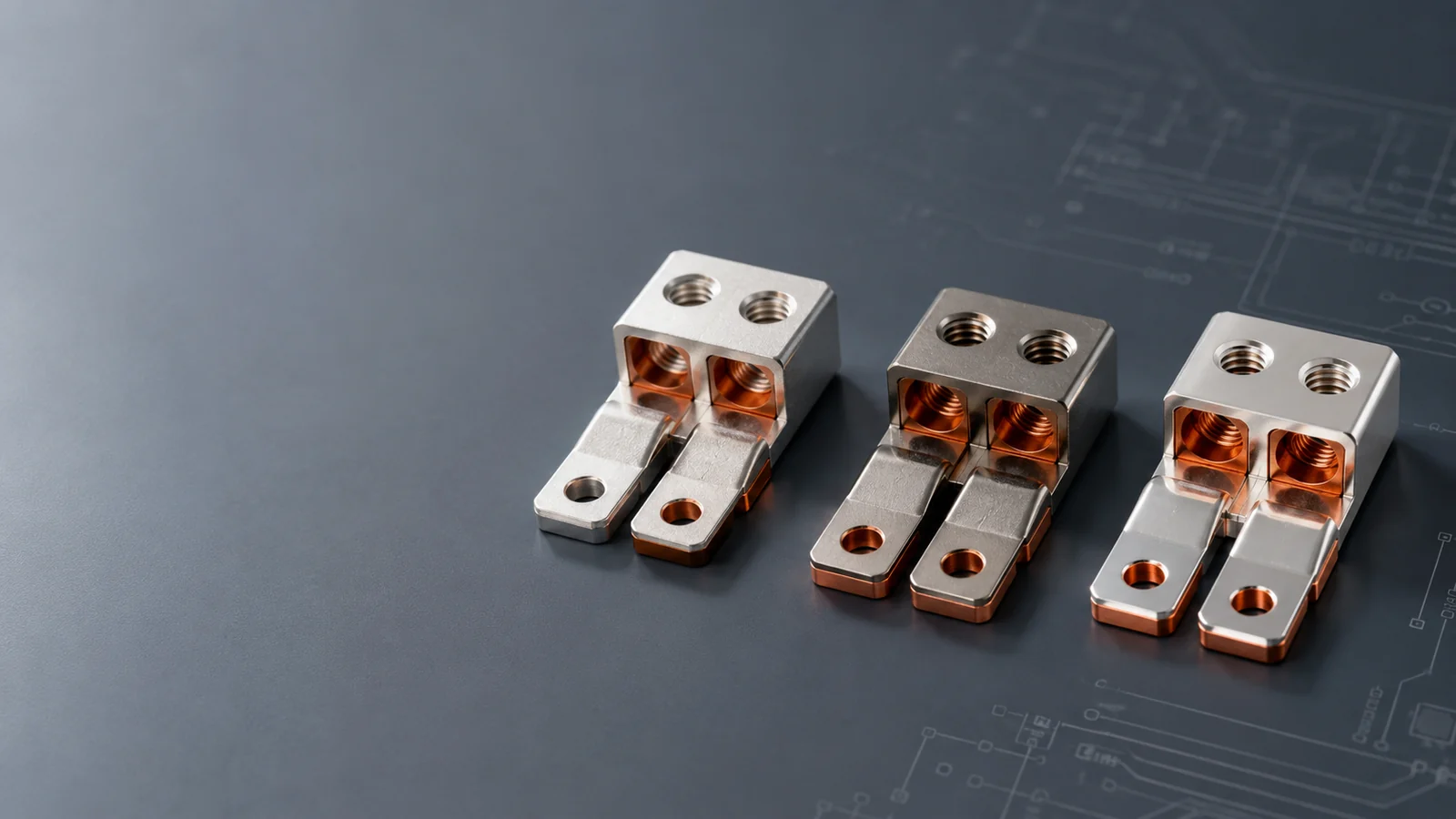
Which conductive finish is best for copper CNC parts? For most economical soldered terminals and general electrical components, tin plating is the practical choice. For high-current contacts, busbars, and parts that must minimize heat generation, silver plating usually delivers the best electrical performance. Nickel plating is better when wear resistance, hardness, elevated-temperature stability, or barrier protection matters more than achieving the lowest contact resistance.
However, the metal with the highest bulk conductivity is not automatically the best finish. Contact pressure, mating cycles, operating temperature, sulfur exposure, coating thickness, porosity, and post-plating dimensions can matter more than a simple conductivity ranking.
| Selection Factor | Tin Plating | Nickel Plating | Silver Plating |
|---|---|---|---|
| Electrical conductivity | Moderate | Lowest of the three | Highest |
| Typical contact resistance | Low when oxide is displaced by adequate contact force | Generally higher and more sensitive to surface oxide | Very low under suitable contact conditions |
| Solderability | Excellent | Difficult without suitable activation or flux | Good, subject to process compatibility |
| Wear resistance | Low to moderate | High | Moderate; depends strongly on hardness and thickness |
| Elevated-temperature use | Limited by coating system, intermetallic growth, and assembly conditions | Good for many demanding environments | Excellent for many high-current applications |
| Main environmental concern | Oxidation and fretting corrosion | Resistive nickel oxide and coating porosity | Sulfide tarnish |
| Relative cost | Lowest | Moderate | Highest |
| Usually best for | Soldered terminals, lugs, economical connectors | Wear surfaces, barrier layers, durable terminals | Busbar joints, high-current contacts, low-loss power systems |
Why Are Copper CNC Parts Plated If Copper Is Already Highly Conductive?
Copper is already an excellent bulk conductor. Plating is therefore not normally used to make the entire copper component dramatically more conductive. Instead, it modifies the surface where current enters or leaves the part.
Bare copper reacts with its environment and develops oxides and other surface films. These films can increase contact resistance, particularly at lightly loaded or contaminated interfaces. A suitable finish protects the copper, improves soldering or joining, controls friction, and stabilizes the electrical contact over time.
This distinction matters for CNC-machined busbars, battery terminals, electrode holders, connector blocks, power-distribution components, grounding parts, and conductive heat-transfer components. Their bulk resistance is mainly determined by copper grade, cross-sectional area, and current path. Their connection resistance is affected by the plated surface, joint design, contact pressure, surface condition, and assembly process.
Does the Most Conductive Plating Always Produce the Best Electrical Connection?
No. Silver has the highest bulk electrical conductivity of the three finishes, followed by tin and then nickel. But bulk conductivity is only one part of a real electrical joint.
Current passes through microscopic contact spots known as asperities rather than across the entire apparent mating area. The number and quality of these contact spots depend on:
- Contact pressure and bolt preload
- Surface roughness and flatness
- Plating hardness and ductility
- Oxides, sulfides, oils, and other contaminants
- Coating thickness and porosity
- Vibration and thermal cycling
- The plating on the mating component
A poorly prepared silver-plated joint can perform worse than a properly designed tin-plated joint. Likewise, a hard nickel finish may be mechanically durable but still produce too much interface resistance for a low-force signal contact.
For high-current parts, the correct comparison is not simply the resistivity of silver, tin, and nickel. It is the measured resistance and temperature rise of the complete plated and assembled joint.
When Is Tin Plating Best for Copper CNC Parts?
Tin plating is usually the best value when the copper part must be soldered, crimped, or connected at moderate current without severe temperature or wear requirements. It is widely used on copper terminals, cable lugs, connector components, grounding hardware, and economical busbars.
Why Is Tin Easy to Solder?
Tin readily participates in common soldering systems, allowing solder to wet the plated surface more easily than it wets oxidized copper or passive nickel. This can reduce assembly time and the risk of incomplete solder joints.
Good initial solderability does not guarantee unlimited storage life. Tin and copper gradually form copper-tin intermetallic compounds. Excessive intermetallic growth, surface oxidation, contamination, or unsuitable storage can reduce solderability. A nickel barrier layer may be specified between copper and tin when long shelf life or diffusion control is important.
How Does Tin Maintain Electrical Contact?
Tin is relatively soft. Under sufficient mating force, the contacting surfaces deform and the joint can break through the thin oxide film, creating conductive metal-to-metal contact spots. This makes tin effective in properly designed connectors with adequate normal force.
The same softness can become a disadvantage in sliding contacts or high-cycle connectors. Repeated movement can wear the surface, expose the underlayer, and produce debris. Small cyclic movements caused by vibration or thermal expansion may also create fretting corrosion, progressively increasing contact resistance.
Where Can Tin Plating Become a Poor Choice?
Tin requires caution when a part experiences high operating temperatures, repeated insertion cycles, severe vibration, or sustained mechanical movement. It may also be unsuitable when the design requires an exceptionally low and stable contact resistance without enough force to disrupt its oxide film.
Pure tin deposits can present a tin-whisker risk in some electronic applications. The actual risk depends on deposit chemistry, stress, underplating, thickness, post-treatment, and service environment. Engineers working on high-reliability electronics should specify an approved whisker-mitigation strategy instead of assuming that every tin finish behaves the same way.
When Is Nickel Plating Best for Copper CNC Parts?
Nickel plating is usually selected for hardness, wear resistance, diffusion control, corrosion protection, and elevated-temperature durability—not because it provides the lowest electrical resistance.
It can be appropriate for copper connector bodies, durable terminal components, contact hardware exposed to abrasion, and parts requiring a robust barrier beneath tin, silver, or gold.
Why Is Nickel Used as an Underplate?
A nickel underlayer can reduce copper migration into the top coating, improve corrosion protection, and provide a mechanically stable foundation. This is why some commercial connector systems use tin or silver over nickel rather than depositing the final finish directly on a copper alloy.
For example, TE Connectivity documents connector contacts made from copper alloy with tin or silver plating over nickel. This illustrates an important point: the most effective finish may be a multilayer system rather than one isolated plating metal. See TE Connectivity’s RAST 5 connector specification.
Is Electrolytic Nickel the Same as Electroless Nickel?
No. This is an important distinction for conductive copper parts.
Electrolytic nickel is deposited using electrical current and may provide better conductivity than nickel-phosphorus electroless coatings. Electroless nickel creates a relatively uniform nickel-alloy layer without external current, which is valuable for complex geometries, recesses, and controlled dimensional buildup. However, its electrical, magnetic, hardness, and corrosion properties vary with phosphorus content and heat treatment.
A high-phosphorus electroless nickel coating should not be treated as electrically equivalent to pure electrolytic nickel. If the coated surface is part of the primary current path, conductivity must be included in the coating specification. RapidMFGPro’s guide to electroless nickel plating for precision CNC parts explains the dimensional and functional differences in more detail.
Why Can Nickel Increase Contact Resistance?
Nickel is significantly less conductive than copper or silver, but coating thickness alone is not always the main problem. A thin nickel layer contributes limited bulk resistance across its thickness. The more serious issue at a mating interface can be nickel’s hard, electrically resistive surface oxide.
High contact force or wiping action may help penetrate surface films, but nickel-only finishes are generally less suitable for low-force, low-voltage signal contacts that require consistently low resistance. Nickel makes more sense when mechanical durability or barrier performance justifies the electrical tradeoff.
When Is Silver Plating Best for Copper CNC Parts?
Silver plating is generally the strongest option for high-current copper contacts, switchgear, busbar joints, charging hardware, and power-distribution components where low contact resistance and controlled temperature rise justify the additional cost.
Silver combines very high electrical and thermal conductivity with a relatively soft contact surface. Under pressure, it creates a large real contact area, which can reduce interface resistance. This helps limit localized Joule heating at bolted or spring-loaded connections.
Does Silver Plating Prevent a Copper Part from Heating Up?
Silver plating does not substantially cool a copper part merely because silver has high thermal conductivity. In most cases, the thin coating contributes little to the bulk heat-spreading capacity of a thick copper component.
Its main thermal benefit is indirect: lower connection resistance can reduce the heat generated at the joint according to P = I²R. Because heating rises with the square of current, even a small reduction in contact resistance can be valuable in high-current systems.
Does Silver Oxidize or Tarnish?
Silver is relatively resistant to ordinary oxidation, but it can tarnish in environments containing sulfur compounds. The resulting silver sulfide layer can interfere with low-force electrical contacts. It is therefore inaccurate to describe silver as universally non-tarnishing.
In high-pressure bolted joints, wiping contacts, or power-switching applications, the surface film may be disrupted during assembly or operation. In low-level signal applications without sufficient wiping or contact force, tarnish can be more troublesome. Environmental testing should reflect actual sulfur exposure, humidity, current, and contact mechanics.
Is Pure Silver Always Best for Switching Contacts?
No. A static busbar joint and an arcing relay contact experience different failure mechanisms. Fine silver offers excellent conductivity, but repeated arcs can cause material transfer, erosion, or contact welding. Silver alloys and silver-metal-oxide contact materials may sacrifice some conductivity to improve resistance to welding and arc erosion.
TE Connectivity’s discussion of relay contact materials and service life shows why a switching-contact material should be selected according to load type and inrush behavior, not conductivity alone.
How Do Tin, Nickel, and Silver Compare for Different Copper CNC Parts?
| Copper CNC Part or Condition | Finish Usually Favored | Reason |
|---|---|---|
| Soldered terminal or electronic lug | Tin | Good solderability at relatively low cost |
| Bolted high-current busbar joint | Silver | Low contact resistance and reduced joint heating |
| Economical general-purpose busbar | Tin | Practical oxidation protection when the joint is correctly designed |
| Sliding or wear-exposed conductive component | Nickel or an engineered multilayer finish | Greater hardness and wear resistance |
| High-mating-cycle power connector | Silver system designed for the cycle count | Better conductivity than tin, but thickness and wear testing remain essential |
| Low-force electrical contact | Usually not bare nickel | Nickel oxide can create unstable interface resistance |
| Complex part requiring uniform coating thickness | Electroless nickel, if its conductivity is acceptable | More uniform coverage on recesses and complex geometry |
| Topcoat requiring a copper diffusion barrier | Nickel underplate plus tin or silver | Combines barrier performance with a more suitable contact surface |
| Sulfur-containing industrial atmosphere | Application-specific; test silver carefully | Silver sulfide tarnish may affect lightly loaded contacts |
| Part intended for resistance welding to a cell | Nickel-plated copper may be considered | Nickel can improve surface compatibility, but weldability must be validated |
Should Both Sides of a Connection Use the Same Plating?
Where practical, matching mating finishes is safer than combining finish systems without validation. Tin-to-tin connections are widely used because their mechanical and chemical behavior is reasonably predictable. Mixed-metal interfaces may have different hardness, friction, oxide behavior, wear rates, and galvanic potential.
The risk increases when moisture, salts, vibration, or thermal cycling is present. A connector that works during initial assembly can develop unstable resistance after repeated temperature changes or small relative movements.
This does not mean that every dissimilar finish will immediately fail. It means that plating compatibility must be assessed as a system. Molex specifically recommends evaluating oxidation, fretting, intermetallic formation, vibration, and thermal cycling rather than treating the finish on one half of a connector independently. Its technical discussion of matching connector plating systems demonstrates this system-level approach.
How Do Contact Force and Joint Design Change the Best Finish?
A finish cannot compensate for an inadequately designed joint. For a bolted copper busbar connection, resistance depends on flatness, surface cleanliness, effective overlap area, washer system, bolt preload, relaxation, and thermal expansion. Increasing the visible contact area alone does not guarantee a proportional reduction in resistance because current flows through microscopic contact spots.
Tin benefits from sufficient pressure to deform the soft surface and penetrate oxides. Silver also performs well under pressure because it can conform to surface asperities. Nickel is harder and may require a different contact-force strategy.
Overtightening is not a reliable solution. It can deform the copper, damage threads, crush soft coatings, or produce joint relaxation. The correct torque must generate repeatable preload without yielding the part or fastener system.
How Does Plating Thickness Affect Electrical Performance and Service Life?
A thicker coating is not automatically a better conductor. Once a continuous functional layer has been established, additional thickness may contribute little to initial resistance. Its greater value may be longer wear life, reduced porosity, improved corrosion protection, or greater allowance for post-processing.
The required thickness should be based on:
- Base material and surface preparation
- Whether the finish is a topcoat or an underplate
- Expected mating or sliding cycles
- Contact force and wear pattern
- Temperature and environmental exposure
- Required solderability shelf life
- Permitted dimensional buildup
- Applicable ASTM, military, customer, or industry specification
Specifying only “tin plated,” “nickel plated,” or “silver plated” leaves too many variables uncontrolled. A production drawing should identify the plating process, deposit type, thickness range, underplate, selective areas, masking requirements, post-treatment, and inspection criteria.
How Does CNC Machining Affect the Final Plated Copper Part?
Plating quality begins before the part enters the plating bath. Cutter marks, burrs, polishing direction, embedded contamination, oxide, and machining fluid residue can all affect adhesion and coating continuity.
Surface Roughness and Contact Performance
A smoother machined surface may support more uniform plating and predictable contact, but the lowest possible roughness is not always necessary. Contact behavior depends on the coated surface after plating, not just the pre-plating roughness value on the drawing.
Heavy tool marks can create local thickness variation, trap contaminants, and concentrate wear. Excessive polishing can round functional edges or change flatness. The required finish should therefore be linked to the electrical interface and the plater’s pretreatment process.
Burrs, Sharp Edges, and Current-Density Effects
Burrs and sharp corners can attract higher current density during electroplating, producing thicker deposits, nodules, or burning at exposed edges. Recesses, blind holes, and shielded areas may receive less coating. This is particularly important on three-dimensional CNC parts, where nominal bath thickness does not guarantee identical coverage at every location.
Small controlled edge breaks can improve coating consistency, but they must not reduce a critical contact area. Burr removal should be completed before plating unless a qualified post-plating operation is specified.
Threads, Holes, Fits, and Plating Allowance
Plating adds material to external surfaces and reduces internal dimensions. The dimensional effect is approximately twice the local coating thickness across a diameter, but actual buildup can vary with geometry and electroplating current distribution.
Internal threads, precision bores, press fits, dowel holes, and sealing surfaces may need pre-plating compensation or masking. A blanket tolerance applied without accounting for coating buildup can cause assembly failures even when the machining and plating processes individually meet their specifications.
The broader relationship between pretreatment, finish selection, and dimensional control is covered in RapidMFGPro’s guide to surface finish selection for prototype and production parts.
Should a Copper Part Be Machined Before or After Plating?
Functional copper parts are normally machined first and plated afterward so the finish covers the final geometry. Machining after plating exposes copper and can damage the protective barrier. It may be justified when a specific contact pad, bearing diameter, or grounding location must remain uncoated, but selective masking is often more controllable.
If post-plating machining is unavoidable, the drawing should explicitly identify where exposed copper is acceptable and whether the cut edge requires sealing, replating, or additional inspection.
Can Tin, Nickel, or Silver Plating Carry More Current?
The current rating of a copper part cannot be determined from its plating alone. Ampacity is primarily governed by the copper cross-section, alloy conductivity, allowable temperature rise, cooling conditions, joint resistance, insulation limits, duty cycle, and enclosure design.
Silver plating can permit a lower-resistance joint and therefore reduce localized heating, but a thin silver layer does not turn an undersized copper busbar into a higher-capacity conductor. Tin and nickel finishes should be evaluated in the same way: calculate the bulk conductor first, then validate the plated joints.
High-current assemblies should be tested at the intended current after thermal stabilization. Measuring voltage drop across each connection is more informative than assuming acceptable performance from material conductivity tables.
Is Silver Plating Worth the Additional Cost?
Silver is worth considering when the cost of electrical loss, overheating, downtime, or contact failure is substantially greater than the plating premium. It may be economical to plate only the functional contact zones rather than the entire copper part.
Tin generally provides the lowest finished cost for solderable and moderate-duty components. Nickel can reduce life-cycle cost where surface wear would quickly damage a softer coating. Silver can reduce life-cycle cost in high-current equipment if lower joint resistance improves efficiency and reliability.
The real finished-part cost includes more than the plating-metal price:
- Surface preparation and activation
- Nickel or copper underlayers
- Selective masking and special fixturing
- Minimum lot or bath charges
- Thickness and adhesion inspection
- Dimensional reinspection after plating
- Solderability or contact-resistance testing
- Rejected parts caused by pits, burns, nodules, or poor coverage
- Packaging needed to prevent tarnish or contamination
What Should Be Included on a Copper Part Plating Specification?
| Specification Item | Why It Matters |
|---|---|
| Copper grade and material condition | Affects conductivity, hardness, machining, and pretreatment |
| Plating process | Distinguishes electrolytic nickel, electroless nickel, matte tin, bright tin, and other deposits |
| Underplate | Controls diffusion, adhesion, corrosion, and final contact behavior |
| Minimum and maximum thickness | Balances coverage, wear life, cost, and dimensional buildup |
| Critical plated areas | Ensures the functional contact receives the required deposit |
| Masked areas | Protects threads, fits, grounding points, or surfaces that must remain bare |
| Contact and mating finish | Prevents incompatible finish combinations |
| Operating environment | Identifies humidity, salt, sulfur, chemical, vibration, and temperature risks |
| Electrical acceptance criteria | Defines allowable contact resistance or voltage drop |
| Mechanical tests | May include adhesion, thickness, wear, or mating-cycle requirements |
| Post-plating dimensions | Prevents failures in threads, holes, fits, and assemblies |
How Should Plated Copper CNC Parts Be Inspected?
Appearance inspection alone cannot confirm electrical performance. A bright, smooth coating may still be too thin in a recessed contact zone, poorly adhered, porous, or dimensionally unacceptable.
An appropriate inspection plan may include:
- X-ray fluorescence or another approved thickness measurement method
- Adhesion testing appropriate to the deposit and specification
- Visual inspection for blisters, pits, burns, nodules, and exposed copper
- Post-plating measurement of threads, bores, and critical fits
- Four-wire Kelvin resistance measurement for low-resistance joints
- Voltage-drop and temperature-rise testing at rated current
- Solderability testing for tin-plated terminals
- Environmental, vibration, and mating-cycle tests for connectors
Resistance should be measured across the actual interface wherever possible. A simple two-wire multimeter measurement can be dominated by lead and probe resistance and may not distinguish a good milliohm-level joint from a marginal one.
Which Conductive Finish Should You Choose?
- Choose tin plating for economical soldered terminals, cable lugs, general connectors, and moderate-duty conductive parts where adequate contact pressure is available.
- Choose nickel plating when hardness, wear resistance, a diffusion barrier, or elevated-temperature durability is more important than minimum interface resistance.
- Choose silver plating for high-current busbar joints, power contacts, switchgear, and other connections where low resistance and controlled temperature rise justify the higher cost.
- Choose a multilayer system when a nickel barrier is required beneath tin or silver to control diffusion, corrosion, or substrate interaction.
- Request application testing when the part faces vibration, sulfur, thermal cycling, repeated mating, resistance welding, or unusually low contact force.
How RapidMFGPro Helps Source Plated Copper CNC Parts
A machine shop experienced with ordinary aluminum or steel parts does not automatically have the process control needed for conductive copper components. Copper grade verification, burr control, contact-flatness requirements, plating allowance, selective masking, and low-resistance inspection all affect the delivered assembly.
RapidMFGPro helps match buyers with manufacturers according to the required copper alloy, CNC milling or turning process, dimensional accuracy, plating system, inspection method, and industry requirements. For demanding projects, the matching process can prioritize suppliers that understand how tin, nickel, or silver plating changes threads, precision holes, contact surfaces, and final electrical performance.
Supplier matching is normally completed within one to two days. Buyers can then communicate directly with the manufacturer about drawings, coating standards, thickness limits, test requirements, and production quantities. If a matched supplier’s capabilities do not meet the stated requirements, the feedback can be reviewed and a more suitable manufacturer identified.
Conclusion
There is no universal best conductive finish for every copper CNC part. Tin is usually the most economical choice for solderability and general electrical connections. Nickel offers the greatest mechanical durability and works well as a diffusion or barrier layer, but it is rarely the best exposed surface when minimum contact resistance is the primary goal. Silver provides the strongest electrical performance for many high-current joints, although tarnish, wear, and cost still require consideration.
The final choice should be based on the complete connection: current, contact force, mating finish, temperature, environment, wear, coating thickness, and post-plating dimensions. For critical parts, validate the assembled joint through resistance and temperature-rise testing rather than selecting a finish from conductivity values alone.
Frequently Asked Questions
Is tin-plated copper more conductive than nickel-plated copper?
Tin is more conductive than nickel as a bulk metal, but real joint resistance also depends on oxide films, contact pressure, coating thickness, and surface condition. Nickel may still be preferable when wear or elevated-temperature durability is more important.
Is silver-plated copper better than tinned copper for busbars?
Silver plating is generally favored for high-current busbar contact areas because it can produce lower connection resistance and less joint heating. Tin is often adequate and more economical for moderate-current assemblies with properly designed bolted joints.
Can silver be plated directly onto copper?
Direct silver plating is possible in some qualified processes, but a barrier or strike layer may be specified to improve adhesion, control copper migration, or enhance corrosion performance. The correct layer system depends on the required specification and service conditions.
Can nickel-plated copper be soldered?
Yes, but nickel is more difficult to solder than tin and may require suitable surface activation, flux, temperature control, and process qualification. If routine soldering is the primary assembly method, tin is usually more convenient.
Does plating thickness affect CNC tolerances?
Yes. Plating increases external dimensions and reduces holes, slots, and internal-thread clearances. The CNC dimensions must account for the specified coating range, including nonuniform buildup on edges and recessed features.
What is the best way to measure the resistance of a plated copper joint?
Use a four-wire Kelvin measurement across the assembled interface. For high-current components, combine resistance measurement with rated-current temperature-rise testing under representative torque, cooling, and environmental conditions.
Need Help Reviewing a Custom Part?
Share your CAD file and requirements to request supplier matching. Supplier capability and commercial terms must be verified before order placement.
Request Supplier Match