Time to read: 20 min
A Complete Guide for CNC Machining Aluminum: Properties and Machining Tips
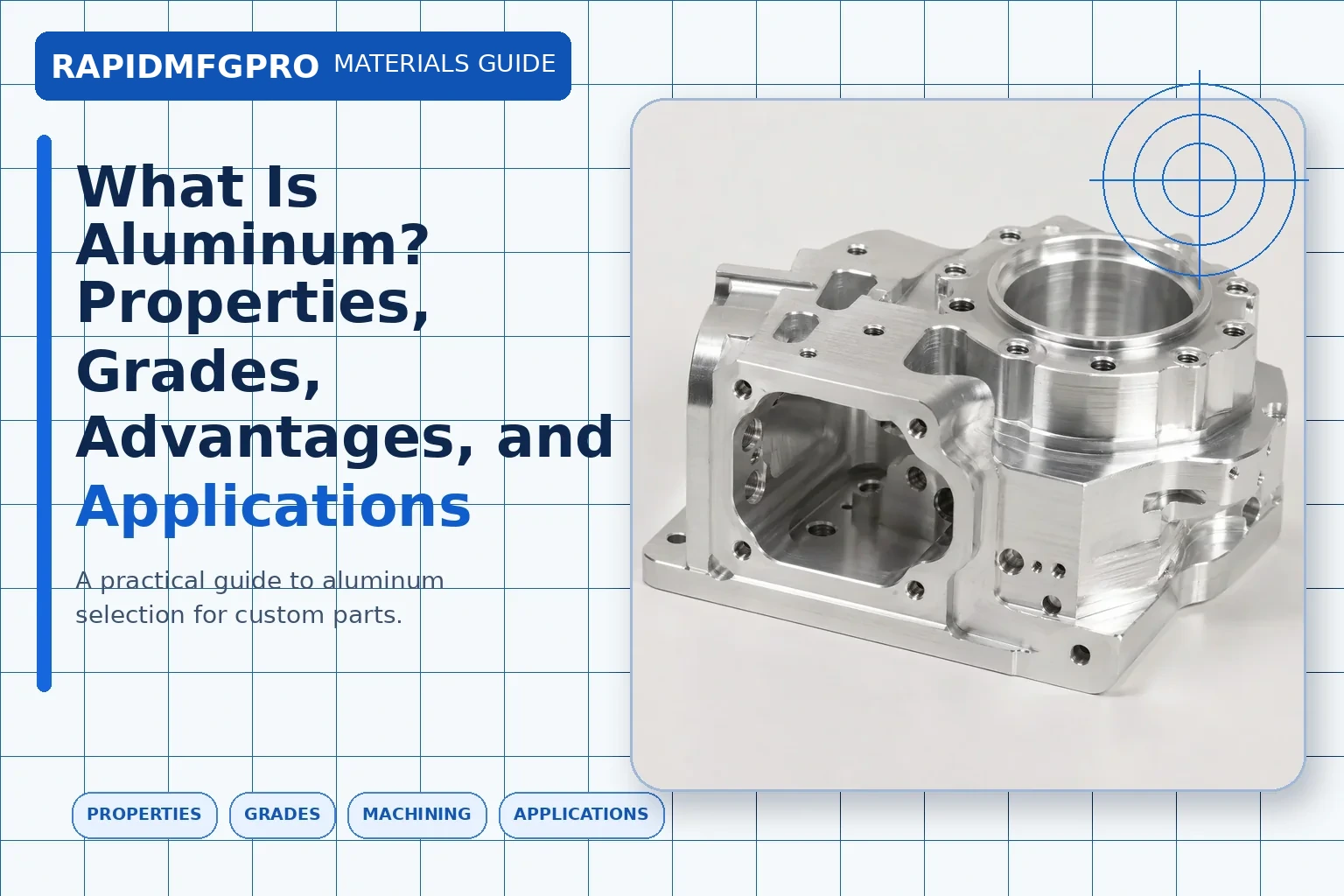
Aluminum is a common metal used in CNC machining because of its good machinability. It can be machined to achieve a smooth surface while maintaining good structural performance. Its low density makes it suitable for manufacturing lightweight machined parts. Aluminum is also nonmagnetic, making it suitable for parts that are sensitive to magnetic interference. However, there are still some challenges when CNC machining aluminum. Read this guide to explore the properties of aluminum and learn practical machining tips.
What Is Aluminum?
Aluminum is a low-density, lightweight, corrosion-resistant metal that is suitable for CNC machining. In addition to these characteristics, aluminum also has high thermal and electrical conductivity. These properties make aluminum a suitable choice for manufacturing parts used in various industries, such as aerospace, medical, chemical, automotive, electronics, and consumer products. Different aluminum alloys provide different combinations of strength, corrosion resistance, machinability, conductivity, and other performance characteristics.
Chemical Properties of Aluminum
| Chemical Element | Symbol | Main Effect in Aluminum Alloys |
|---|---|---|
| Aluminum | Al | Base element |
| Magnesium | Mg | Increases strength and corrosion resistance |
| Silicon | Si | Improves castability and contributes to strengthening |
| Copper | Cu | Increases strength and hardness |
| Zinc | Zn | Provides high strength, especially when combined with Mg |
| Manganese | Mn | Improves strength and corrosion resistance |
| Iron | Fe | Common impurity; affects strength and ductility |
| Chromium | Cr | Improves corrosion resistance and grain structure |
| Titanium | Ti | Refines grain structure |
| Zirconium | Zr | Improves grain stability and high-temperature performance |
In practice, engineers often need to check the chemical composition of specific aluminum grades to evaluate whether an alloy is suitable for structural parts, connecting parts, moving components, housings, or other machined parts. Comparing chemical compositions can also help engineers identify suitable alternative grades. For designers, understanding the role of different alloying elements helps explain why aluminum grades provide different combinations of strength, corrosion resistance, hardness, machinability, and other properties.
Mechanical Properties of Aluminum
The following table shows representative mechanical properties of aluminum alloys in tempers commonly used for CNC machining. These values are provided for reference. Actual properties may vary depending on material thickness, product form, heat treatment condition, and applicable material standard.
| Aluminum Alloy & Temper | Tensile Strength (MPa) | Yield Strength (MPa) | Elongation (%) | Brinell Hardness (HB) | Elastic Modulus (GPa) |
|---|---|---|---|---|---|
| 2024-T351 | ~470 | ~325 | ~19 | ~120 | ~73.1 |
| 5052-H32 | ~228 | ~193 | ~12 | ~60 | ~70.3 |
| 5083-H111 | ~275–350 | ≥125 | ~12–17 | ~75 | ~71 |
| 6061-T651 | ~310 | ~276 | ~12 | ~95 | ~68.9 |
| 6063-T6 | ~241 | ~214 | ~12 | ~73 | ~68.9 |
| 6082-T651 | ~310 | ~260 | ~8–10 | ~91 | ~70 |
| 7075-T651 | ~570 | ~500 | ~11 | ~150 | ~71.7 |
| 7050-T7451 | ~510–525 | ~440–455 | ~10–11 | ~140 | ~71.7 |
Common Aluminum Grades for CNC Machining
In machining practice, several aluminum grades are particularly common because they provide useful combinations of machinability, mechanical performance, availability, and cost. The following table compares several aluminum grades commonly considered for CNC parts.
| Grade | Advantages | Applications |
|---|---|---|
| Aluminum 6061 | Balanced performance, good machinability, reasonable price, corrosion resistance, and good anodizing response | General-purpose CNC machined parts |
| Aluminum 7075 | High strength and good machinability | High-strength structural and precision parts |
| Aluminum 2024 | High strength and good fatigue performance | Aerospace structural parts and connectors |
| Aluminum 5052 | Good corrosion resistance and formability | More commonly used for sheet metal fabrication than extensive CNC machining |
| Aluminum 5083 | Good corrosion resistance and relatively high strength | Parts exposed to harsh or marine environments |
| Aluminum 6082 | Relatively high strength | Structural and mechanical parts |
| Aluminum 7050 | High strength and good resistance to stress-corrosion cracking | High-strength aerospace structural parts |
| Aluminum MIC-6 | Good dimensional stability | Fixtures, base plates, and tooling plates |
Heat Treatment of Aluminum Before CNC Machining
Does aluminum need heat treatment before CNC machining? Aluminum used for CNC machining is often purchased in an appropriate temper that has already undergone the required thermal and mechanical treatments. For example, CNC shops may machine 6061-T651, 7075-T651, or 2024-T351 stock directly rather than heat-treating the raw material themselves before machining.
Advantages of Heat Treatment
Heat treatment can improve the strength and hardness of heat-treatable aluminum alloys and help the material achieve the mechanical properties required for the finished component. Certain tempers also incorporate stress-relief operations that reduce residual stresses and improve dimensional stability during subsequent machining.
Can Heat Treatment Reduce Warping During CNC Machining?
Stress-relieved aluminum tempers can reduce the risk of warping after heavy material removal during CNC machining because they contain lower levels of residual stress. Examples include T351, T651, and T7451. These tempers incorporate stress-relief treatments, such as controlled stretching, as part of the tempering process.
Material removal still changes the internal stress balance of the workpiece. However, when the initial residual stress is lower, there is generally less residual stress available to drive distortion as the material is removed. This can be particularly important for large plates, thin-wall parts, high-material-removal components, and parts with tight flatness requirements.
CNC Machining Processes for Aluminum Parts
Aluminum can be machined using different CNC processes depending on the required geometry, tolerance, surface finish, and functional features of the part. CNC milling and CNC turning are two of the most common machining methods used for aluminum components.
CNC Milling Aluminum
CNC milling is often used to machine aluminum parts with complex geometries such as deep pockets, multi-level cavities, curved surfaces, slots, channels, and thin-wall structures.
When CNC milling aluminum, common machining problems include:
- Aluminum sticking to the end mill
- Built-up edge
- Tool breakage
- Part deformation
Tips for CNC Milling Aluminum
Choose Suitable End Mills
Flute Count: Two- or three-flute end mills usually provide more chip-clearance space, making them suitable for aluminum slotting and roughing where large volumes of chips are produced.
Sharp Cutting Edges: Sharp end mills help shear aluminum cleanly and reduce material smearing and built-up edge.
Tool Geometry: Tool geometry should be selected according to the aluminum alloy, machining operation, depth of cut, chip evacuation requirements, surface finish, and geometry of the part.
Keep Chips Out of the Cutting Zone
Effective chip evacuation is important when milling aluminum. Recutting accumulated aluminum chips can increase cutting heat, damage the surface finish, and contribute to material adhesion on the cutting edge. Appropriate coolant, air blast, and toolpath strategies can help remove chips from the cutting zone.
Keep Proper Cutting Speed
Aluminum generally allows relatively high cutting speeds, but the appropriate speed depends on the alloy, cutting tool, tool diameter, machine condition, depth of cut, and machining operation. Excessively conservative parameters can promote rubbing and built-up edge, while inappropriate high-speed conditions can create heat and tool stability problems.
Leave a Consistent Allowance for Finishing
When machining precision aluminum parts, roughing should leave a reasonably consistent amount of material for the finishing pass. A consistent finishing allowance helps stabilize cutting forces and makes it easier to control dimensional accuracy and surface finish.
CNC Turning Aluminum
CNC turning aluminum is primarily used to produce cylindrical, tapered, stepped, threaded, grooved, bored, and other rotationally symmetric geometries. Typical aluminum turned parts include shafts, pins, sleeves, spacers, bushings, fittings, adapters, hubs, and other parts containing concentric features.
Tips for CNC Turning Aluminum
Choose Sharp Turning Inserts
Aluminum can adhere to turning tools and form a built-up edge. Aluminum-specific polished carbide inserts with sharp, positive-rake cutting edges are generally effective at reducing cutting forces and minimizing material adhesion. This can help improve both dimensional consistency and turned surface finish.
Optimize Speed and Feed
Aluminum generally supports higher cutting speeds during turning. Running too slowly may increase the tendency for built-up edge formation. Feed should also be selected carefully because an extremely low feed does not necessarily improve the finish and may increase rubbing. An appropriate combination of spindle speed and feed helps maintain efficient cutting and a stable surface finish.
Improve Chip Control
Ductile aluminum alloys can produce long, continuous chips during OD turning and boring. These chips may wrap around the workpiece, toolholder, or chuck. Suitable chip-breaker geometry, feed rate, depth of cut, and cutting parameters should therefore be selected to encourage chips to curl and break safely.
Support Slender Parts
Long aluminum shafts, rods, and pins have relatively low rigidity when their length-to-diameter ratio becomes large. Cutting forces can cause deflection and chatter, affecting diameter tolerance, straightness, cylindricity, and surface finish. Reducing unsupported length and using a tailstock or steady rest where appropriate can improve turning stability.
Control Thin-Wall Deformation
Thin-wall aluminum sleeves, rings, and cylindrical housings can deform under chucking and cutting forces. Excessive chuck pressure may distort the component while it is being machined, allowing the diameter to change after the part is unclamped. Controlling chuck pressure, using sharp tooling, and limiting excessive cutting forces can help reduce this problem.
How to Find a Reliable CNC Manufacturer for Your Project?
In today's highly transparent information environment, AI tools can make finding CNC machining suppliers appear easier than ever. However, AI-generated information can sometimes be inaccurate, outdated, or incomplete. The challenge is no longer simply finding a list of CNC manufacturers. It is determining which supplier actually has the machining capabilities, quality control, communication, pricing, and delivery performance required for your project.
This is where RapidMFGPro can help. Our team members have years of experience in the CNC machining industry and access to an established network of CNC machining service suppliers. We also understand how to evaluate suppliers based on their actual manufacturing capabilities and project requirements.
If you need custom aluminum parts, you can provide your drawings and project requirements to RapidMFGPro. We can evaluate the manufacturing requirements and recommend suitable, cost-effective CNC suppliers for your project. Suppliers are screened before recommendation, and we avoid recommending suppliers with behaviors or problems such as:
- Offering intentionally low initial prices and significantly increasing prices later without reasonable justification
- Poor or unresponsive communication
- False or unverifiable certifications
- Unexplained production or delivery delays
- Machining capabilities that do not meet the project requirements
- Unstable or inconsistent product quality
For aluminum CNC machining projects, supplier selection should consider not only price but also experience with the required aluminum alloy and temper, machining complexity, tolerances, surface treatment requirements, inspection methods, and delivery expectations. RapidMFGPro helps connect these requirements with suppliers whose capabilities are better aligned with your project.
Need Help Reviewing a Custom Part?
Share your CAD file and requirements to request supplier matching. Supplier capability and commercial terms must be verified before order placement.
Request Supplier Match