Time to read: 8 min
What Is Secondary Machining and Does Your Part Need It?
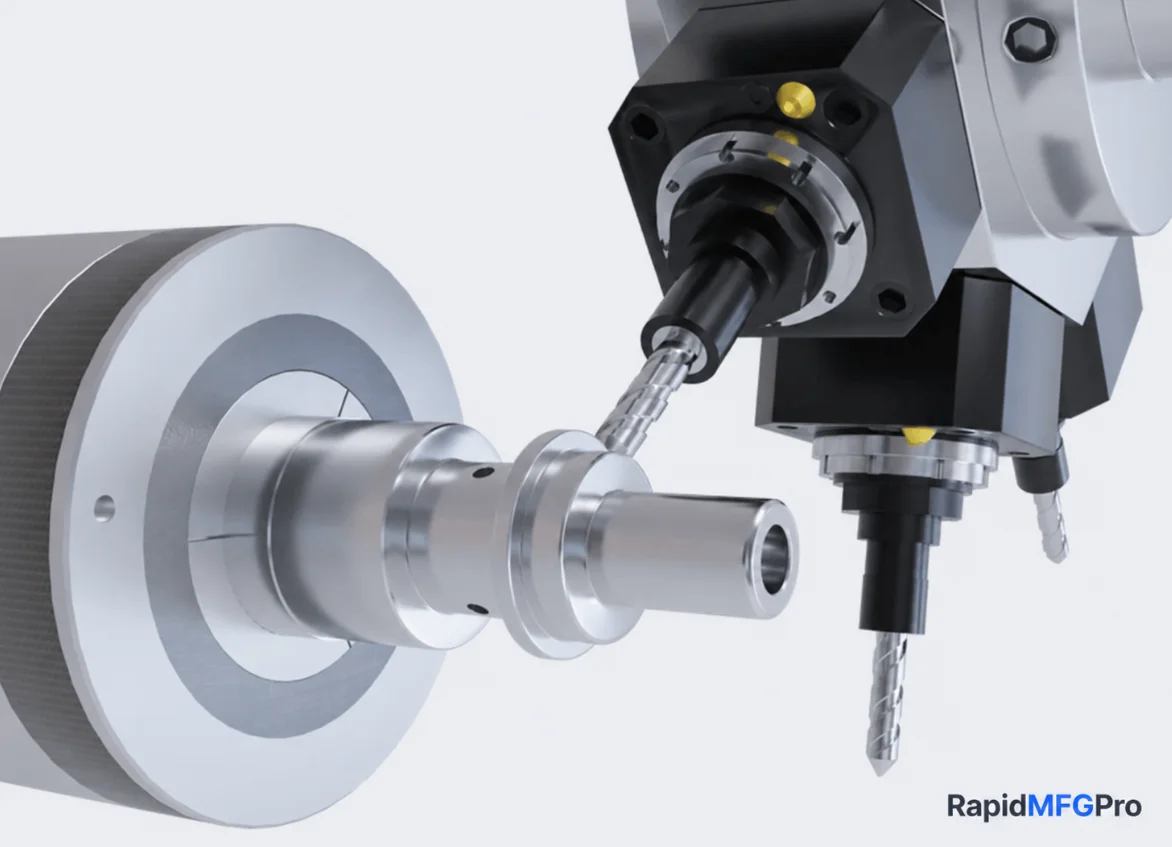
Secondary machining is an additional machining operation performed after a part's primary shape has already been created. It is used when the first manufacturing step cannot economically produce every required hole, thread, tolerance, surface, or functional feature. Typical secondary machining processes include drilling, tapping, reaming, boring, milling, turning, grinding, honing, lapping, EDM, and deburring.
The term is sometimes used more broadly to include heat treatment, anodizing, plating, marking, cleaning, and assembly. Technically, these are better described as secondary manufacturing or finishing processes because they do not necessarily remove material.
For sourcing, the terminology matters less than clearly defining the complete process route. A cast housing that still needs precision bearing bores, or a turned shaft requiring a keyway and ground journal, is not finished simply because the primary manufacturing operation is complete.
| Question | Short Answer |
|---|---|
| What is secondary machining? | Machining performed after the main part shape has already been created. |
| Why is it used? | To add features, improve tolerances or surfaces, or finish areas the primary process cannot produce efficiently. |
| Common processes | Drilling, tapping, reaming, boring, milling, turning, grinding, honing, lapping, EDM, and deburring. |
| Is anodizing secondary machining? | No in the strict sense. It is a secondary surface-finishing process rather than a machining operation. |
| Does secondary machining require another machine? | Not necessarily. A secondary feature may be completed on the same CNC machine or even in the same setup. |
| Does every part need secondary machining? | No. It is required only when the complete part requirements cannot be achieved efficiently during the primary process. |
What Is Secondary Machining?
Secondary machining describes material-removal operations applied after a component has already received its basic geometry through another manufacturing step.
The original shape might have been produced by:
- CNC turning;
- CNC milling;
- die casting;
- forging;
- extrusion;
- injection molding;
- sheet metal fabrication;
- additive manufacturing;
- or another near-net-shape manufacturing process.
The secondary operation then creates features or final conditions that were not practical, economical, or accurate enough to generate during the first operation.
For example, a die-cast component may already contain ribs, bosses, walls, and most of its external shape. Bearing bores, sealing faces, dowel holes, and threaded mounting locations may still require CNC machining because those features demand greater dimensional control than the casting process alone can consistently provide.
Another example is a standard enclosure purchased from a catalog. Instead of machining a completely custom enclosure from billet, a manufacturer may start with the standard product and use secondary milling or drilling to create connector openings, mounting holes, or other customized features.
In this case, secondary machining can reduce raw-material waste and manufacturing time because most of the required geometry already exists.
What Is the Difference Between Primary and Secondary Machining?
The difference is mainly the role an operation plays within the manufacturing route, not the name of the machine or cutting process.
A primary operation establishes the fundamental geometry of the component. A secondary operation adds, modifies, or finishes features after that basic geometry already exists.
| Factor | Primary Machining | Secondary Machining |
|---|---|---|
| Main purpose | Create the primary geometry of the part | Add, refine, or finish remaining features |
| Starting condition | Raw stock or a near-net blank | Partially manufactured component |
| Typical example | Turning a shaft from bar | Milling a keyway into the turned shaft |
| Material removal | Often substantial | Usually more localized or finishing-oriented |
| Main goal | Establish overall shape | Meet remaining functional requirements |
Can the Same Process Be Primary or Secondary?
Yes. Milling, turning, drilling, and other machining methods are not inherently primary or secondary.
Consider drilling:
- Drilling the major features of a simple machined plate may be part of the primary machining cycle.
- Drilling a radial cross hole after a shaft has already been turned is secondary machining.
- Drilling mounting holes after an enclosure has been molded or cast is also a secondary operation.
The same applies to milling. Milling an entire aluminum housing from billet is primary machining. Milling only the sealing surface of an existing casting is secondary machining.
The distinction therefore depends on where the operation occurs in the manufacturing sequence and what function it serves.
Does Secondary Machining Require a Separate Machine or Setup?
No. Secondary describes the purpose and sequence of the operation, not necessarily another machine.
A CNC lathe with live tooling may turn a shaft, drill radial holes, mill flats, and cut a keyway without the component ever leaving the machine.
Likewise, a multi-axis machining center may machine several faces, holes, slots, and angled features within one setup.
This matters because an operation that would traditionally require:
Turning → unload → milling setup → drilling setup → inspection
may sometimes be completed as:
Multi-function CNC machining → inspection
Reducing setup transfers can decrease handling time and reduce variation caused by repeatedly relocating the part from different datums.
However, combining every operation on one machine is not automatically the lowest-cost solution. Grinding, broaching, EDM, or another specialized operation may still be more efficient than forcing a general-purpose CNC machine to perform the same work slowly.
What Are the Most Common Secondary Machining Processes?
Drilling, Tapping, and Reaming
Drilling is frequently performed after turning, casting, molding, or primary milling to create mounting holes, fluid passages, cross holes, or fastener locations.
Tapping creates internal threads after a suitable hole has been produced. Depending on thread size, material, production volume, and failure risk, thread milling or thread forming may be used instead.
Reaming removes a relatively small amount of material from an existing hole to improve its final diameter and surface condition. It is commonly used for dowel holes, locating features, bushings, and other precision interfaces.
The important distinction is that reaming normally refines an existing hole rather than creating the hole from solid material.
Boring
Boring enlarges or corrects an existing hole using a controlled cutting operation.
It is useful when a drilled, cast, or previously machined hole cannot provide the required diameter, alignment, location, or surface finish.
Typical applications include:
- bearing seats;
- gearbox housings;
- pump bodies;
- engine components;
- alignment bores.
A cast housing, for example, may include a near-net hole but still require precision boring so the final bearing axis aligns correctly with other functional features.
Secondary Milling
Milling is commonly used after turning, casting, forging, extrusion, and molding.
A turned component may require:
- flats;
- keyways;
- slots;
- cross holes;
- bolt patterns;
- mounting faces.
A casting may require precision milling only on surfaces that mate with bearings, seals, motors, covers, or another assembly.
This selective machining approach can often be more economical than producing the complete component from solid stock.
Secondary Turning
Turning can also serve as a secondary process.
A forged, cast, molded, or otherwise near-net cylindrical blank may require turning to establish final concentric diameters, grooves, sealing surfaces, shoulders, or threads.
A purchased standard component can also be shortened, reduced in diameter, or modified on a CNC lathe rather than manufactured completely from raw material.
Grinding
Grinding is often used near the end of a manufacturing route when a component needs tight dimensional control or a finer surface condition than ordinary turning or milling can economically provide.
A hardened shaft might follow a sequence such as:
Rough turning → heat treatment → straightening if required → grinding → final inspection
The upstream machining operation must leave sufficient material allowance for the grinding process after heat-treatment distortion has occurred.
Honing and Lapping
Honing is commonly applied to precision bores where controlled size, roundness, straightness, and surface texture are important.
Lapping removes very small amounts of material and may be used for precision flatness or extremely fine mating surfaces.
These operations should not be specified only because they are associated with high precision. If standard CNC machining already satisfies the functional requirement, an unnecessary finishing process adds cost without creating meaningful part performance.
Electrical Discharge Machining
Electrical discharge machining, or EDM, can be used as a secondary operation on electrically conductive materials when conventional cutting tools cannot efficiently reach or produce the required geometry.
Applications may include:
- sharp internal corners;
- deep narrow slots;
- small precision features;
- features in hardened material;
- tooling components;
- difficult internal profiles.
EDM is usually selected because of geometry, accessibility, material condition, or tool limitations rather than simply because the drawing contains a tight tolerance.
Deburring and Edge Finishing
Machining processes can leave burrs at hole exits, intersecting holes, slots, threads, cutoff surfaces, and milled edges.
Deburring removes these unwanted projections and may be performed manually, mechanically, robotically, thermally, or through other specialized methods.
It may appear to be a minor operation, but burr location and accessibility should be considered during process planning. A burr on an open external edge may be simple to remove, while a burr inside a small intersecting passage can require much more work.
NIST research on advanced deburring and chamfering illustrates how burr generation and removal can be treated as part of machining-process planning rather than as an unrelated cosmetic step.
Are Heat Treatment and Surface Finishing Secondary Machining?
Not in the strict sense.
This is an area where manufacturing terminology is often used inconsistently.
Secondary machining usually refers to material-removal or dimensional-refinement operations such as drilling, milling, reaming, boring, grinding, or honing.
The broader term secondary manufacturing processes may also include:
- heat treatment;
- anodizing;
- electroplating;
- passivation;
- powder coating;
- painting;
- polishing;
- laser marking;
- welding;
- insert installation;
- cleaning;
- assembly.
These operations may be part of the same finished-part manufacturing route even though they are not technically machining operations.
For purchasing, the practical solution is to specify the exact final requirements rather than relying on terminology such as “secondary operations included.”
Which Parts Commonly Need Secondary Machining?
| Part | Primary Process | Typical Secondary Machining | Reason |
|---|---|---|---|
| Die-cast motor housing | Die casting | Boring, face milling, drilling, tapping | Bearing alignment and mounting accuracy |
| Gearbox shaft | CNC turning | Keyway milling, cross drilling, grinding | Off-axis features and precision journals |
| Aluminum extrusion | Extrusion | Cutting, milling, drilling, tapping | Final length and assembly features |
| Forged aerospace fitting | Forging | Turning, milling, drilling, reaming | Functional dimensions and interfaces |
| Molded plastic enclosure | Injection molding | Drilling, milling, tapping | Custom openings or low-volume variants |
| Metal 3D-printed manifold | Additive manufacturing | Face milling, drilling, reaming, thread machining | Critical sealing and connection surfaces |
| Standard purchased component | Existing catalog product | Drilling, slotting, shortening, diameter modification | Customization without remanufacturing the complete part |
How Do You Know If a Part Needs Secondary Machining?
The correct decision starts with the final functional requirements, not with a predefined list of manufacturing processes.
The Primary Process Cannot Create the Feature
A conventional lathe can produce rotational geometry efficiently but cannot create every radial hole, keyway, flat, or other non-axisymmetric feature.
Those features require another operation unless the selected machine includes live tooling or mill-turn capability.
The Primary Process Cannot Hold the Required Tolerance Economically
A casting may produce a bore close to the required size but still lack the accuracy needed for a bearing fit.
Secondary boring, reaming, or finish machining can establish the final functional dimensions only where they are required.
The Final Material Condition Changes the Part
Heat treatment can create dimensional changes or distortion.
Critical journal diameters, bores, or flat surfaces may therefore need finish grinding or machining after heat treatment rather than being completed beforehand.
The Part Is a Modified Standard Component
If an existing enclosure, coupling, bracket, gear, extrusion, or other standard product already satisfies most requirements, modifying only the missing features may be more economical than manufacturing the entire component from raw material.
Only Selected Features Need High Precision
Not every surface on a component needs the same tolerance.
A casting may provide acceptable geometry for most surfaces while CNC machining is used only for bearing seats, sealing surfaces, threaded holes, locating datums, or assembly interfaces.
This selective approach is one of the strongest economic reasons to use secondary machining.
How Should Secondary Machining Be Sequenced?
Process order directly affects dimensional control, surface condition, and manufacturing cost.
Consider a hardened steel shaft:
Rough turn → heat treat → straighten if necessary → finish grind → inspect
Grinding the final journal before heat treatment may be ineffective because the heat-treatment cycle can change its size or straightness.
An aluminum housing may follow:
Machine → deburr → clean → anodize → final inspection → assemble
Critical fits may require masking or dimensional compensation for coating thickness.
A die-cast housing might follow:
Cast → inspect casting → machine bores and faces → deburr → clean → pressure test
The sequence is therefore part of tolerance planning, not simply production scheduling.
NIST's machining process-planning research discusses how manufacturing requirements and intermediate tolerances can be allocated between process stages so that the final design requirements remain achievable.
How Does Secondary Machining Affect CNC Tolerances?
Every additional setup can introduce another fixture condition, datum transfer, handling step, and source of dimensional variation.
For example, a shaft may be turned first and then transferred to a milling fixture for a keyway. If the second setup references an unstable or inconsistent datum, the relationship between the keyway and the shaft axis can vary.
Secondary processes can also deliberately improve tolerance. Reaming can refine a hole, grinding can improve a journal, and honing can finish a precision bore.
The important principle is:
Final tolerance capability is determined by the complete manufacturing route, not by the accuracy specification of one machine.
Designers and manufacturers should consider:
- which operation creates each critical feature;
- which datum locates the component at each stage;
- whether enough finishing allowance remains;
- whether heat treatment may distort the component;
- whether coating thickness affects final fits;
- which dimensions are inspected before or after secondary processing.
For a deeper explanation of setup transfer, workholding, tool deflection, material movement, temperature, and post-processing effects, see RapidMFGPro's guide to controlling CNC machining tolerances.
Is Secondary Machining the Same as Rework?
No. Planned secondary machining and rework have different purposes.
Secondary machining is intentionally included in the manufacturing route before production begins.
For example:
Cast bore → precision-machine bearing seat
is planned secondary machining.
Rework occurs when the originally manufactured component fails to meet a requirement and another operation is introduced to correct the nonconformance.
For example:
Machined feature outside specification → approved corrective operation
is rework rather than ordinary secondary machining.
There is also a third case: intentional modification of an existing standard component. When that modification is planned from the beginning as the selected manufacturing strategy, it is secondary machining rather than rework.
How Much Does Secondary Machining Add to Cost?
Every additional process introduces some cost, but eliminating secondary machining does not automatically reduce the total cost of a finished component.
Secondary-machining cost may include:
- programming;
- additional fixtures;
- machine setup;
- machining time;
- specialized tooling;
- part handling;
- transport to another processor;
- intermediate inspection;
- deburring and cleaning;
- minimum lot charges;
- final inspection.
For prototypes and low-volume manufacturing, setup and minimum-lot charges may account for a relatively large percentage of unit cost.
For higher production quantities, integrating operations into a mill-turn machine, automated transfer process, or dedicated fixture can reduce per-part cost.
The correct comparison is therefore:
complete finished-part cost
rather than simply:
number of machining operations.
For example, a near-net casting combined with selective secondary machining can still be substantially less expensive than machining the same complex geometry entirely from solid billet.
Need a Supplier for a Multi-Process Machined Part?
If your component requires CNC machining plus drilling, tapping, grinding, EDM, heat treatment, surface finishing, or other secondary operations, choosing a supplier based only on the first machining process may not be enough.
RapidMFGPro can help identify independent manufacturers whose capabilities fit the complete production route, including your material, tolerance, quantity, secondary processes, inspection, and delivery requirements.
Submit your drawings and project requirements to find a supplier suited to the finished part—not just one machining operation.
Find a Supplier for Your PartCan Secondary Machining Be Eliminated?
Sometimes, but eliminating every secondary operation should not automatically be the design goal.
Use Multi-Function CNC Equipment
Live-tool lathes, mill-turn centers, and multi-axis machining centers can combine operations that traditionally required several machines and setups.
This can reduce handling and datum transfers when the geometry and production quantity justify the more capable machine.
Improve the Primary Manufacturing Process
A better casting, forging, extrusion, molding, or additive-manufacturing design may incorporate additional near-net features and reduce later material removal.
For example, repositioning a cast boss closer to its final geometry may reduce machining stock while still leaving sufficient allowance for finish machining.
Redesign Noncritical Features
An unnecessarily tight tolerance, difficult internal corner, inaccessible hole, or precision-machined cosmetic surface may require an additional operation without providing functional value.
DFM review can identify these features before production.
Use Standard Components Strategically
Sometimes the most economical solution is actually the opposite of eliminating secondary machining.
A manufacturer may purchase a nearly suitable standard component and machine only the features that must be customized.
The objective should therefore not be “zero secondary operations.”
The better objective is:
the lowest-risk, lowest-total-cost manufacturing route that satisfies the final drawing.
What Should You Put on a Drawing or RFQ for Secondary Machining?
Do not simply write “secondary machining as required.”
Specify the final requirement clearly enough that the manufacturer can determine the complete process route and quote the necessary operations.
Useful information may include:
- final dimensions and tolerances;
- GD&T datums;
- material and material condition;
- heat-treatment requirements;
- surface-treatment specification;
- coating thickness where relevant;
- masking requirements;
- surface roughness;
- thread specifications;
- burr and edge-break requirements;
- marking content and location;
- inspection requirements;
- required material or process certificates;
- final-condition acceptance criteria.
It should also be clear whether a critical dimension applies before or after coating, plating, heat treatment, or another secondary process.
This is particularly important when several suppliers participate in the manufacturing route.
A CNC machine shop may coordinate anodizing, grinding, heat treatment, or another process, but the buyer should still confirm whether the required supplier qualifications, process certifications, and inspection documentation apply to the complete route.
How RapidMFGPro Helps With Secondary Machining
A multi-process component should be sourced according to the finished-part requirement rather than only the first manufacturing operation.
For example, a supplier capable of turning a shaft may not necessarily have the grinding capability, external heat-treatment network, inspection equipment, or process-control experience required to deliver the finished component.
RapidMFGPro can help buyers identify independent manufacturers based on factors such as:
- primary machining capability;
- secondary milling or turning requirements;
- drilling, tapping, boring, and reaming capability;
- grinding, honing, EDM, or other precision finishing requirements;
- material experience;
- tolerance and inspection capability;
- external-process coordination;
- prototype or production quantity;
- quality and documentation requirements.
For custom CNC machining projects, the most useful RFQ describes the final drawing, material, quantity, heat treatment, surface finish, inspection requirements, and required delivery condition rather than requesting a quotation for only the initial machining operation.
When sufficient project information is available, supplier matching can then focus on whether the manufacturer and its process route fit the complete component rather than simply whether a CNC machine is available.
After matching, buyers can communicate directly with the selected manufacturer about machining strategy, secondary operations, inspection, quotation assumptions, lead time, and manufacturing risks.
Frequently Asked Questions
What Is a Secondary Machining Process?
A secondary machining process is an operation performed after the main geometry of a component has already been established. Typical examples include drilling, tapping, reaming, boring, milling, grinding, honing, EDM, and deburring.
Is CNC Machining a Secondary Manufacturing Process?
It can be. CNC machining is a primary manufacturing process when it creates the main component directly from raw stock. It becomes a secondary process when it machines a previously cast, forged, molded, extruded, printed, or otherwise manufactured component.
Is Drilling a Primary or Secondary Machining Process?
It can be either. Classification depends on the manufacturing sequence and the role of the drilling operation. Drilling mounting holes into an existing casting, extrusion, or turned component is a typical secondary operation.
Is Grinding Secondary Machining?
Grinding is commonly used as a secondary or finishing machining process because it frequently occurs after turning, milling, or heat treatment to achieve final dimensions, form, or surface condition.
Is Secondary Machining the Same as Finishing?
No. The terms overlap but are not identical. Secondary machining can add or refine geometry, while finishing generally focuses on final surface condition, appearance, or surface functionality. Grinding or deburring may reasonably fall into both categories depending on the reason the operation is performed.
Does Secondary Machining Always Increase Manufacturing Cost?
It adds another processing step, but it may reduce the total finished-part cost. Creating most of the geometry through casting, forging, extrusion, molding, or a standard component and machining only critical features can be considerably more economical than producing the entire part from solid stock.
Conclusion
Secondary machining is used when the primary manufacturing process cannot efficiently deliver every final feature, tolerance, or functional surface. Drilling, tapping, reaming, boring, milling, grinding, honing, EDM, and deburring are common examples, while heat treatment and surface finishing are more accurately described as broader secondary manufacturing processes.
The most important consideration is not whether an operation is labeled “secondary,” but how it fits into the complete manufacturing route. Process sequence, machining allowance, datum transfer, heat-treatment distortion, inspection, and outside processing can all affect final quality and cost. The best manufacturing plan uses secondary operations where they provide functional or economic value and evaluates the finished component rather than one machining operation in isolation.
Need Help Reviewing a Custom Part?
Share your CAD file and requirements to request supplier matching. Supplier capability and commercial terms must be verified before order placement.
Request Supplier Match