Time to read: 8 min
Is Titanium Stronger Than Steel? Material Properties and CNC Machining Compared
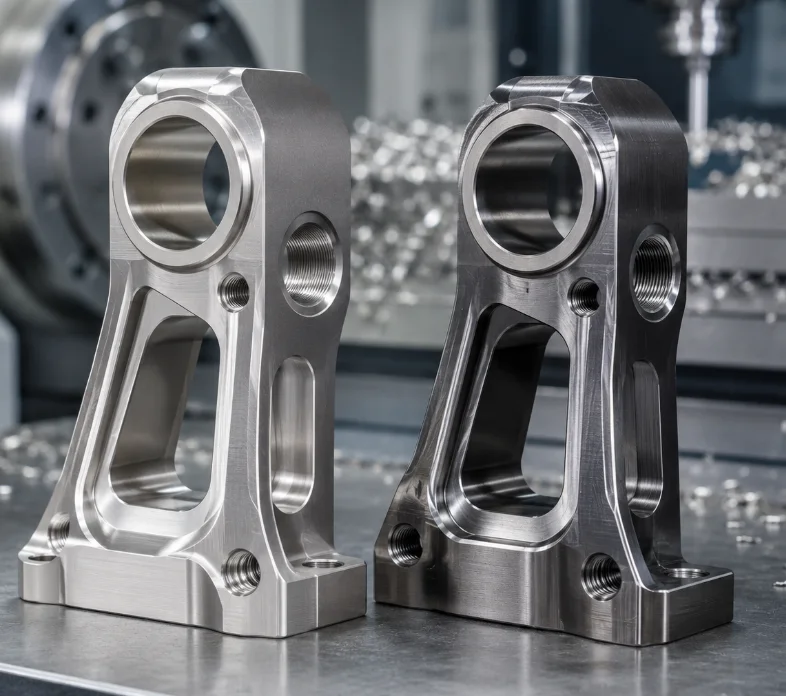
Is titanium stronger than steel? Not always. Some titanium alloys are stronger than common carbon steels and stainless steels, but high-strength steels can exceed titanium in absolute tensile and yield strength. Titanium's main advantage is its combination of high strength and much lower density, giving it an excellent strength-to-weight ratio.
This distinction matters when choosing a material for CNC machining. Titanium is often preferred when weight reduction and corrosion resistance are important, while steel can provide higher stiffness, greater hardness, better wear resistance, easier machining, and lower production cost. If titanium is already being considered for your project, reviewing its material properties, common grades, and machining characteristics can help narrow the selection before comparing it with a specific steel grade.
| Property | Titanium | Steel |
|---|---|---|
| Tensile Strength | High | Very wide range; high-strength grades can be higher |
| Yield Strength | High | High-strength grades can be higher |
| Density | About 4.4–4.5 g/cm³ | About 7.8–8.0 g/cm³ |
| Strength-to-Weight Ratio | Very high | Usually lower |
| Elastic Modulus | About 105–115 GPa | About 190–210 GPa |
| Hardness Potential | Moderate to high | Can be much higher |
| Corrosion Resistance | Excellent | Strongly grade-dependent |
| Magnetic Behavior | Generally non-magnetic | Depends strongly on steel grade |
| Wear Resistance | Moderate; galling can be a concern | Many high-wear grades available |
| Thermal Conductivity | Low | Generally higher |
| CNC Machinability | More difficult | Generally easier |
| CNC Machining Cost | Higher | Usually lower |
These are general differences. The exact comparison depends on the alloy and its condition. Ti-6Al-4V, 304 stainless steel, 17-4 PH, 4140, and 4340 should not be treated as if they have the same mechanical or machining properties simply because they belong to titanium or steel families.
Is Titanium Stronger Than Steel?
Titanium can be stronger than many common steels, but it is not stronger than all steels.
Ti-6Al-4V, also known as Titanium Grade 5, is a high-strength titanium alloy. Depending on material condition, its tensile strength can exceed 900 MPa. This makes it substantially stronger than many low-carbon steels and some common stainless steels.
However, heat-treated alloy steels such as 4340 and ultra-high-strength steels such as 300M can achieve considerably higher tensile and yield strengths.
Titanium is stronger than some steels, while high-strength steels can be stronger than titanium.
The comparison becomes more favorable to titanium when strength is evaluated relative to weight.
Tensile Strength of Titanium vs Steel
Tensile strength represents the maximum tensile stress a material can withstand before fracture.
Titanium Grade 5 provides high tensile strength and is commonly selected when high mechanical performance must be combined with low weight.
Steel has a much broader strength range. Mild steel may have considerably lower tensile strength than Ti-6Al-4V, while heat-treated 4140, 4340, 300M, and other high-strength steels can meet or exceed the tensile strength of common titanium alloys.
This is why comparing simply “titanium vs steel” has limitations. For actual material selection, it is more useful to compare specific grades such as:
- Ti-6Al-4V vs 304 stainless steel
- Ti-6Al-4V vs 17-4 PH
- Ti-6Al-4V vs 4140
- Ti-6Al-4V vs 4340
Yield Strength of Titanium vs Steel
Yield strength represents the stress at which permanent deformation begins.
Titanium alloys such as Ti-6Al-4V provide high yield strength, but high-strength steel grades can reach even higher values after suitable heat treatment.
Yield strength can be more important than ultimate tensile strength when permanent deformation is unacceptable. A material does not need to fracture to become unsuitable. Once stress exceeds its yield strength, permanent deformation can remain after the load is removed.
Therefore, when comparing titanium and steel for load-bearing applications, yield strength should usually be considered alongside tensile strength rather than using tensile strength alone.
Compressive Strength of Titanium vs Steel
Titanium and steel can both withstand high compressive loads, but comparing them using a single “compressive strength” value can be misleading.
For ductile metals such as titanium and steel, compression is often evaluated by considering compressive yield behavior, elastic modulus, alloy grade, material condition, and loading conditions rather than only the stress at which the material completely fails.
High-strength titanium alloys such as Ti-6Al-4V have strong resistance to permanent deformation under compression. High-strength alloy steels can also achieve very high yield strength and generally have a much higher elastic modulus.
Steel's higher stiffness means it undergoes less elastic deformation under the same compressive stress. Titanium, although strong, can deform elastically more because its elastic modulus is only around half that of steel.
Therefore, neither titanium nor steel can simply be described as having universally higher compressive strength. The actual comparison depends on the alloy grade and condition.
For material selection, yield strength is especially important when permanent compression deformation is the main concern, while elastic modulus matters when minimizing deformation under load is important.
Toughness of Titanium vs Steel
Strength and toughness are also different properties.
Toughness describes the ability of a material to absorb energy before fracture. A material with extremely high tensile strength is not automatically the material with the best resistance to cracking or impact.
Both titanium and steel are available in grades designed for different combinations of:
- tensile strength
- yield strength
- elongation
- fatigue resistance
- fracture toughness
This is another reason that no single material can simply be described as “stronger” in every condition.
Is Titanium Lighter Than Steel?
Yes. Titanium is significantly lighter than steel.
Most titanium alloys have densities around 4.4–4.5 g/cm³, while most steels are around 7.8–8.0 g/cm³.
This means titanium has only about 55–60% of the density of steel. For the same material volume, a titanium component can therefore be roughly 40% lighter than a steel component.
This density difference is one of titanium's most important advantages.
Titanium vs Steel Strength-to-Weight Ratio
Titanium's strength-to-weight ratio is generally more impressive than its absolute strength.
A high-strength steel may have higher tensile strength than titanium, but steel is also substantially heavier. Titanium combines relatively high strength with much lower density, so the amount of strength available for each unit of mass can be excellent.
This explains why these two statements have different meanings:
Titanium is stronger than steel.
Titanium has a better strength-to-weight ratio than many steels.
The second statement is generally more accurate.
If reducing weight is a major requirement, titanium can justify its higher material and machining cost. If weight has little effect on performance, steel's higher density may not be a serious disadvantage, making its lower cost and higher stiffness more attractive.
Is Titanium Harder Than Steel?
Generally, no.
Titanium has good strength, but strength should not be confused with hardness.
Steel offers a much wider hardness range. Many steel grades can also be heat treated specifically to achieve very high hardness.
Examples include:
- tool steels
- bearing steels
- hardened alloy steels
- martensitic stainless steels
These materials can achieve hardness levels considerably higher than common titanium alloys such as Ti-6Al-4V.
Hardness becomes particularly important when material selection depends on indentation resistance, abrasive wear, scratching, surface contact, or repeated sliding.
Therefore, titanium may provide a higher strength-to-weight ratio while steel provides better hardness and wear performance.
Does Titanium Dent More Easily Than Steel?
It depends on the grades being compared.
Tensile strength alone cannot predict dent resistance. Denting is a form of local deformation, so yield strength and hardness are generally more relevant. Material thickness, contact area, support conditions, and the type of applied load also matter.
A titanium alloy with high yield strength may resist permanent deformation better than a low-strength steel. However, a hardened high-strength steel may offer much greater resistance to indentation.
High tensile strength does not automatically mean high dent resistance.
When denting or surface damage matters, compare yield strength and hardness rather than tensile strength alone.
Is Titanium More Flexible Than Steel?
Titanium is less stiff than steel.
Common titanium alloys have an elastic modulus of approximately 105–115 GPa, while most steels are around 190–210 GPa.
Steel is therefore almost twice as stiff as titanium.
This often causes confusion because titanium can have very high tensile and yield strength. However, strength and stiffness are not the same property.
Strength tells you how much stress a material can withstand before yielding or breaking. Stiffness tells you how much it elastically deforms under load.
A titanium material can therefore withstand high stress while still undergoing more elastic deformation than steel under the same loading conditions.
If minimizing elastic deflection is a major material requirement, steel can have an advantage even when titanium has an attractive strength-to-weight ratio.
Does Titanium Bend More Easily Than Steel?
Titanium generally undergoes more elastic deformation than steel because of its lower elastic modulus.
However, that does not necessarily mean titanium permanently bends more easily. Permanent bending depends largely on yield strength.
This creates an important distinction:
- Elastic modulus determines how readily the material flexes.
- Yield strength determines when the material begins to stay bent.
- Tensile strength relates to maximum tensile loading before failure.
- Toughness relates to energy absorption before fracture.
A titanium alloy can therefore flex more than steel before unloading while still having high resistance to permanent deformation.
These properties should be evaluated separately during material selection.
Which Has Better Corrosion Resistance: Titanium or Steel?
Titanium generally has excellent corrosion resistance.
A thin, stable oxide film naturally forms on titanium surfaces and protects the underlying material from many corrosive environments.
However, the comparison depends heavily on the type of steel.
Titanium vs Carbon Steel
Titanium generally provides much better corrosion resistance than ordinary carbon steel.
Carbon steels may require additional protection such as:
- painting
- plating
- conversion coatings
- protective oils
when exposed to moisture or corrosive environments.
Titanium often requires no comparable protective coating for many applications.
Titanium vs Stainless Steel
The comparison is closer when titanium is compared with stainless steel.
304 and 316 stainless steels already provide good corrosion resistance and are commonly selected when ordinary carbon steel would corrode too quickly.
Titanium can outperform these materials in particularly aggressive environments, including some chloride-containing or chemical conditions.
However, titanium is usually considerably more expensive.
Therefore, if 304 or 316 already provides sufficient corrosion resistance, stainless steel may offer a more economical material choice.
The comparison should therefore be based on the actual environment rather than simply assuming titanium is always necessary.
Which Has Better Wear Resistance: Titanium or Steel?
Steel generally provides more options for high wear resistance.
One of steel's advantages is its wide range of heat-treatable grades. Hardened alloy steel, tool steel, and bearing steel can provide very high surface hardness and wear resistance.
Titanium behaves differently. Its corrosion resistance is excellent, but its sliding wear performance is not necessarily equally strong.
Titanium can experience adhesive wear and galling under sliding contact.
Does Titanium Gall More Easily Than Steel?
Titanium can have a significant tendency to gall.
Galling occurs when sliding metal surfaces locally adhere to each other. Material can then transfer between the surfaces, creating roughness, seizure, or damage.
The issue can become particularly important for:
- threads
- sliding contact surfaces
- repeated assembly
- titanium-to-titanium contact
This does not mean titanium lacks strength. A titanium alloy can have excellent tensile and yield strength while still having poor behavior under certain sliding-contact conditions.
Where galling is a concern, factors such as mating material, lubrication, surface treatment, coating, and contact pressure may need to be considered.
Some stainless steels can also gall, so this is not exclusively a titanium problem. However, it remains an important difference to evaluate when choosing between titanium and steel.
Is Titanium Magnetic Compared With Steel?
Titanium is generally considered non-magnetic. Common titanium grades such as Grade 2 and Ti-6Al-4V do not behave like conventional ferromagnetic steels, making titanium useful when low magnetic interference is an important material requirement.
Steel, however, should not be treated as one magnetic material category.
Many carbon steels, alloy steels, ferritic stainless steels, and martensitic stainless steels are magnetic. Austenitic stainless steels such as 304 and 316 are generally non-magnetic or only weakly magnetic in the annealed condition, although cold working or machining can increase their magnetic response.
This means the comparison should not simply be:
Titanium = non-magnetic, steel = magnetic.
Instead, the specific steel grade and condition should be checked.
If low magnetic response is an important requirement, titanium provides a more predictable choice than many steel grades, but certain stainless steels may also be suitable.
How Do Titanium and Steel Compare at High Temperatures?
Titanium and steel behave differently as temperature increases, but melting point alone is not enough to determine which material is better for high-temperature use.
The service-temperature limit of an alloy depends on factors such as:
- strength retention
- oxidation
- creep
- fatigue
- exposure time
- material condition
Ti-6Al-4V, for example, has a high melting point, but its recommended continuous service temperatures are far below its melting temperature.
A higher melting point does not automatically mean better high-temperature mechanical performance.
The actual operating temperature and required mechanical properties should determine the choice.
Thermal Conductivity of Titanium vs Steel
Titanium has relatively low thermal conductivity.
This means heat moves through titanium more slowly than through many steels.
This difference matters both during service and during CNC machining. During machining, low thermal conductivity prevents cutting heat from spreading efficiently into the workpiece. More heat can remain concentrated around the tool-workpiece interface.
This is one of the main reasons titanium is considered a difficult material to machine.
Thermal Expansion of Titanium vs Steel
Titanium generally has lower thermal expansion than austenitic stainless steels such as 304.
Lower thermal expansion means the material changes dimension less as its temperature changes.
This can be an advantage when thermal dimensional stability matters.
However, thermal expansion should not be confused with CNC machining accuracy. A material with lower thermal expansion is not automatically easier to machine to tight tolerances.
Titanium vs Steel: Which Is Easier to CNC Machine?
Steel is generally easier to CNC machine than titanium.
Titanium combines several properties that make cutting difficult:
- low thermal conductivity
- concentrated cutting heat
- strong interaction with cutting tools
- lower elastic modulus
- demanding chip control
- relatively high tool wear
Successful titanium CNC machining therefore requires greater attention to machining parameters and process stability.
Why Is Titanium Difficult to CNC Machine?
Low Thermal Conductivity
In many easily machinable metals, part of the cutting heat travels into the workpiece and chips.
Titanium transfers heat relatively slowly. As a result, a greater amount of heat remains concentrated close to the cutting edge.
This can increase:
- tool temperature
- edge wear
- coating degradation
- risk of premature tool failure
Effective coolant delivery therefore becomes particularly important in titanium machining.
Lower Material Stiffness
Titanium's lower elastic modulus can also influence machining behavior.
Under cutting forces, titanium can elastically deflect more than steel.
This can make dimensional control more demanding where the workpiece or unsupported section lacks sufficient rigidity.
Tool Wear
Titanium generally places greater demands on cutting tools than common steels.
Stable machining usually requires:
- sharp carbide tooling
- rigid workholding
- appropriate cutting speed
- controlled feed
- effective coolant
- consistent tool engagement
- close monitoring of tool wear
Titanium should not simply be machined using the same cutting parameters used for ordinary steel.
Is Steel Easier to CNC Machine Than Titanium?
Usually, yes.
However, the answer also depends on the steel grade.
Steel covers a very broad material family. Some steels are specifically formulated for excellent machinability, while others are relatively difficult to cut.
Free-machining steel: generally very easy to machine.
Low-carbon steel: normally manageable with conventional CNC tooling.
304 and 316 stainless steel: more demanding because of their cutting behavior and tendency to work harden.
Heat-treated 4140 and 4340: increasingly difficult to machine as hardness rises.
Hardened tool steel: may require specialized hard turning, grinding, EDM, or other processes.
Therefore, it is more accurate to compare Ti-6Al-4V with a specific steel grade than to say that every steel is easy to machine.
Even so, titanium generally remains more demanding than most commonly machined steels.
Can Titanium Be CNC Machined to Tighter Tolerances Than Steel?
Titanium can be machined to very tight tolerances, but titanium does not inherently provide tighter CNC tolerances than steel.
This misconception can arise because titanium has relatively low thermal expansion.
Lower thermal expansion can improve dimensional stability as temperature changes, but CNC tolerance capability depends on many other factors. For a broader explanation of how material, geometry, tooling, workholding, heat, and inspection affect final accuracy, see this guide to controlling CNC machining tolerances.
These factors include:
- machine accuracy
- cutting force
- workholding
- tool deflection
- workpiece stiffness
- tool wear
- machining heat
- residual stress
- machining sequence
- finishing method
- inspection conditions
Steel's greater stiffness can sometimes make dimensional control easier during machining.
Steel also offers manufacturing advantages for some precision finishing processes, depending on the grade and required geometry.
Low thermal expansion does not mean titanium is automatically easier to machine accurately.
Both titanium and steel can achieve tight CNC tolerances when the machining process is properly controlled.
When the requirement involves a specific shaft-and-hole fit rather than a general dimensional tolerance, the ISO hole and shaft tolerance calculator can be used to check tolerance limits and fit relationships before sending the drawing for quotation.
Can Titanium and Steel Achieve the Same CNC Surface Finish?
Both titanium and steel can achieve high-quality machined surfaces.
The achievable surface finish depends more on the complete machining process than on material name alone.
Important factors include:
- cutting tool geometry
- tool sharpness
- cutting speed
- feed rate
- machine rigidity
- vibration
- coolant
- finishing allowance
- material grade
Titanium can be more demanding because concentrated cutting heat and tool wear can affect surface quality.
Steel generally offers a wider range of proven tooling and machining strategies. This can make achieving consistent surface finish more straightforward for many steel grades.
Is Titanium More Expensive to CNC Machine Than Steel?
Usually, yes.
Titanium CNC machining normally costs more because both the material and the machining process are more expensive.
Higher Raw Material Cost
Titanium bar, plate, and billet generally cost considerably more than common carbon and stainless steels.
This becomes especially important when the manufacturing process removes a large amount of material.
Longer Machining Time
Titanium commonly requires more conservative machining conditions than easily machinable steels.
Longer cycle times increase machine cost.
Higher Tooling Cost
Tool wear can be higher during titanium machining because cutting heat is concentrated around the tool edge.
This can increase:
- cutting tool consumption
- tool changes
- setup monitoring
- machine downtime
More Demanding Process Control
Titanium may also require greater attention to:
- coolant delivery
- tool engagement
- workholding
- temperature control
- tool condition
Therefore, comparing only raw material price does not show the full cost difference.
A better comparison is the finished CNC machining cost.
Common Titanium and Steel Grades for CNC Machining
The specific grade can change strength, corrosion resistance, hardness, and machinability significantly.
| Material | Main Characteristics | CNC Machinability |
|---|---|---|
| Titanium Grade 2 | Excellent corrosion resistance, lower strength than Grade 5 | Difficult compared with many common steels |
| Titanium Grade 5 / Ti-6Al-4V | High strength and excellent strength-to-weight ratio | Common CNC titanium grade but demanding to machine |
| Titanium Grade 23 / Ti-6Al-4V ELI | Ti-6Al-4V variant with lower interstitial content | Similar fundamental machining challenges to Grade 5 |
| 304 Stainless Steel | Good corrosion resistance and general availability | Moderate to difficult |
| 316/316L Stainless Steel | Strong corrosion resistance | Moderate to difficult |
| 17-4 PH | High strength and good corrosion resistance | Depends strongly on material condition |
| 4140 Alloy Steel | Heat-treatable engineering steel | Generally good before high hardness |
| 4340 Alloy Steel | High-strength alloy steel | More difficult as hardness increases |
Grade selection should therefore come before making detailed manufacturing decisions.
Specifying simply “titanium” or “steel” is usually insufficient for serious CNC sourcing.
Titanium vs Steel: Which Material Should You Choose?
There is no universal winner. Titanium and steel solve different material-selection problems.
Choose Titanium When
Titanium is generally more attractive when the priorities include:
- low density
- low weight
- high strength-to-weight ratio
- excellent corrosion resistance
- relatively low thermal expansion
- low magnetic response
Its main disadvantages are higher material cost and more demanding CNC machining.
Choose Steel When
Steel is generally more attractive when the priorities include:
- high stiffness
- high absolute strength
- high hardness
- strong wear resistance
- broad material availability
- easier CNC machining
- lower finished manufacturing cost
| Requirement | Usually Favors |
|---|---|
| Lowest Material Weight | Titanium |
| High Strength-to-Weight Ratio | Titanium |
| Maximum Stiffness | Steel |
| Very High Hardness | Steel |
| Severe Corrosion Resistance | Often titanium |
| Low Magnetic Response | Often titanium, depending on steel grade |
| Wear Resistance | Often steel |
| Easier CNC Machining | Steel |
| Lower CNC Manufacturing Cost | Steel |
| Lower Thermal Expansion Than Austenitic Stainless Steel | Titanium |
| Extremely High Absolute Strength | Certain high-strength steels |
The final decision should always compare specific alloy grades and conditions instead of relying on broad titanium-versus-steel generalizations.
How RapidMFGPro Helps With Titanium and Steel CNC Machining
After choosing the material, the next challenge is finding a CNC manufacturer with suitable experience.
A supplier that commonly machines mild steel does not necessarily have the same experience machining Ti-6Al-4V. Likewise, machining 304 stainless steel, hardened 4340, and titanium can require different tooling, cutting strategies, equipment, and inspection capabilities.
RapidMFGPro helps buyers find manufacturers familiar with the specified material and manufacturing requirements.
The service can help:
- find manufacturers experienced with titanium or steel CNC machining;
- review supplier qualifications and manufacturing capability;
- match different precision requirements with suitable manufacturers;
- evaluate CNC milling, CNC turning, tolerance, inspection, material, finish, and production quantity requirements;
- connect buyers directly with the selected manufacturer.
RapidMFGPro has access to manufacturing resources for different industries and precision levels, including high-precision and more demanding projects.
Supplier matching can typically be completed within 1–2 days. The matching process is designed around the buyer's manufacturing requirements without hidden or malicious charges.
If a recommended supplier does not meet expectations, buyers can provide feedback so the supplier can be reviewed and another suitable manufacturer can be considered.
For titanium projects in particular, this helps avoid choosing a supplier based only on a general “CNC machining” capability when actual titanium machining experience is required.
FAQs
Is Titanium Actually Stronger Than Steel?
Titanium is stronger than many common steels, but some high-strength steels can exceed titanium in tensile and yield strength. Titanium's main advantage is its high strength relative to its low weight.
Is Titanium Stronger Than Stainless Steel?
Ti-6Al-4V can be stronger than common stainless steels such as annealed 304 and 316. However, high-strength stainless grades such as precipitation-hardening stainless steels can significantly reduce the difference.
Is Titanium Harder Than Steel?
Not generally. Hardened alloy steels, tool steels, and bearing steels can achieve much higher hardness than common titanium alloys.
Is Titanium More Flexible Than Steel?
Yes, in the sense that titanium is less stiff. Its elastic modulus is approximately half that of steel, so it undergoes more elastic deformation under the same stress.
Is Titanium Lighter Than Steel?
Yes. Titanium has a density of roughly 4.5 g/cm³ compared with approximately 7.8–8.0 g/cm³ for most steels.
Is Titanium Magnetic?
Titanium is generally considered non-magnetic. Many steels are magnetic, but stainless steels such as annealed 304 and 316 can have very low magnetic response.
Does Titanium Have Better Wear Resistance Than Steel?
Not necessarily. Steel offers many hardenable grades with excellent wear resistance, while titanium can experience galling under sliding contact.
Is Titanium Harder to CNC Machine Than Steel?
Generally, yes. Titanium has low thermal conductivity, produces concentrated cutting heat, and places greater demands on tooling and process control.
Can Titanium Be CNC Machined to Tight Tolerances?
Yes. Titanium can achieve tight tolerances, but it does not inherently provide tighter CNC tolerances than steel. Final accuracy depends on the complete machining and inspection process.
Why Is Titanium CNC Machining More Expensive?
Titanium stock is more expensive, machining cycles are often longer, tool wear can be higher, and the manufacturing process generally requires greater control.
Conclusion
Titanium is not universally stronger than steel.
High-strength steels can exceed titanium in absolute tensile strength, yield strength, stiffness, hardness, and wear resistance. Titanium's major advantage is its combination of high strength, low density, excellent strength-to-weight ratio, corrosion resistance, and low magnetic response.
For CNC machining, steel is generally easier and less expensive to process. Titanium requires greater control of cutting heat, tool wear, cutting conditions, and workpiece behavior.
The better material therefore depends on whether the priority is weight, corrosion resistance, and strength-to-weight ratio or stiffness, hardness, machinability, wear resistance, and cost. The final comparison should always be made between specific titanium and steel grades rather than treating either material family as a single set of properties.