Time to read: 20 min
What Is Hard Metal and When Do You Need to Consider It?
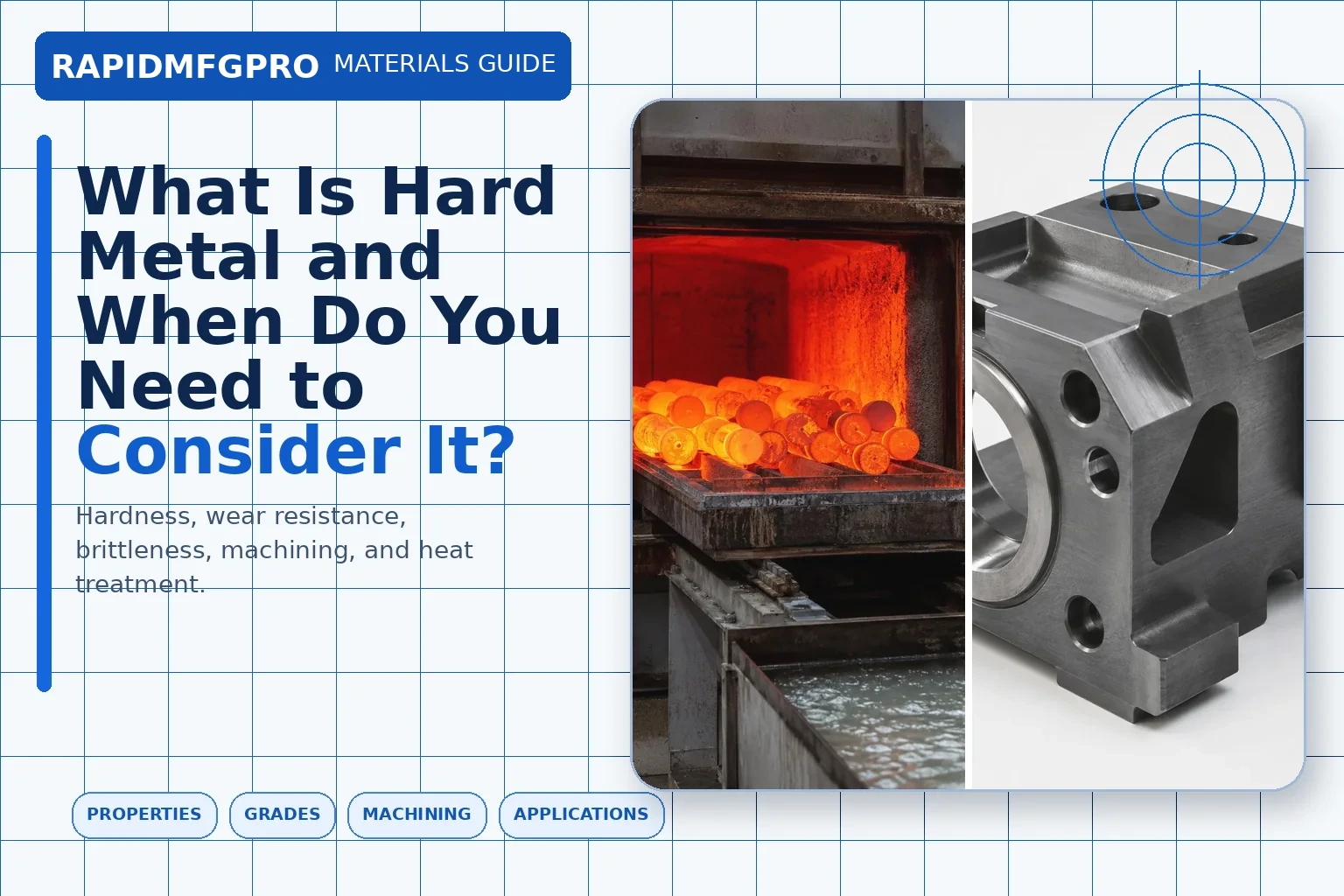
The phrase “hard metal” can describe two different material concepts. In general engineering discussion, it may refer to metals that have high hardness after alloying, cold working, or heat treatment. In the cutting-tool and powder-metallurgy industries, the single word “hardmetal” commonly refers to cemented carbide, a sintered composite containing hard carbide particles and a metallic binder.
This distinction matters because hardened steel and cemented carbide are not selected, manufactured, or inspected in the same way. Hardened steel can provide a useful balance of hardness, toughness, machinability, and cost. Cemented carbide can provide much greater wear resistance and compressive strength, but it is more brittle and usually requires powder-metallurgy production, grinding, or electrical discharge machining.
A harder material is not automatically a better part material. Excessive hardness can reduce impact resistance, increase cracking risk, complicate machining, and raise manufacturing cost. The correct decision depends on the type of wear, contact pressure, temperature, impact, fatigue, lubrication, geometry, production quantity, and required service life.
RapidMFGPro evaluates hard-metal projects from a manufacturing supplier-matching perspective. The platform reviews the required hardness, material system, product form, geometry, quantity, heat treatment, grinding, coating, inspection, and operating conditions before identifying suppliers with suitable hard machining, powder metallurgy, heat-treatment, EDM, grinding, and quality-control capabilities.
This guide explains what hard metal means, when hardness should control material selection, how hard metals differ from tough metals, and how to prepare a realistic hard-metal part project.
What Does Hard Metal Mean?
Hard metal can mean a high-hardness metallic material or a specific class of cemented carbide. Engineers should clarify which meaning applies before selecting a grade or requesting a quotation.
General Engineering Meaning
In general engineering language, hard metal may refer to hardened alloy steel, tool steel, bearing steel, martensitic stainless steel, cobalt alloy, or another metal that resists indentation and wear.
The hardness may come from carbon content, alloying, cold work, quenching, tempering, aging, carburizing, nitriding, or another strengthening process.
Powder-Metallurgy Meaning
In powder metallurgy, hardmetal normally refers to cemented carbide. The material contains hard ceramic carbide particles bonded by a metallic phase.
Tungsten carbide with a cobalt-rich binder is the most common system, although titanium carbide, tantalum carbide, niobium carbide, nickel binders, and other compositions may be used.
Drawing Terminology
A drawing should not state only hard metal. It should identify the exact steel grade, carbide grade, binder content, grain class, hardness, coating, and applicable standard.
Without this information, different suppliers may quote completely different materials.
| Term Usage | Typical Material | Production Route | Common Application |
|---|---|---|---|
| General hard metal | Hardened steel or hard alloy | Melting, forming, machining, heat treatment | Shafts, gears, dies, wear plates |
| Hardmetal | Cemented carbide | Powder pressing, sintering, grinding | Cutting tools, dies, nozzles, wear inserts |
When Do You Need a Hard Material?
A hard material is needed when surface deformation or material loss controls part life. The wear mechanism should be identified before a hardness target is selected.
Abrasive Wear
Abrasive wear occurs when hard particles or rough surfaces cut, scratch, or plow the part surface.
Mining tools, powder-handling components, guide surfaces, dies, and agricultural wear parts may require high hardness.
Rolling Contact
Bearings, rollers, cam followers, and gear teeth experience repeated concentrated contact.
High hardness, surface quality, material cleanliness, residual stress, and fatigue resistance are all important.
Cutting Contact
Cutting tools must remain harder than the workpiece while resisting heat, wear, and edge chipping.
Tool steels, high-speed steels, cemented carbides, cermets, ceramics, and superhard materials may be considered.
High Contact Pressure
Punches, dies, valve seats, forming rolls, and wear inserts can experience intense local pressure.
Compressive strength and support geometry may be more important than tensile strength.
When Is Hardness Not the Main Requirement?
Hardness should not dominate selection when the part is controlled by impact, bending, fatigue, corrosion, conductivity, weight, or weldability.
Impact Loading
Brittle hard materials can crack under sudden impact.
A tougher alloy steel may survive a hammering or shock-loaded application better than cemented carbide.
Flexible Components
Springs, clips, diaphragms, and flexible links require elastic strength and fatigue resistance.
Maximum surface hardness may reduce forming capability or cause early cracking.
Welded Structures
Very hard steels are generally more difficult to weld and may crack in the heat-affected zone.
Low-carbon or controlled-alloy structural steel may be more suitable for frames and large weldments.
Corrosive Service
A hard carbon steel may fail rapidly if corrosion creates pits or removes the hardened surface.
Stainless steel, titanium, nickel alloy, coating, or corrosion allowance may be more important than maximum hardness.
What Is the Difference Between Hardness and Strength?
Hardness and strength are related in some metals, but they describe different behavior. A hard material resists local indentation, while a strong material resists applied stress.
Hardness
Hardness measures resistance to localized plastic deformation.
It is commonly used to evaluate heat treatment, wear surfaces, cutting tools, and case-hardened layers.
Yield Strength
Yield strength describes the stress at which permanent bulk deformation begins.
It is important for brackets, shafts, frames, pressure components, and structural parts.
Tensile Strength
Tensile strength is the maximum tensile stress reached before fracture in a tensile test.
It does not directly describe wear or impact performance.
Compressive Strength
Compressive strength is especially important for cemented carbide, ceramic-containing materials, dies, and contact-loaded inserts.
A material can be very strong in compression but weak in bending or impact.
What Is the Difference Between Hardness and Toughness?
Toughness describes the ability to absorb energy before fracture. Hardness and toughness often compete with each other.
Hard but Brittle
Cemented carbide, ceramic, and highly hardened tool steel can resist wear but may chip or crack under impact.
Edge geometry and support are critical.
Tough but Softer
Tempered alloy steel can absorb impact and tolerate bending while providing moderate wear resistance.
It may be more suitable for hammers, impact tools, shafts, and shock-loaded machine parts.
Property Balance
Tooling and wear parts often require the highest hardness that still provides enough toughness for the actual load.
Grade selection should be based on failure history and operating conditions.
How Is Metal Hardness Measured?
Hardness tests use different indenters, loads, and measurement methods. The correct scale depends on material type, thickness, surface treatment, and expected hardness.
Rockwell Testing
Rockwell testing measures indentation depth under controlled load.
Rockwell C is commonly used for hardened steels, while other scales serve softer metals or different thickness ranges.
Vickers Testing
Vickers testing measures the diagonal dimensions of a diamond indentation.
It can be used for a wide hardness range, thin sections, coatings, and case-depth profiles.
Brinell Testing
Brinell testing uses a larger ball indentation.
It is common for castings, forgings, structural steels, and materials with nonuniform microstructure.
Shore Testing
Shore hardness methods may be used for rebound testing or selected hard materials.
The method should not be confused with Shore scales used for polymers.
How Is Hardmetal Hardness Measured?
Cemented carbide is generally too hard for many conventional steel hardness methods. Vickers and Rockwell A testing are commonly used, along with microstructural and material-property checks.
Vickers Hardness
Vickers hardness is widely used to compare cemented carbide grades.
Surface preparation, test load, grain size, binder content, and porosity influence the result.
Rockwell A
Rockwell A can provide rapid production checks for hardmetal.
It is less detailed than microhardness analysis but useful for lot comparison.
Hardness Limitation
Hardness alone does not define carbide grade performance.
Fracture toughness, transverse rupture strength, binder distribution, grain size, and defect level must also be considered.
What Types of Hard Metal Are Common?
Hard-metal part projects may use bulk hardened steels, surface-hardened steels, cemented carbides, cermets, cobalt alloys, or coated substrates.
Hardened Alloy Steel
Alloy steel can be quenched and tempered to provide strength, hardness, and toughness.
It is used for shafts, gears, pins, rollers, and heavy-duty machine components.
Tool Steel
Tool steel is designed for cutting, forming, molding, or wearing against other materials.
Cold-work, hot-work, shock-resistant, and high-speed grades serve different conditions.
Bearing Steel
Bearing steel provides high hardness, rolling-contact fatigue resistance, and dimensional stability.
Cleanliness and heat treatment are critical.
Cemented Carbide
Cemented carbide contains hard carbide particles and a metallic binder.
It is used for cutting tools, wear inserts, dies, nozzles, mining components, and precision gauges.
Cermet
Cermets contain ceramic hard phases and metallic binders, often using titanium carbonitride systems.
They are used for finishing tools and applications requiring wear resistance and chemical stability.
Hard Coated Metal
A tough steel or carbide substrate can receive a thin hard coating.
PVD, CVD, DLC, nitriding, and hard chrome can improve surface performance without making the entire component equally hard.
| Material System | Main Advantage | Main Limitation | Typical Part |
|---|---|---|---|
| Hardened alloy steel | Strength and toughness | Heat-treatment distortion | Shaft or gear |
| Tool steel | Wear resistance | Cost and cracking risk | Die or punch |
| Bearing steel | Rolling-contact fatigue | Cleanliness and grinding requirements | Bearing race |
| Cemented carbide | Extreme hardness and compressive strength | Brittleness | Cutting insert |
| Cermet | Wear and chemical stability | Lower impact resistance | Finishing insert |
| Hard coating on steel | Hard surface with tough core | Coating adhesion and thickness | Sliding component |
Which Hardened Steel Grades Are Common?
Hardened steel selection depends on required hardness, section size, toughness, wear, fatigue, machining, and heat-treatment response.
AISI 4140 Steel
AISI 4140 is a chromium-molybdenum alloy steel used for shafts, gears, fixtures, bolts, rollers, and high-load components.
It can be supplied prehardened or quenched and tempered to a specified range.
AISI 4340 Steel
AISI 4340 provides higher toughness and hardenability than many general alloy steels.
It is used for aircraft components, heavy shafts, gears, axles, and impact-loaded parts.
AISI 52100 Steel
AISI 52100 is a high-carbon chromium bearing steel.
It is used for bearing races, rollers, balls, gauges, and high-hardness wear parts.
440C Stainless Steel
440C is a high-carbon martensitic stainless steel capable of high hardness.
It is used for bearings, valve components, knives, precision tools, and corrosion-resistant wear parts.
Which Tool Steel Grades Are Common?
Tool steels are divided according to the wear, impact, temperature, dimensional stability, and manufacturing conditions they are designed to resist.
D2 Tool Steel
D2 provides high wear resistance and useful dimensional stability.
It is used for blanking dies, punches, shear blades, molds, and wear inserts.
A2 Tool Steel
A2 provides a more balanced combination of wear resistance and toughness than many high-wear grades.
It is used for forming tools, gauges, dies, and precision wear components.
S7 Tool Steel
S7 is designed for shock resistance.
It is used for chisels, punches, impact tools, and applications where D2 may be too brittle.
H13 Tool Steel
H13 resists thermal fatigue and softening at elevated tool temperature.
It is used for die-casting dies, hot forging, extrusion tooling, and molds.
M2 High-Speed Steel
M2 retains hardness at cutting temperature.
It is used for drills, taps, broaches, cutters, and wear-resistant precision parts.
What Is Cemented Carbide?
Cemented carbide is a powder-metallurgy composite in which hard carbide grains are bonded by a metallic binder. It combines ceramic-like hardness with greater toughness than a fully ceramic material.
Tungsten Carbide Phase
Tungsten carbide provides hardness, wear resistance, and compressive strength.
Grain size affects edge strength, toughness, and wear behavior.
Cobalt Binder
Cobalt is a common binder that holds the carbide grains together.
Increasing binder content generally improves toughness while reducing hardness and wear resistance.
Mixed Carbides
Titanium carbide, tantalum carbide, and niobium carbide may be added to improve hot hardness, crater wear resistance, or chemical stability.
These grades are common in metal-cutting applications.
Nickel Binder
Nickel-bonded carbide may be used where corrosion resistance or magnetic behavior differs from conventional cobalt-bonded grades.
Mechanical performance and cost should be evaluated for the exact composition.
How Does Binder Content Change Carbide?
Binder content is one of the main variables controlling cemented carbide hardness and toughness.
Low Binder Content
Low binder content generally increases hardness and wear resistance.
The material becomes more sensitive to impact, edge chipping, and tensile stress.
High Binder Content
Higher binder content improves toughness and impact tolerance.
Hardness and abrasion resistance generally decrease.
Application Balance
Fine finishing inserts may use a harder grade, while mining buttons and impact-loaded wear parts may require a tougher grade.
Binder percentage should not be selected without considering grain size and geometry.
How Does Grain Size Change Carbide?
Carbide grain size influences hardness, edge sharpness, toughness, wear, and sintering behavior.
Ultrafine Grain
Ultrafine grades can provide high hardness and sharp cutting edges.
They are used for micro-tools, precision cutting, and small wear components.
Medium Grain
Medium-grain grades provide a broad balance of wear resistance and toughness.
They are widely used for general cutting and wear applications.
Coarse Grain
Coarser grades may provide greater fracture toughness under heavy loading.
They are used in mining, crushing, and severe-impact applications.
Grain Uniformity
Abnormal grain growth or uneven distribution can create weak regions.
Metallographic inspection may be required for critical grades.
When Should You Choose Cemented Carbide?
Cemented carbide should be considered when wear, compressive loading, edge retention, or temperature exceeds the practical range of hardened steel.
Long Wear Life
Carbide can provide substantially longer service life in abrasive contact.
This may justify higher initial cost in automated or difficult-to-access equipment.
High Cutting Speed
Carbide cutting tools retain hardness at higher cutting temperatures than high-speed steel.
This supports higher productivity in machining.
High Compressive Load
Carbide performs well in dies, rolls, seats, and supported inserts under compressive loading.
Tensile bending and impact should be minimized.
Dimensional Stability
Properly produced carbide can maintain wear dimensions for long periods.
Gauges, guide bushings, and precision tooling benefit from this stability.
When Should You Avoid Cemented Carbide?
Cemented carbide may be unsuitable when impact, bending, complex joining, large size, low cost, or field repair controls the project.
Heavy Impact
Unsupported carbide edges can chip under shock.
Tougher steel or a protected carbide insert may be more reliable.
Thin Flexible Geometry
Carbide has limited tolerance for elastic bending.
Thin springs, clips, and flexible arms should use another material.
Large Structural Parts
Producing a large solid carbide body is expensive and unnecessary in many applications.
A steel body with local carbide inserts may provide better cost and toughness.
On-Site Repair
Carbide cannot be welded and repaired like ordinary steel.
Replaceable insert designs are preferable for service equipment.
How Does Carbide Compare With Hardened Steel?
Carbide and hardened steel are common alternatives for wear parts, tooling, guides, and dies.
Hardness Comparison
Cemented carbide is generally much harder than hardened steel.
It provides better abrasion resistance under suitable loading.
Toughness Comparison
Hardened and tempered steel is generally tougher.
It is better for impact, bending, and structural support.
Manufacturing Comparison
Steel can be conventionally machined before hardening and ground afterward.
Carbide is pressed and sintered, then commonly ground or EDM-finished.
Cost Comparison
Carbide raw material and finishing are more expensive.
Longer service life may reduce total operating cost.
| Selection Factor | Cemented Carbide | Hardened Steel |
|---|---|---|
| Hardness | Very high | High |
| Abrasion resistance | Excellent | Good to very good |
| Impact toughness | Low to moderate by grade | Moderate to high |
| Conventional machining | Limited after sintering | Practical before hardening |
| Part size | Usually smaller inserts or tools | Small to very large parts |
| Repairability | Limited | Better |
What Is a Cermet?
A cermet is a composite containing ceramic hard phases and a metallic binder. It is related to cemented carbide but can use different hard-phase chemistry.
Titanium Carbonitride
Many cutting-tool cermets use titanium carbonitride as the principal hard phase.
Nickel or cobalt may form the binder.
Surface Finish
Cermets can provide good chemical stability and a smooth finish in steel machining.
They are often used for finishing and semi-finishing.
Impact Limitation
Cermets are generally less tolerant of interrupted cutting and heavy shock than tough carbide grades.
Stable cutting conditions are preferred.
What Is a Hard Coating?
A hard coating is a thin surface layer applied to a tougher substrate. It improves surface behavior without replacing the bulk material.
PVD Coating
Physical vapor deposition produces thin coatings such as TiN, TiAlN, CrN, and DLC-related systems.
It is used on cutting tools, molds, dies, medical parts, and sliding components.
CVD Coating
Chemical vapor deposition can create thicker, wear-resistant layers on carbide cutting inserts and tooling.
Process temperature may affect the substrate.
DLC Coating
Diamond-like carbon reduces friction and improves wear in selected sliding applications.
Adhesion and contact pressure must match the coating system.
Hard Chrome
Hard chrome plating provides wear resistance, low friction, and dimensional buildup.
Environmental restrictions, cracking, hydrogen embrittlement, and coating thickness require review.
When Is Surface Hardening Better?
Surface hardening is useful when the part needs a wear-resistant surface and a tough core.
Carburizing
Carburizing adds carbon to the surface of low-carbon alloy steel before hardening.
It is used for gears, cams, shafts, and pins.
Nitriding
Nitriding introduces nitrogen and creates a hard surface with relatively low distortion.
It is used for gears, molds, screws, shafts, and tooling.
Induction Hardening
Induction hardening selectively heats and quenches local surfaces.
It is used for gear teeth, shaft journals, pins, and rails.
Boriding
Boriding forms very hard boride layers for severe abrasion.
Brittleness, layer thickness, and process temperature should be considered.
Which Material Fits Each Wear Mechanism?
Wear type should guide material selection more directly than a single hardness value.
Abrasion
Cemented carbide, high-chromium tool steel, borided steel, or wear-resistant alloy may be selected.
Particle size, hardness, angle, and velocity affect the choice.
Adhesive Wear
Sliding surfaces can transfer material and gall.
Coatings, lubrication, material pairing, and surface finish may be more important than bulk hardness.
Erosion
High-velocity particles or fluid droplets can remove material.
Carbide, ceramic, hard coating, or erosion-resistant alloy may be used.
Rolling Fatigue
Bearing steel and carburized alloy steel provide hard surfaces and controlled fatigue performance.
Cleanliness and compressive residual stress are important.
Thermal Fatigue
Hot-work tool steel and selected cobalt or nickel alloys resist repeated heating and cooling.
Maximum hardness alone does not prevent heat checking.
How Is Cemented Carbide Manufactured?
Cemented carbide is produced through powder preparation, forming, sintering, and precision finishing. It is not made by ordinary casting.
Powder Preparation
Carbide powder, binder powder, additives, and pressing aids are mixed to a controlled composition.
Contamination and particle distribution influence final properties.
Compaction
Powder is pressed into a green compact using uniaxial pressing, cold isostatic pressing, extrusion, or another forming method.
The compact is oversized because it will shrink during sintering.
Green Machining
Some geometry can be machined before sintering while the compact is relatively soft.
Handling is delicate because the green part has limited strength.
Sintering
Sintering heats the compact so the binder phase densifies and bonds the carbide structure.
Shrinkage, carbon balance, atmosphere, temperature, and time require tight control.
Hot Isostatic Pressing
Hot isostatic pressing may reduce residual porosity and improve consistency.
It is used for critical grades and demanding wear parts.
How Is Hard Metal CNC Machined?
The machining route depends on whether the material is prehardened steel, fully hardened steel, green carbide, sintered carbide, or a coated component.
Prehardened Steel Machining
Prehardened mold and alloy steels can be milled and turned with suitable carbide tooling.
Machine rigidity and heat control are important.
Hard Milling
Hardened tool steel can be finish milled using coated carbide or other specialized tools.
Small engagement, stable toolpaths, and limited runout help protect the cutting edge.
Hard Turning
Hardened steel can be turned with CBN or ceramic inserts in selected applications.
Surface integrity should be validated when replacing grinding.
Green Carbide Machining
Carbide compacts can be machined before sintering.
Sintering shrinkage must be predicted and compensated.
Sintered Carbide Machining
Conventional cutting is very limited after sintering.
Diamond grinding, EDM, laser processing, and lapping are commonly used.
How Is Hard Metal Ground?
Grinding is a primary finishing method for hardened steel and cemented carbide. It establishes precision dimensions, sharp edges, and controlled surfaces.
CBN Grinding
Cubic boron nitride wheels are used for hardened ferrous materials.
Wheel grade, speed, dressing, coolant, and feed affect surface integrity.
Diamond Grinding
Diamond wheels are used for cemented carbide and other non-ferrous hard materials.
They are generally not preferred for grinding ordinary hardened steel because of chemical interaction.
Grinding Burn
Excessive heat can soften, reharden, crack, or damage hardened steel.
Grinding burn inspection may be required for critical parts.
Carbide Edge Chipping
Aggressive grinding or poor support can chip carbide edges.
Wheel condition, feed, coolant, and edge geometry should be controlled.
How Is EDM Used for Hard Metal?
Electrical discharge machining removes electrically conductive material without conventional cutting force. It is useful for hardened steel and cemented carbide.
Wire EDM
Wire EDM produces profiles, slots, punches, dies, and intricate through-features.
Taper, wire diameter, flushing, and recast layer affect the result.
Sinker EDM
Sinker EDM creates cavities, blind features, ribs, and complex mold geometry.
Electrode wear and surface finish must be planned.
Recast Layer
EDM can leave a thermally altered recast layer.
Critical fatigue or edge surfaces may require polishing, grinding, or additional passes.
Carbide EDM Risk
Poor EDM parameters can create microcracks or binder damage in carbide.
Experienced process control is required.
How Are Carbide Inserts Joined to Steel?
Many wear components use a steel body for toughness and a carbide insert for local wear resistance.
Brazing
Carbide inserts can be brazed into steel holders.
Filler alloy, joint clearance, heating rate, cooling, and thermal expansion mismatch require control.
Shrink Fitting
Interference and thermal assembly can retain carbide inserts without filler metal.
Contact pressure must not exceed carbide tensile capability.
Mechanical Retention
Screws, wedges, clamps, and pockets are used for replaceable cutting and wear inserts.
Support surfaces should distribute load evenly.
Adhesive Bonding
Adhesives may be used for low-temperature, low-impact applications.
Surface preparation and service temperature limit suitability.
How Should Hard-Metal Parts Be Designed?
Hard-metal design should reduce tensile stress, avoid unsupported edges, support the wear surface, and allow realistic finishing and inspection.
Avoid Sharp Internal Corners
Sharp corners concentrate stress and are difficult to grind.
Radii improve strength and manufacturing stability.
Support Carbide Inserts
Carbide performs best under compression with full support.
Gaps, uneven seats, and point loading can cause fracture.
Use Edge Preparation
A sharp edge cuts efficiently but chips easily.
Chamfers, hones, radii, and land geometry balance sharpness and strength.
Control Wall Thickness
Very thin carbide walls are fragile during sintering, grinding, assembly, and service.
Uniform sections reduce sintering distortion.
Allow Grinding Access
Precision surfaces should be reachable by a suitable wheel.
Deep narrow grooves and hidden corners can increase cost or require EDM.
Plan Replaceability
High-wear inserts should be replaceable when possible.
This reduces repair cost and protects the main assembly.
How Should Hardened Steel Parts Be Designed?
Hardened steel design should account for heat-treatment distortion, cracking, grinding allowance, fatigue, and coating.
Use Uniform Sections
Uneven section thickness causes uneven heating and quenching.
Smooth transitions reduce distortion and cracking.
Add Finish Allowance
Bearing seats, seal faces, and precision datums may require grinding after hardening.
The drawing should include sufficient stock.
Reduce Notches
Threads, grooves, holes, and sharp corners can initiate cracks.
Fillets and controlled surface finish improve fatigue performance.
Control Decarburization
High-temperature processing can reduce carbon at the surface.
Protective atmosphere and post-treatment stock removal may be required.
Which Hard Material Fits the Quantity?
Production quantity influences whether the project should use hardened stock, custom heat treatment, replaceable carbide inserts, powder pressing, or dedicated tooling.
Prototype Quantity
Hardened steel or standard carbide blanks may support prototypes without custom pressing tools.
Wire EDM and grinding can create complex prototype geometry.
Pilot Quantity
Pilot production validates wear life, heat-treatment distortion, grinding time, insert retention, and inspection.
It can confirm whether the hardness target is appropriate.
Production Quantity
High volume may justify dedicated carbide pressing tools, near-net compaction, automated grinding, or replaceable insert systems.
Tooling cost should be compared with material and cycle-time savings.
| Production Route | Typical Quantity | Main Advantage | Main Limitation |
|---|---|---|---|
| Machine then heat treat steel | Prototype to medium volume | Flexible geometry | Distortion |
| Machine prehardened steel | Prototype to medium volume | No final quench | Higher cutting force |
| Standard carbide blank | Prototype to low volume | No custom pressing tool | Grinding waste |
| Custom pressed carbide | Medium to high volume | Near-net geometry | Tooling and shrinkage control |
| Steel body with carbide insert | Low to high volume | Balanced toughness and wear | Joint design |
Where Are Hard Metals Used?
Hard metals are used where ordinary metals lose dimensions, edges, or surface condition too quickly.
Cutting Tools
Cemented carbide, cermet, high-speed steel, and coated tools are used for turning, milling, drilling, threading, and grooving.
Workpiece material and cutting condition determine grade selection.
Stamping Tools
Tool steel and carbide are used for punches, dies, guide bushings, and forming inserts.
Sheet material, thickness, burr, impact, and production volume influence the choice.
Mining Components
Coarse-grain carbide is used for drill buttons, picks, teeth, and crushing components.
Toughness and insert retention are critical.
Oil and Gas Parts
Carbide and hard alloys are used for valve seats, choke components, nozzles, seals, and drilling tools.
Erosion, corrosion, pressure, and impact act together.
Mold Components
Hardened tool steel, carbide, nitrided steel, and coated inserts are used for molds and dies.
Wear, polish, thermal cycling, and repair influence selection.
Precision Gauges
Carbide is used for plug gauges, ring gauges, anvils, and measurement contacts.
Dimensional stability and lapped finish are important.
What Should Be Specified on the Drawing?
A hard-metal drawing should define the complete material system and final condition.
Exact Material Grade
State steel grade, carbide grade, binder content, grain class, or cermet designation.
Hard metal alone is not an acceptable material specification.
Hardness Range
Specify the hardness scale, range, test load, and test location.
Case-hardened parts may also require effective case depth.
Heat Treatment
Define quenching, tempering, aging, nitriding, carburizing, or stress relief where required.
The final condition should be clear.
Surface Finish
Define grinding, lapping, polishing, EDM finish, coating, and roughness.
Edge preparation should be shown.
Joint Requirement
Brazed, shrink-fit, or mechanically retained inserts should identify joint gap, location, and acceptance.
Pull-out or torque tests may be required.
Inspection Requirement
State hardness, density, grain size, porosity, crack inspection, dimensional report, or functional test.
What Should Be Included in the RFQ?
A complete RFQ helps suppliers evaluate material production, hard machining, heat treatment, grinding, coating, inspection, and delivery.
Technical Files
Provide a 3D model and controlled 2D drawing.
The drawing should define material and final acceptance.
Operating Conditions
State wear material, contact pressure, impact, speed, temperature, lubrication, and expected service life.
These details help select hardness and toughness.
Quantity
State prototype quantity, first order, and annual demand.
Quantity influences custom carbide tooling and automated grinding.
Material Documentation
Specify certificates, composition, binder content, hardness, density, and heat-treatment records.
Quality Documentation
Identify dimensional reports, hardness maps, case-depth reports, metallography, crack inspection, and certificates of conformity.
Packaging Requirement
Carbide edges and precision ground surfaces require protective packaging.
Parts should not contact each other during transport.
How Does RapidMFGPro Evaluate Hard-Metal Projects?
RapidMFGPro evaluates hard-metal projects by identifying the wear mechanism, impact level, material system, manufacturing route, finish, inspection, and supplier capabilities required for the actual part.
Failure-Mode Review
The review begins with abrasion, adhesion, erosion, rolling fatigue, thermal fatigue, impact, or edge wear.
This prevents choosing hardness without understanding the failure.
Material Review
The material review compares hardened steel, tool steel, bearing steel, carbide, cermet, and coated systems.
Hardness, toughness, corrosion, temperature, and cost are considered together.
Process Review
The process review considers machining before heat treatment, hard milling, hard turning, grinding, EDM, powder pressing, sintering, brazing, coating, and lapping.
The production route is matched to geometry and quantity.
Supplier Matching
Suppliers are compared according to hard-machining experience, heat-treatment control, powder-metallurgy resources, EDM, grinding, coating, metrology, and production capacity.
A supplier suitable for hardened 4140 shafts may not be suitable for ultrafine carbide micro-tools.
Quality Review
The quality review confirms material traceability, hardness, grain size, porosity, dimensions, cracks, surface integrity, joint quality, and packaging.
The final scope should be agreed before production.
How Should Hardened Steel Be Inspected?
Hardened steel inspection should confirm grade, hardness, case depth, dimensions, surface integrity, cracks, and final function.
Hardness Testing
Rockwell, Vickers, Brinell, or microhardness methods may be used.
The correct method depends on the part and treatment.
Case-Depth Testing
Carburized, nitrided, and induction-hardened parts may require a hardness traverse.
Effective and total case depth should not be confused.
Crack Inspection
Magnetic-particle or penetrant inspection may detect surface cracks.
Critical parts may also require ultrasonic testing.
Grinding-Burn Inspection
Chemical etching, Barkhausen noise, microhardness, or metallographic methods may be used.
The applicable method depends on risk and customer standard.
How Should Cemented Carbide Be Inspected?
Carbide inspection should confirm composition, density, hardness, microstructure, porosity, dimensions, surface finish, and cracks.
Density Testing
Density helps identify composition or porosity variation.
It is commonly used for production-lot control.
Hardness Testing
Vickers or Rockwell A methods may be used.
Test surface and load should be controlled.
Metallographic Inspection
Grain size, binder distribution, porosity, eta phase, and free carbon may be examined.
Critical grades may have defined microstructural acceptance.
Magnetic Testing
Magnetic saturation and coercivity can provide information about binder composition, carbon balance, and grain structure.
Results should be interpreted against the specific grade.
Crack Inspection
Visual inspection, penetrant testing, acoustic methods, or specialized techniques may identify cracks.
Sharp edges and brazed joints deserve special attention.
What Safety Controls Are Needed?
Finished hard-metal parts are generally stable during normal use, but manufacturing operations can create hazardous dust, mist, fumes, or sharp fragments.
Grinding Dust
Grinding cemented carbide can release fine particles containing tungsten carbide and binder metals.
Local exhaust, enclosed equipment, appropriate respiratory protection, and controlled housekeeping may be required.
Cobalt Exposure
Cobalt-containing dust and mist require occupational exposure control.
Suppliers should follow applicable workplace regulations and safety data.
Coolant Management
Grinding coolant can carry fine carbide and cobalt particles.
Filtration, maintenance, disposal, and worker protection should be controlled.
Dry Sweeping
Dry sweeping or compressed-air cleaning can spread fine dust.
Approved vacuum and wet-cleaning methods are generally more suitable.
What Problems Commonly Occur?
Hard-metal problems commonly involve the wrong hardness-toughness balance, heat-treatment distortion, carbide chipping, grinding damage, EDM cracks, poor insert support, or unclear material specification.
Excessive Brittleness
A grade selected only for maximum hardness may crack under impact.
A tougher grade or supported insert may be required.
Insufficient Wear Life
A tough grade may wear too quickly in severe abrasion.
Hardness, grain size, coating, and lubrication should be reviewed.
Heat-Treatment Distortion
Hardened steel can warp, shrink, or grow.
Finish allowance and straightening may be required.
Carbide Edge Chipping
Sharp unsupported edges can chip during grinding, assembly, or service.
Edge preparation and support geometry should be improved.
Brazed-Joint Failure
Thermal expansion mismatch, poor wetting, incorrect gap, or residual stress can fail the joint.
Brazing procedure and insert design require review.
Grinding Burn
Hardened steel can be damaged by excessive grinding heat.
Wheel condition, coolant, feed, and inspection should be controlled.
Frequently Asked Questions
These questions address common decisions when considering hard metal for a precision part.
Is Hard Metal the Same as Tungsten Carbide?
In powder-metallurgy and cutting-tool terminology, hardmetal commonly means cemented carbide, often based on tungsten carbide. In general language, hard metal may also refer to hardened steel or another high-hardness metal.
Is Carbide Harder Than Steel?
Yes. Cemented carbide is generally much harder and more wear resistant than hardened steel.
Is Carbide Stronger Than Steel?
Carbide has very high compressive strength but lower impact and bending tolerance. Steel is usually tougher and better for structural loading.
Can Hard Metal Be CNC Machined?
Prehardened steel can be conventionally machined with suitable tools. Fully hardened steel may be hard milled or hard turned. Sintered carbide usually requires diamond grinding, EDM, laser processing, or lapping.
Can Carbide Be Welded?
Cemented carbide is not normally fusion welded like steel. It may be brazed, shrink-fitted, adhesively bonded, or mechanically retained.
Which Is Better for a Wear Part?
Carbide is often better for abrasion and compressive contact. Hardened steel is often better when impact, bending, large size, repairability, or cost is important.
Does Higher Hardness Always Mean Longer Life?
No. A harder grade may chip, crack, gall, or fail thermally. Wear mechanism, toughness, support, coating, and lubrication also determine life.
Can Hard Metal Rust?
Hardened carbon and tool steels can rust. Cemented carbide corrosion depends on binder and environment. Corrosion-resistant grade or coating may be required.
Conclusion
Hard metal can refer broadly to hardened metallic materials or specifically to cemented carbide. Hardened steel is usually preferred when a part needs toughness, structural support, repairability, and economical production. Cemented carbide is preferred when extreme wear resistance, compressive strength, dimensional stability, or cutting-edge retention justifies higher cost and lower impact tolerance. Correct selection requires the wear mechanism, hardness, toughness, grain size, binder, heat treatment, geometry, production route, finish, inspection, and safety requirements to be defined. RapidMFGPro supports this decision by matching projects with suppliers whose hard machining, powder metallurgy, grinding, EDM, heat-treatment, coating, and quality capabilities fit the actual part.
Need Help Reviewing a Custom Part?
Share your CAD file and requirements to request supplier matching. Supplier capability and commercial terms must be verified before order placement.
Request Supplier Match